A landmark study published in April 2026 has constructed the first district-level Environmental Quality Index for Assam, revealing a state of stark ecological contrasts — where pristine forested highlands coexist with severely degraded urban and agricultural lowlands.
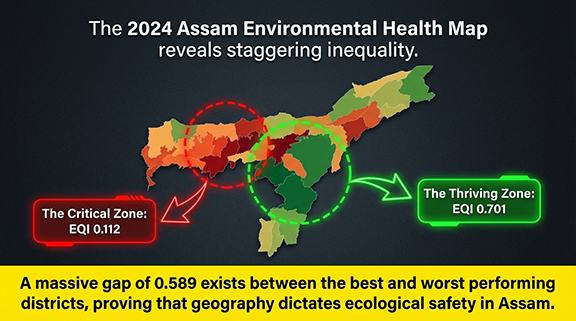
Assam has long been romanticised as one of India's most ecologically gifted states — a land of tea gardens stretching to the horizon, the mighty Brahmaputra carving its way through lush floodplains, and the last stronghold of the one-horned rhinoceros. But beneath this verdant reputation, the state's environment is fracturing along invisible district boundaries. A sweeping new study published in the Research Journal of Chemistry and Environment (Vol. 30, Issue 4) has laid bare what policymakers have long struggled to quantify: that environmental health in Assam is not a single story, but 35 different ones — some inspiring, many deeply troubling.
The paper, authored by Gariyashi Borah and Kalpita Kuki Mahanta of the Department of Statistics at Dibrugarh University, introduces an Environmental Quality Index (EQI) — a composite, district-level metric designed to measure ecological health across three fundamental pillars: air quality, water quality, and green cover. The result is the most granular environmental diagnostic tool ever applied to the state, and its findings carry urgent implications for planners, policymakers, and communities across Northeast India.
The historical Ahom rulers once described Assam as "Nung Dun Chun Kham" — the Country of Golden Gardens — a time when forests blanketed more than 37% of the state's geographical area. That legacy now faces a direct collision with rapid urbanisation, industrial expansion, and the intensification of modern agriculture.
The consequences are measurable. Urban centres across Assam are registering rising concentrations of vehicular and industrial emissions, including fine particulate matter (PM2.5 and PM10), sulfur dioxide, and nitrogen oxides — pollutants with well-documented links to respiratory and cardiovascular disease. Simultaneously, both surface and groundwater sources are being contaminated by mining runoff, livestock operations, and heavy metal leaching. Water samples from multiple districts show elevated levels of fluoride and arsenic that frequently exceed safe drinking-water guidelines set by the World Health Organisation.
It is against this backdrop that the EQI study was conceived — not merely as an academic exercise, but as a practical governance tool aligned with India's commitments to the United Nations' Sustainable Development Goals.
The researchers compiled secondary data from 2020 to 2024 across all 35 districts of Assam, drawing from the Statistical Handbook of Assam, State Pollution Control Boards, National Ambient Air Quality Monitoring Stations, and the India State of Forest Report. Three sub-indices were constructed and then combined into the overall EQI.
The Air Quality Index incorporated four pollutant parameters — SO2, NO2, PM10, and PM2.5. The Water Quality Index was considerably more complex, aggregating twenty physico-chemical and biological parameters including pH, dissolved oxygen, biochemical oxygen demand, uranium, arsenic, fluoride, and coliform bacteria. The Green Cover Index standardised available forest area and canopy data at the district level.
For newly formed districts where some data was unavailable, the team applied Kriging Spatial Interpolation — a geostatistical technique that predicts missing values based on the spatial relationships between nearby observation points. Principal Component Analysis was then used to address statistical multicollinearity and generate weighted sub-indices. The final EQI was computed using the geometric mean of the air and water indices averaged with green cover — a method deliberately chosen to prevent extreme outliers from distorting the overall picture.
All scores were normalised on a scale of 0 to 1, where higher values indicate better environmental quality.
The findings expose a chasm between Assam's best- and worst-performing districts.
At the top of the ranking sits West Karbi Anglong, with an EQI of 0.701, followed closely by Dima Hasao (0.689) and Karbi Anglong (0.633). These districts, located primarily in the hilly southern and central belt of Assam, benefit from lower population densities, relatively limited industrial activity, and strong forest cover. Dima Hasao, in particular, led the entire state on the Green Cover Index with a score of 0.827.
At the opposite end, Darrang recorded the lowest EQI in the state — a stark 0.112 — followed by Nagaon (0.142) and Kamrup Rural (0.199). The researchers attribute these dismal scores to runaway population growth, poorly planned urban sprawl, severe deforestation, and the near-total absence of effective pollution-control infrastructure.
The gap between the top and bottom districts — 0.589 points on a 1.0 scale — is not merely a statistical figure. It represents the difference between communities breathing relatively clean air and drinking reasonably safe water, and those bearing the cumulative burden of polluted rivers, degraded farmland, and toxic skies.
Perhaps the study's most striking insight is what it reveals about districts that excel in one area while failing catastrophically in others.
Sivasagar recorded the highest air quality score in the entire state (AQI: 0.999), yet its water quality score was a dismal 0.162 and its green cover a meagre 0.208. As a result, it ranked 28th overall. Lakhimpur achieved the highest Water Quality Index in Assam (0.930), but its severely depleted forest cover dragged it to 6th place overall.
These trade-offs carry a critical policy message: piecemeal environmental improvement is not environmental improvement. A district cannot be considered ecologically healthy if it boasts clean air but lacks forests and safe water. Sustainability, the authors argue, demands balance across all three dimensions simultaneously.
The study's regional breakdown adds further geographic texture to the findings. Barak Valley — comprising Cachar, Hailakandi, and Karimganj — emerged as the standout region, with the highest median EQI and the smallest variation between its districts, reflecting uniformly stable environmental conditions. North Assam, by contrast, recorded the lowest median EQI with wide variability, indicating severe but unevenly distributed ecological stress. Central Assam showed the broadest statistical spread, housing both some of the state's cleanest and most degraded districts within its boundaries.
Using Hierarchical Cluster Analysis, the researchers grouped all 35 districts into three governance tiers. Eight districts — including West Karbi Anglong, Dima Hasao, Kamrup Metropolitan, and Cachar — were classified as high environmental quality, requiring mainly maintenance-focused policies. Twenty-one districts fell into the moderate category, needing targeted, sector-specific interventions. Six districts — Darrang, Nagaon, Kamrup Rural, Jorhat, Hojai, and Udalguri — were classified as critically endangered, demanding intensive, integrated emergency responses.
The researchers do not stop at diagnosis. Their policy recommendations are detailed and district-sensitive, rejecting any one-size-fits-all approach.
On air pollution, they call for expanded networks of continuous air quality monitoring stations in urbanising areas, incentives for electric vehicle adoption, modernised public transport, and the enforcement of strict emission standards on brick kilns and industrial units. Clean cooking solutions — LPG, biogas, and electric stoves — must be subsidised for vulnerable households still relying on biomass.
On water, the authors urge mandatory wastewater treatment before any industrial or municipal discharge, community-level water management systems in rural areas, and a decisive shift toward agroecological farming practices to limit toxic agricultural runoff. Targeted remediation must be deployed where aquifers are contaminated with fluoride and arsenic.
On forest cover, the study advocates large-scale afforestation using native species, legally backed by real-time satellite and GIS monitoring to detect illegal logging and land encroachment. In cities, green belts, tree-lined corridors, and urban forests are identified as both an ecological and a public health necessity.
The district-level EQI is more than an academic instrument — it is a call to urgency. As Assam's population grows, its cities expand, and its economy integrates deeper into national and global supply chains, the pressure on its ecological systems will only intensify. The question is whether governance can keep pace.
The blueprint, as the researchers conclude, has now been clearly drawn. The forests, rivers, and air of the Country of Golden Gardens are not lost yet — but how long they hold depends entirely on whether the political will to act follows the science.
The study "Towards Sustainable Development: A District-Level Environmental Quality Index in Assam" was authored by Gariyashi Borah and Kalpita Kuki Mahanta, Department of Statistics, Dibrugarh University, and published in the Research Journal of Chemistry and Environment, Vol. 30, Issue 4, April 2026.