NSO’s first pilot study maps Assam’s informal construction sector, revealing rural dominance, heavy reliance on household-led building, strong employment generation, minimal female ownership, and unusually high spending on paints and finishing materials.
A long-overlooked pillar of India’s economy—the unincorporated construction sector—has, for the first time, been systematically quantified through a pilot study conducted by the National Statistics Office under the Ministry of Statistics and Programme Implementation. The report, based on fieldwork carried out between July and December 2025, provides a rare, data-driven window into the scale, structure, and economic dynamics of informal construction activities across the country. Within this national exercise, Assam emerges as a critical case study, offering uniquely detailed insights due to its classification as the only “major state” in the Northeast region under the survey framework.
The survey’s execution in Assam reflects a high level of statistical rigor and operational efficiency. A total of 436 First Stage Units were allocated to the state, comprising 172 rural villages and 264 urban blocks. All units were successfully surveyed, with zero non-response—a rare achievement in large-scale field operations.
Within these units, the NSO collected primary data from 40 unincorporated construction establishments and 701 households undertaking own-account construction. The relatively small number of establishments compared to households highlights a defining feature of Assam’s construction landscape: the dominance of household-led building activity over formal or semi-formal enterprise-driven construction.
Urban households accounted for a larger share of the sample, but this distribution contrasts with the broader population-level findings, where rural activity overwhelmingly dominates.
When extrapolated to the state level, the data reveals the immense scale of unincorporated construction in Assam. The NSO estimates that over 5,300 establishments are engaged in construction activities, with rural areas accounting for the bulk of these units.
However, the most significant contribution comes from households. More than 2 lakh households across Assam undertook construction or renovation activities during the reference period. Of these, an overwhelming majority—over 1.7 lakh—are located in rural areas, reinforcing the central role of self-built housing in the state’s development pattern.
This rural skew reflects broader socio-economic realities, including land ownership patterns, settlement structures, and limited penetration of formal real estate developers in non-urban regions.
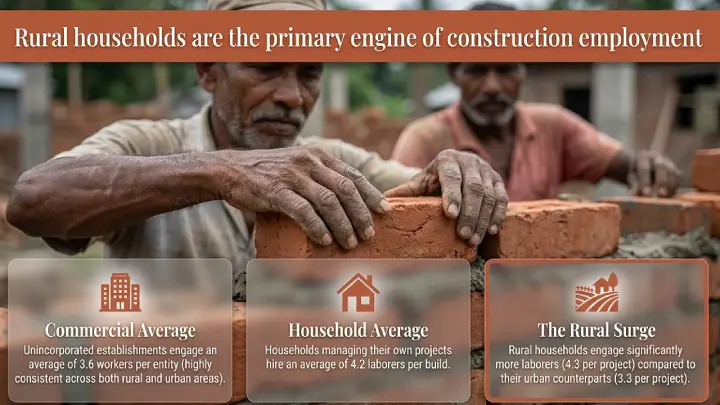
The construction sector in Assam continues to serve as a major employment generator, particularly within the informal economy. The study finds that each unincorporated establishment employs an average of 3.6 workers, with minimal variation between rural and urban units.
Household construction projects, meanwhile, engage an average of 4.2 labourers per project. Interestingly, rural households tend to employ more labourers than urban ones, suggesting that construction practices in rural areas may rely more heavily on manual labour and less on mechanization or specialized contracting.
This labour-intensive nature underscores the sector’s importance in providing livelihoods across a wide spectrum of skill levels, from unskilled workers to semi-skilled artisans.
One of the most significant contributions of the NSO pilot study is its estimation of Gross Value Added and output for unincorporated construction activities. In Assam, the average GVA per market establishment stands at ?3.69 lakh, with a corresponding output of ?9.26 lakh.
However, these averages mask a stark rural-urban divide. Rural establishments, while more numerous, generate significantly lower output compared to their urban counterparts. Urban construction firms operate at a much larger scale, producing output that is several times higher than rural units.
This disparity points to differences in project size, capital investment, and market access. Urban builders are likely engaged in larger, more complex projects, often catering to commercial or high-value residential markets, while rural builders operate within smaller, localized contexts.
A similar trend is observed in household construction. Urban households incur substantially higher costs, both in terms of labour and materials, indicating more resource-intensive projects. Rural households, by contrast, operate within more constrained budgets, reflecting income disparities and differing construction standards.
The ownership structure of Assam’s unincorporated construction sector is overwhelmingly dominated by male proprietors. Nearly all establishments operate as sole proprietorships, with the study recording no instances of female ownership in the sample.
This complete absence of female proprietorship underscores deep-rooted gender disparities within the sector. Cultural norms, access to capital, and the physically demanding nature of construction work may all contribute to this imbalance.
Alternative ownership structures, such as societies or trusts, account for a negligible share and are confined to urban areas. The absence of partnership-based enterprises further emphasizes the fragmented and individualized nature of operations in this sector.
The study provides critical insights into how construction activities are financed in Assam. A striking 98.2% of households rely on their own savings or income to fund construction projects. Institutional credit plays a secondary role, accessed by about a quarter of households.
In terms of total expenditure, nearly 80% is financed through personal resources, with formal financial institutions contributing less than one-fifth of the total funding. Informal sources, such as loans from family or moneylenders, account for a minimal share.
Urban households demonstrate relatively higher engagement with institutional credit, reflecting better access to banking services and financial infrastructure. Rural households, on the other hand, remain largely dependent on self-financing, highlighting gaps in financial inclusion.
A detailed breakdown of construction expenditure reveals a distinctive feature of Assam’s building practices. Materials account for more than three-fourths of total construction costs, followed by labour and a small share of service-related expenses.
Within the materials category, paints, varnishes, and lacquers emerge as the single largest expenditure component. This is a significant deviation from national trends, where bricks and cement typically dominate.
The prominence of paints in Assam’s construction spending may be attributed to multiple factors, including climatic conditions requiring enhanced protective coatings, aesthetic preferences, or local pricing dynamics. The state’s heavy monsoon conditions, for instance, may necessitate frequent use of weather-resistant finishes.
Construction establishments mirror this trend, allocating a disproportionately high share of their material budgets to finishing products. This consistency across both household and enterprise data suggests a structural characteristic rather than a statistical anomaly.
Other key materials include cement, bricks, iron and steel, and wood, but none approach the expenditure share of paints in the Assam context.
To ensure the robustness of its estimates, the NSO has incorporated statistical reliability measures such as Relative Standard Error. The findings for Assam demonstrate strong reliability, particularly for household-level data, which exhibits low sampling variability.
While establishment-level estimates show slightly higher variability, they remain within acceptable bounds for policy analysis. These reliability metrics enhance the credibility of the study’s findings and support their use in refining national accounts.
The pilot study marks a significant step toward integrating informal construction activities into India’s macroeconomic framework. By providing detailed estimates of output, employment, and expenditure patterns, it enables a more accurate assessment of the sector’s contribution to Gross Domestic Product.
For Assam, the findings highlight the need for targeted policy interventions. Improving access to institutional credit, promoting skill development, and addressing gender disparities could enhance productivity and inclusivity within the sector.
At the same time, the strong reliance on household-led construction underscores the importance of policies that support affordable housing and rural infrastructure development.
Ultimately, the NSO’s pilot study brings into focus a segment of the economy that has long operated in statistical shadows. In Assam, this sector is revealed as expansive, deeply rooted in rural communities, and driven by individual initiative rather than formal enterprise.
It is a sector characterized by resilience and self-reliance, yet marked by structural challenges, including limited access to finance and entrenched gender imbalances. As India continues to refine its economic measurement systems, incorporating such localized realities will be essential to capturing the true contours of growth and development.
The insights from Assam not only enrich the national dataset but also provide a template for understanding similar dynamics across other states, particularly in regions where informal economic activity remains the dominant mode of production.