While Phangrei is a popular picnic spot, it is far more than a scenic vista. It is a high-altitude frontier where ancient laws, rare science, and modern survival intersect. Beneath its tranquil meadows lie secrets of Paleolithic history and World War II survival.
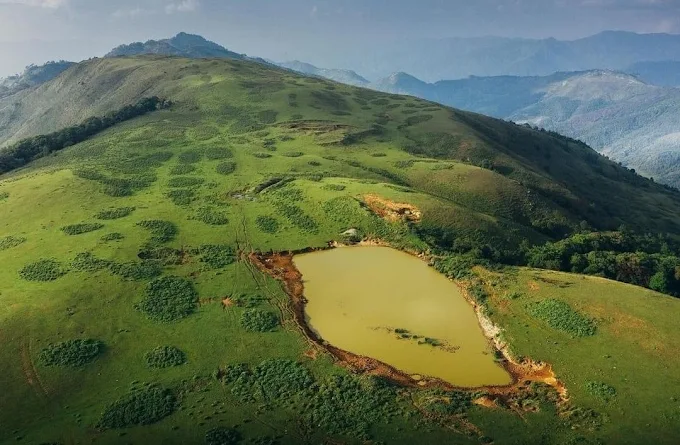
Phangrei Lake. Photo Credit: Kh Izaz
Travelers typically view the eastern Himalayas as a world of undulating ranges and rippling topography, defined by jagged, vertical ridges. Yet, tucked away in Manipur’s Ukhrul district is Phangrei—a sprawling, flat plateau that defies this rugged logic.
While Phangrei is a popular picnic spot, it is far more than a scenic vista. It is a high-altitude frontier where ancient laws, rare science, and modern survival intersect. Beneath its tranquil meadows lie secrets of Paleolithic history and World War II survival.
Phangrei Lake is a geographical anomaly that baffles both geologists and residents. While the administrative center of Ukhrul Town sits at 5,453 feet, this plateau forms a high-altitude bridge leading toward the even loftier Shirui Peak (2,835 meters).
The pond remains full throughout the bone-dry winter months, despite its location on a high crest where water retention is typically minimal. This perennial source sustains a unique micro-ecosystem along the ridge.
Geological Theories: Local analysis suggests the pond is fed by subterranean aquifers or specific lithological traps.
Historical Depth: This landscape isn't just a scenic marvel; the nearby Khangkhui Mangsor Cave served as a critical shelter during World War II.
One of the most profound examples of indigenous persistence involves a land dispute between the villages of Sihai and Lunghar. To resolve a conflict that spanned four decades, the communities turned to Tara Kajang, the "Water Immersion Test."
In October 2008, representatives submerged themselves in the Nungshangkong River under the gaze of customary judges. The Sihai headman, K. Luingam, won the claim by remaining underwater longer than his counterpart.
In a landmark example of legal pluralism, the Indian judicial system eventually validated this ritual. In February 2023, the Court of District Judge, Imphal East, upheld the customary outcome as a legal precedent to settle the title suit.
"The challenge was to remain immersed in the water for longer period of time... and the one who stayed longer inside the water will be declared winner... to enjoy the rightful possession of the suit land."
The neighboring Shirui peak is the exclusive home of the Lilium mackliniae, or Shirui Lily. Discovered in 1946 by Frank Kingdon Ward while on assignment for the New York Botanical Garden, it is a global symbol of biodiversity.
While the lily is famous for its delicate bell shape, Kingdon Ward documented a surprising scientific property. When viewed through a microscope, the petals reflect seven distinct colors, a phenomenon invisible to the naked eye.
Scientific Metrics:
Habitat: Found only on Shirui Kashong Peak at an elevation of 2,835 meters.
Blooming Season: Typically blossoms between mid-June and July.
Status: Declared the State Flower of Manipur in 1989.
In March 2026, the region faced a severe connectivity crisis following arson attacks in Litan and the discovery of bodies near Shangkai. These events led to a total blockade of National Highway 202, the primary lifeline for the district.
To maintain essential movement for students and patients, the Transport Department established an emergency "Heli-Bridge." This strategic response bypassed the "grave situation" along the highway through scheduled helicopter sorties.
Logistics of the Heli-Bridge:
Schedule: Two sorties each on March 14 and 18; single sorties on March 15 and 17.
Luggage Constraint: A strict 7 kg limit per passenger was enforced for mountain weight logistics.
Purpose: Maintaining communal resilience during transit disruptions around Mongkot Chepu.
Near the Phangrei frontier lies the village of Longpi (Nungbi), home to a ceramic tradition that contradicts global pottery norms. Longpi pottery is one of the few traditions in the world that does not use a potter’s wheel.
Artisans manually manipulate a precise mixture of Black Serpentinite rock and weathered rock. The resulting "ancient tech" produces metallic-looking earthenware that is exceptionally durable and polished using only local leaves.
This manual process ensures the pottery remains resistant to high heat. It stands as a globally relevant example of indigenous innovation that requires no mechanical intervention to produce high-performance kitchenware.
Phangrei reflects the Tangkhul Naga identity—a culture balancing the transition from Hao (animism) to Christianity. While they once propitiated the Kaphung Kameo (mountain spirits) and Kong Kameo (river spirits), the community now merges faith with tradition.
The social structure remains rooted in the ancient "seven clans," even as modern education transforms the landscape. The region proves that communal "common sense" can still find a place within the modern world.
As the district navigates 2026 and beyond, it remains defined by a central paradox. One is left to wonder: should modern legal systems lean more on the communal traditions that have sustained this frontier for millennia?