MPCC Vice President Hareshwar Goshwami challenged Chief Minister Yumnam Khemchand’s claim that a Census must precede NRC in Manipur, calling it legally incorrect, citing Assam precedent, separate legal frameworks, and contradictory senior Bharatiya Janata Party leaders’ statements.
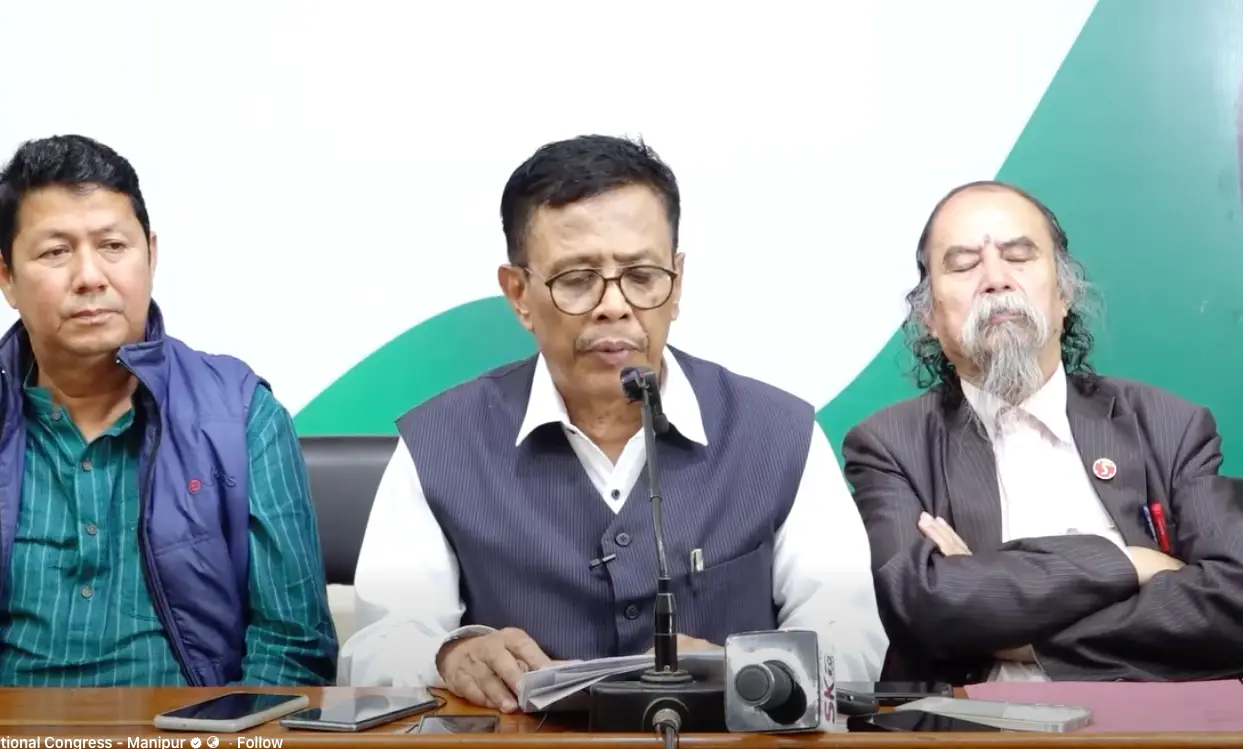
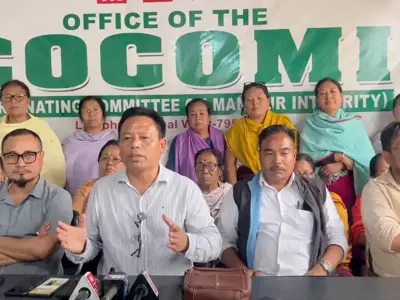
IMPHAL — The Manipur Pradesh Congress Committee (MPCC) on Sunday formally challenged Chief Minister Yumnam Khemchand’s assertion that the National Register of Citizens (NRC) cannot be implemented in the state without first completing a Census, calling the statement legally untenable and a deliberate attempt to mislead a public already exhausted by the ongoing ethnic crisis. Speaking at a press conference at Congress Bhavan on BT Road, attended by prominent party leaders, MPCC Vice President Hareshwar Goshwami argued that the two processes are governed by entirely separate legislation and that the Chief Minister’s April 25 press meet claim fundamentally misrepresents the legal framework.
|
NRC vs Census: Two Separate Legal Frameworks |
|
|
NRC governed by |
Citizenship Act, 1955; Citizenship Rules, 2003 |
|
Census governed by |
Census Act, 1948 |
|
Purpose of NRC |
Register only citizens of India; verify parentage, relationships and proof of citizenship |
|
Purpose of Census |
Count all persons in a household; no documentary proof required from residents |
|
Assam NRC basis |
Conducted on 1951 Census data, not the most recent Census at the time |
|
CM’s claim (April 25) |
Census must be completed before NRC can be implemented in Manipur |
|
MPCC position |
The two are independent processes; NRC can proceed without a Census |
Two Acts, Two Processes: The Legal Case Against the CM’s Claim
Goshwami’s central argument rested on statutory ground. The NRC, he explained, is maintained under the Citizenship Act, 1955, supplemented by the Citizenship Rules, 2003, and subsequent amendments — a framework that makes no provision requiring a concurrent or preceding Census exercise. The Census, by contrast, is conducted under the Census Act, 1948, an entirely separate piece of legislation with a different purpose, different methodology and different constitutional basis.
The distinction in methodology is equally significant, he argued. In a Census exercise, an enumerator visits a household, records the number of occupants and collects demographic data without requiring residents to produce any verifiable documentation. The NRC process works differently: it draws from the National Population Register and requires individuals to establish citizenship through verifiable proofs — electoral rolls, documentary evidence of parentage, genealogical records across generations — to determine who is a citizen and who is not. Linking the two, Goshwami contended, is not merely a legal error but a practical confusion of fundamentally different administrative exercises.
“Census is not a prerequisite condition for conducting the NRC. These are two entirely different entities carried out under two different Acts. A Chief Minister should not make such misleading statements in a land already suffering from crisis.”
— Hareshwar Goshwami, MPCC Vice President
The Assam Precedent: NRC Without a Recent Census
To reinforce his argument, Goshwami cited the precedent of the NRC conducted in Assam — the only state in India where the register has been completed. The Assam NRC emerged from the movement led by the All Assam Gana Parishad and the Assam Accord of 1985, which was itself a response to large-scale illegal immigration into that state. Crucially, Goshwami noted, the Assam NRC was not built on the most recent Census available at the time. It was based on the 1951 Census. The argument that NRC must await a fresh Census is therefore contradicted by the only actual NRC exercise India has conducted.
The parallel to Manipur’s situation, he argued, is direct. A large number of foreigners have entered the state from Myanmar following the military junta’s takeover in February 2021, compounding pre-existing concerns over illegal immigration. In such circumstances, he said, the urgency of an NRC is heightened, not diminished. And conducting a fresh Census — an exercise Goshwami himself noted would be practically impossible given the current restrictions on movement across the state — should not be made a condition for addressing that urgency.
A Trail of BJP Contradictions: Shah, Modi, Biren and Now Khemchand
The press conference’s sharpest political moment came when Goshwami catalogued a series of contradictory positions on NRC taken by senior BJP leaders at both the national and state level, arguing that the current Chief Minister’s claim sits awkwardly within his own party’s record.
At the national level, Union Home Minister Amit Shah announced in the Rajya Sabha in 2019 that the NRC would be implemented across the entire country. In the same year, Prime Minister Narendra Modi told a public gathering at Ramlila Maidan in New Delhi that there was no discussion of implementing the NRC nationally — a statement directly at odds with Shah’s parliamentary declaration. The contradiction between India’s two most senior BJP leaders on a flagship policy has never been formally resolved.
Within Manipur, the inconsistency is equally pointed. Former Chief Minister N. Biren Singh, responding to a question raised on the floor of the state Assembly by Congress MLA K. Ranjit, confirmed that a letter had been sent to the Union Government requesting implementation of the NRC. Goshwami asked directly: did that letter stipulate that a Census must precede the NRC? If not, on what basis does the current Chief Minister now introduce that condition? Since the office of the Chief Minister represents a continuous institution, he argued, the government cannot simply abandon commitments made under a predecessor without explanation.
Congress’s Own Position: ‘We Support NRC’
Goshwami also used the occasion to rebut what he described as a disinformation campaign on social media alleging that Congress MLAs oppose NRC implementation in Manipur. He characterised this as a deliberate misrepresentation arising from superficial analysis of the party’s conduct in the Assembly.
In January 2024, MLAs from multiple parties passed a resolution at Kangla that included a demand for NRC implementation. When the matter came before the Assembly and Congress legislators pushed for the Kangla resolution — including its NRC component — to be formally adopted by the House, they walked out following a disagreement over the process. That walkout, Goshwami insisted, has been mischaracterised as opposition to NRC. He noted that Congress leader and former Chief Minister Okram Ibobi Singh stated clearly to media on exiting the House that Congress MLAs support NRC implementation in the state. The party’s position, he concluded, has been consistent; the confusion has been manufactured.