CJIM, Imphal West, has acquitted journalist Kishorechandra Wangkhem of all charges arising from a 2018 Facebook video controversy. CJMSadananda ruled the investigation was tainted from the start, called the initial sedition charge a 'smokescreen', and found all digital evidence inadmissible
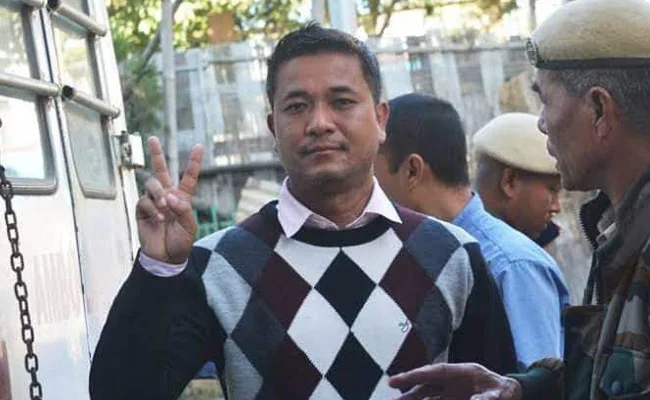
IMPHAL – The case dates to November 19, 2018, when the Officer-in-Charge of Imphal Police Station suo motu registered an FIR after coming across an account named 'WangkhemchaWangthoi' on Facebook, which had posted four videos. The prosecution alleged that the account holder had spoken with hatred and contempt toward the government, used obscene language, and defamed the Prime Minister of India and the Chief Minister of Manipur. The content was specifically directed against government policy regarding the observance of Rani Laxmibai's birth anniversary in Manipur.
Wangkhem was identified, arrested, and his mobile handset seized. The initial FIR invoked Section 124-A (Sedition), Section 294 (Obscenity), and Section 500 (Defamation) of the Indian Penal Code. The prosecution produced eight witnesses during the trial, including the complainant police officer, the second Investigating Officer, an Executive Magistrate, and two BJP Manipur Pradesh office-bearers who testified to finding the videos abusive and derogatory.
The Court's most stinging finding concerned the invocation of sedition. When the formal charge-sheet was filed, Section 124-A was quietly dropped after the investigation found no materials to sustain it. Chief Judicial Magistrate Sorokhaibam Sadananda pointed to the stark contradiction: the same videos used to justify a sedition charge in the FIR were later deemed entirely insufficient to establish it. The Magistrate stated that the court could not but wonder whether the invocation of Section 124-A was only a smokescreen — used either to allow police to investigate a non-cognizable offence without Magistrate permission, or to subject the accused to custody over what was in fact a bailable offence.
The toll on Wangkhem's personal liberty was severe. He was remanded into police custody for six days and subsequently spent four and a half months in detention under the National Security Act — a consequence the Court explicitly cited as adding to the inference that the case was tainted from its very inception. A further procedural flaw compounded the problem: the complainant officer had also acted as the first Investigating Officer. Citing the Supreme Court ruling in Mukesh Singh vs. State, the Court held that this created an irremediable conflict of interest in a case as sensitive as this one — the complainant had controlled the source of evidence, seized the mobile phone, recorded the disclosure statement, and exercised complete evidentiary autonomy. The investigation should have been handed to another officer. The Court also noted a direct violation of Section 199 of the CrPC, which bars taking cognizance of criminal defamation under Section 500 IPC without a complaint from an officially aggrieved person — no such complaint existed at the time the FIR was registered.
The prosecution's case rested almost entirely on digital evidence — a Compact Disc containing the video clips and printed screenshots. This foundation collapsed entirely due to non-compliance with Section 65B of the Indian Evidence Act, which requires that electronic records be accompanied by a certificate signed by an authorized person occupying a responsible official position in relation to the device from which the record was generated. The complainant officer had issued this certificate himself, but the Court found he was not the competent person to do so, and the evidence did not clearly establish from which device the videos had been downloaded.
Relying on the landmark Supreme Court ruling in Arjun Panditrao Khotkar vs. Kailash Kushanrao Gorantyal, the Court declared the Compact Disc and all printed screenshots completely inadmissible. Without the original video, the written transcriptions of the content were held to have weak evidentiary value, leaving the prosecution with no tangible proof of the alleged offences.
Because the accused was charged under Section 294 IPC for alleged obscenity in a public place, the Court was required to determine whether Facebook legally constitutes a public space. The Magistrate acknowledged that Facebook is a virtual space designed for the sharing of ideas and the voicing of dissent, and that it can reflect an individual's right to self-determination. However, relying heavily on the Supreme Court's landmark right-to-privacy ruling in Justice K.S. Puttaswamy vs. Union of India, the Court cautioned against floating freely in digital ambiguity. It noted that users have the choice to restrict their posts to selected persons or expose them to the entire internet — and that the destruction of personal identity and privacy collapsing into surveillance must be avoided. The legal test for whether a digital outburst occurs in a public place depends on whether the user voluntarily exposed it to the public, thereby waiving their right to privacy. Since all primary evidence in this case had been ruled inadmissible, there was no proof that Wangkhem had set his Facebook posts to public view, making the charge impossible to sustain.
On the question of obscenity, witness testimony indicated that the accused had allegedly used derogatory words and shown his middle finger in the videos. The Court applied the rigorous legal standard for obscenity under Section 294(b) IPC, citing Supreme Court precedents in N.S. Madhanagopal vs. K. Lalitha and Aveek Sarkar vs. State of West Bengal. The Magistrate held that for content to be legally obscene, it must have a tendency to deprave and corrupt. The Court ruled that the mere presence of abusive, humiliating, or defamatory words — without lascivious elements arousing sexual thoughts or feelings — cannot attract the offence of obscenity. The Court also observed that a relevant contextual indicator for digital obscenity would be whether the content breached the social media platform's own community standards — evidence that was entirely absent from the trial record.
Finding no materials which make out a case against the accused, Chief Judicial Magistrate Sorokhaibam Sadananda ordered the full acquittal of Kishorechandra Wangkhem. The Court acknowledged the severe reality of Wangkhem's undisputed four-and-a-half months in NSA detention but noted that the defence had pointed to it only as a ground for acquittal rather than pursuing a formal claim for malicious prosecution compensation. All bails and bonds associated with Wangkhem in this case were ordered cancelled and discharged, bringing the long-running legal battle to a close. The judgment is expected to carry significant precedential weight on the handling of digital evidence, the scope of privacy rights in online spaces, and the limits of obscenity law as applied to social media in Manipur and beyond.