FedEx and IIT Madras have successfully completed India's first intra-city drone delivery flight trials in Bengaluru, reducing a 53 km, 60-minute road journey between Electronic City Phase II and Kempegowda International Airport to a 39–42 km aerial route completed in approximately 21 minutes.
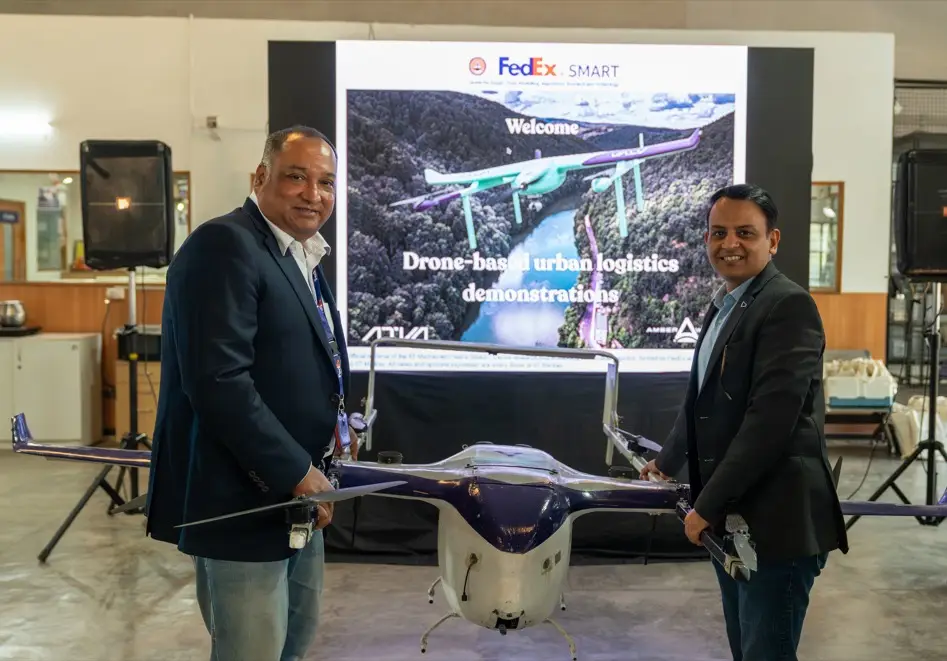
CHENNAI — In what has been described as a landmark moment for urban logistics in India, Federal Express Corporation and the Indian Institute of Technology Madras have successfully completed the country's first intra-city drone delivery flight trials in Bengaluru. The trials, which demonstrated the ability to dramatically compress transit times between two of the city's most commercially vital nodes, signal a new chapter in the application of aerial robotics to supply chain challenges that conventional road-based infrastructure has long struggled to solve.
The milestone was achieved under the research framework of the FedEx SMART Centre — a Supply Chain Modelling, Algorithms, Research and Technology Centre established at IIT Madras in December 2023 with a five-year grant of USD 5 million from FedEx. The trials are the most visible output yet of that collaboration, and come as India's broader drone logistics ecosystem moves rapidly from isolated pilot experiments toward scalable, commercially relevant operations in 2026.
The Route: From Tech Hub to Airport in 21 Minutes
The trials validated a mid-mile aerial logistics corridor connecting Electronic City Phase II — Bengaluru's sprawling technology and manufacturing district — with a site near Kempegowda International Airport. By road, this journey covers approximately 53 km and, during peak hours on Bengaluru's chronically congested arteries, routinely exceeds 60 minutes. The aerial route, mapped through detailed analysis of safe corridors by the IIT Madras FedEx SMART Centre team, covered a significantly shorter distance of 39 to 42 km and completed the same journey in approximately 21 minutes.
For time-critical logistics — whether pharmaceutical cold-chain consignments, urgent industrial components, or high-value express parcels — the implications of that compression are considerable. A delivery operation that would have consumed a full hour of vehicle time, fuel, and driver capacity can now be executed in a fraction of that window, with greater predictability and without the variability introduced by road traffic.
"A 53 km road journey typically taking over 60 minutes, reduced to a 39–42 km aerial route completed in approximately 21 minutes."
Navigating Controlled Airspace: DGCA Clearances Secured
The complexity of the trials extended well beyond simple point-to-point flight. The aerial corridor between Electronic City and the airport passes through Airport Yellow and Red Zones — some of the most tightly regulated airspace classifications in Indian civil aviation. All necessary permissions were secured from the Directorate General of Civil Aviation (DGCA) prior to the trials, making this not merely a technical achievement but a regulatory one as well.
Operations were conducted at an altitude of 120 metres, in strict compliance with DGCA guidelines governing unmanned aerial vehicle operations in controlled airspace. The drones deployed during the trials were equipped with a comprehensive suite of safety systems, including an autonomous flight termination system, return-to-home capability in the event of communication loss, and anti-collision strobe lighting to ensure visibility and separation from manned aircraft.
Technical Parameters at a Glance
Operating Altitude: 120 metres (per DGCA guidelines)
Road Distance (baseline): 53 km — Electronic City Phase II to Kempegowda International Airport
Aerial Route Distance: 39–42 km
One-Way Transit Time: Approximately 21 minutes
Road Transit Time (baseline): Over 60 minutes
Airspace Zones Navigated: Airport Yellow Zone and Red Zone
Safety Systems: Autonomous flight termination, return-to-home, anti-collision strobe lighting
Regulatory Authority: Directorate General of Civil Aviation (DGCA)
Implementation Partner: Amber Wings, IIT Madras-incubated deep-tech start-up
Amber Wings: The Start-Up Behind the Flight
The implementation partner for the trials was Amber Wings, a deep-tech drone company founded in 2019 and incubated at IIT Madras. The company was founded by Prof. Satyanarayanan R. Chakravarthy, core faculty member of the FedEx SMART Centre, making the collaboration a tightly integrated one between the research institution and its own incubated enterprise. Amber Wings operates under Ubifly Technologies, the parent company of The ePlane Company, and has developed expertise spanning logistics drone design, autonomous navigation, and operations in complex urban and peri-urban airspace.
Vinay MK, CEO of Amber Wings, has previously spoken about the broader potential of drone logistics in time-critical applications, particularly for medical supply chains — noting that life-saving medicines and devices could be dispatched from district health centres and reach remote or disaster-affected locations within minutes, reducing waste and improving survival outcomes. The Bengaluru trials now add a major commercial logistics dimension to that portfolio.
The FedEx SMART Centre: A USD 5 Million Academic-Industry Wager on India's Logistics Future
The FedEx SMART Centre — whose full name is the Supply Chain Modelling, Algorithms, Research and Technology Centre — was formally inaugurated at IIT Madras in August 2025, backed by a five-year, USD 5 million grant from FedEx announced in December 2023. The centre operates across four research focus areas, guided by 20 IIT Madras faculty members and a 50-member research team, and has already engaged more than 3,000 students through national competitions in partnership with Shaastra, IIT Madras's annual technical festival.
The centre's research mandate spans air cargo optimisation, electric vehicle integration into logistics networks, advanced demand forecasting, carbon-neutral operations, autonomous delivery systems, and digital supply chain frameworks. The drone trials sit squarely within that agenda — representing the translation of theoretical corridor analysis and airspace modelling into real-world flight operations.
Voices From the Field
Nitin Navneet Tatiwala, Vice President of Marketing, Customer Experience, and Air Network for FedEx's Middle East, Indian Subcontinent, and Africa (MEISA) region, said the milestone reflected the SMART Centre's broader research agenda and its focus on building future-ready, resilient and sustainable supply chain ecosystems in partnership with academia, industry and policymakers. He described innovation as central to how FedEx enables global commerce.
Prof. Satyanarayanan R. Chakravarthy, core faculty member and the force behind the drone programme, described the trials as a significant leap in the centre's mission, moving beyond theoretical research to prove the efficacy of high-impact, future-ready solutions capable of redefining the global logistics landscape. Prof. Arshinder Kaur, Professor In-Charge of the FedEx SMART Centre, said the trials demonstrated the centre's commitment to driving innovation and accelerating cutting-edge technologies across modern supply chains.
India's Drone Logistics Moment: A Race Accelerating in 2026
The FedEx–IIT Madras trials land at a moment when India's drone delivery sector is undergoing a visible shift from isolated experimentation to scaled commercial intent. Bengaluru, alongside Delhi-NCR and Hyderabad, has emerged as one of the primary testing grounds for urban drone logistics, supported by a combination of government policy reform, regulatory evolution at the DGCA, and growing private investment in unmanned aerial vehicle infrastructure.
Companies including Skye Air, TechEagle, Blue Dart, and Swiggy have all launched or expanded drone pilots in Indian cities, while the government's updated drone policy for 2026 has streamlined registration, certification, and zone-based operations to encourage adoption. What distinguishes the FedEx–IIT Madras trials is their focus on mid-mile logistics — the segment connecting fulfilment nodes to distribution points — rather than the last-mile consumer delivery space that has received the most commercial attention to date.
If validated at scale, mid-mile aerial logistics of the kind demonstrated in Bengaluru could offer India's logistics sector a meaningful tool against a structural challenge that road infrastructure alone cannot resolve: the urban congestion that inflates transit times, fuel costs, and emissions across the country's largest cities. Whether this week's trials translate into operational services — and on what timeline — remains to be seen. But as a proof of concept, they have set a marker that the rest of the industry will now have to reckon with.