UN Spokesman Stéphane Dujarric's April 23 noon briefing covered a second French peacekeeper's death in Lebanon, continued Gaza strikes, the killing of a Lebanese journalist, 73 UN staff detained by Houthis in Yemen, Haiti's security challenges, and Central African Republic election preparations.
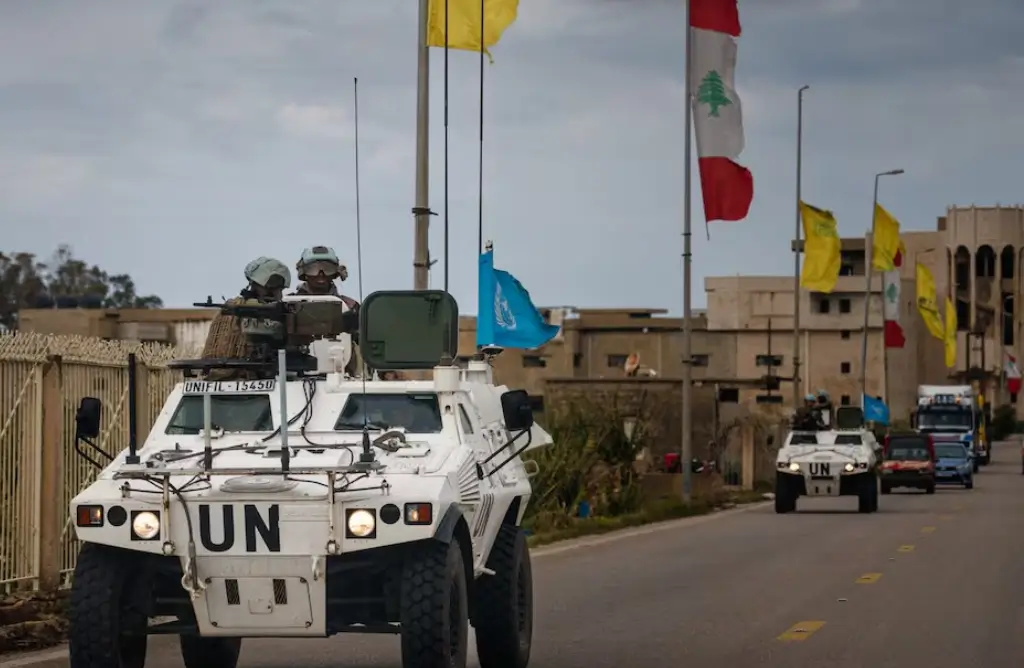
PARIS – The United Nations confirmed on April 23 that a second French peacekeeper has died from wounds sustained in an attack on April 18, when UN peacekeepers came under fire from non-State actors presumed to be Hizbullah. Corporal Anicet Girardin succumbed to his injuries in Paris. The Secretary-General had earlier expressed sadness at the news in a statement issued the previous afternoon.
Separately, the UN condemned the killing of Lebanese journalist Amal Khalil in a reported Israeli airstrike in Tiri, in southern Lebanon, on April 22. The Spokesman extended condolences to the journalist's family, friends, and colleagues, and expressed hope for the full and swift recovery of a second journalist injured in the same incident. Following the strike, the United Nations Interim Force in Lebanon (UNIFIL) undertook deconfliction efforts with the Israel Defense Forces (IDF) to facilitate access for the Lebanese Red Cross to reach the injured.
Where's the condemnation from world leaders?
— Denise070 (@MichelleS070) April 24, 2026
Lebanon buries journalist Amal Khalil in anger and grief
https://t.co/mvZultGqUd
The Secretary-General reiterated that civilians, including journalists, must be respected and protected at all times under international humanitarian law, and called for a prompt and impartial investigation into the killing. He also stressed that targeting civilians and obstructing aid are violations of international humanitarian law and that journalists must be able to perform their duties without interference, harassment, or worse. When asked whether it was time to be more forceful in criticism of Israel, the Spokesman stated that the Secretary-General has been very clear in condemning the killings of journalists.
On a positive development, following sustained deconfliction efforts with the IDF, UNIFIL was able to resupply several of its isolated positions along the Blue Line, resolving a supply issue that had been raised over previous days. Separately, the UN welcomed a second round of direct talks between Israel and Lebanon, with the Spokesman describing direct dialogue between the two countries as by definition a good thing.
On the broader humanitarian situation in Lebanon, the Office for the Coordination of Humanitarian Affairs (OCHA) noted that needs remain severe and the operating environment highly fragile. Damage to bridges and critical infrastructure, displacement orders, unexploded ordnance, and other hazards continue to limit people's movement and complicate aid delivery in southern Lebanon. Since the previous day, five more humanitarian operations had been carried out through the OCHA-managed Humanitarian Notifications System, bringing the total number of facilitated humanitarian movements to 80 since the start of the conflict. Water has been delivered to support over 600,000 people, and health partners have conducted over 190,000 medical consultations for displaced people and provided essential medication for acute and chronic conditions to over 70,000. The Lebanon Flash Appeal remains critically underfunded, with only 30 per cent of the required $308 million — approximately $94 million — received to date.
On the question of whether southern Lebanon risks becoming another Gaza, the Spokesman noted that the Secretary-General has been very clear in stating that Lebanon cannot be another Gaza, and acknowledged that senior Israeli leaders had themselves made statements about the framing of their military campaign.
In Gaza, OCHA reported continued strikes, shelling, and gunfire in residential areas, raising deepening concerns for civilian safety. Reports were received of children killed in North Gaza, where a tent was struck. The UN reiterated that under international humanitarian law, civilians and civilian infrastructure must be protected at all times.
On food security, the UN and its partners continue to distribute meals, bread, and other supplies, including in hard-to-reach areas. As of Monday, partners were serving approximately 1.1 million meals and producing around 230 metric tons of bread every day, in collaboration with more than 120 kitchens, commercial bakeries, and community ovens. However, the World Food Programme (WFP) warned that every fifth family in Gaza is eating just one meal per day.
Turning to the West Bank, the UN reported very alarming accounts of settler-related attacks causing Palestinian casualties, material damage, and displacement. Recent attacks have particularly targeted education facilities. On Tuesday, a school in the Ramallah area came under fire from Israeli settlers, and one child was reportedly killed. Earlier the same day, settlers demolished a school serving approximately 60 students in the Jordan Valley. In the Hebron area, settlers have obstructed the access of a similar number of students for around 10 days. UN partners have warned that children in the West Bank are witnessing increasing violence in and around their schools, placing them at risk and making it harder for them to continue learning. The UN underscored the urgent need to protect and restore every child's right to education.
The UN provided an update on its ongoing efforts to secure the release of 73 UN colleagues arbitrarily detained by the Houthi de facto authorities in Yemen, some of whom have been held for years. Muin Shreim, the senior UN official leading regional engagement on arbitrary detention, travelled to Muscat earlier in the week, where he held meetings with Ansar Allah's Mohammed Abdulsalam, with Omani officials, and with a number of resident ambassadors. The discussions focused on the immediate and unconditional release of all UN personnel held by the Houthis.
This follows a recent visit by Shreim to Riyadh, where he met with the President of the Presidential Leadership Council, Rashad al-Alimi, as well as senior Saudi government officials and ambassadors representing the permanent members of the Security Council. The Spokesman confirmed that the Houthis are currently the biggest detainers of UN staff. He acknowledged that the UN has limited direct leverage in this situation, and called upon every Member State — especially those with influence over or contact with the Houthi de facto authorities — to apply pressure for the release of the detained personnel. The Spokesman noted that court processes are ongoing in a number of cases, but confirmed that all 73 remain arbitrarily detained. The UN reiterated its call for the immediate and unconditional release of all arbitrarily detained personnel, including from the UN, non-governmental organisations, civil society, and diplomatic missions.
The UN Special Representative for Haiti, Carlos Ruiz-Massieu, briefed the Security Council on April 23 on the situation in the country. He described Haiti as standing at a pivotal moment, where political and institutional progress is laying the foundations for a credible path forward. He stated that elections remain the only legitimate path back to constitutional order, and that the UN's political mission continues to support national efforts and coordinate international assistance to deliver credible and inclusive elections.
However, Ruiz-Massieu cautioned that without tangible improvements on the security front, progress will be difficult to sustain. He underscored that the full and timely deployment of the Gang Suppression Force (GSF) is essential to reinforce the strengthening of national security forces. He renewed the UN's commitment to working alongside Haitian authorities to help turn what he described as a window of opportunity into tangible progress toward restoring security and re-establishing democratic institutions.
In a significant financial development, the State of Qatar confirmed a pledge of $30 million to the Trust Fund in support of the Gang Suppression Force, to be paid at $10 million per year over three years. With this contribution, the Trust Fund has now received a total of $203.3 million in pledges, of which $174.1 million has been received in cash. The UN thanked Qatar for its support.
The UN Mission in the Central African Republic (MINUSCA) is actively supporting preparations for legislative elections and by-elections scheduled for Sunday, April 27. As of April 23, nearly 29 metric tons of electoral material had been delivered by air and land to multiple locations across the country without any reported incidents. A second phase of deliveries is ongoing, with materials being transported from UN peacekeeping bases to local branches of the National Elections Authority, with completion expected within days. MINUSCA is also supporting the transportation of hundreds of national electoral personnel to their polling stations across the country.
Preparations at the National Data Tabulation Centre are continuing, with software testing and capacity-building for national staff being supported by UN peacekeepers and the United Nations Development Programme (UNDP). On the security front, MINUSCA is working under an Integrated Elections Security Plan, providing airlift assistance to particularly sensitive areas, and supporting civic education efforts that promote peaceful participation and the inclusion of women in the electoral process.
On the humanitarian front, the outlook is deeply concerning. OCHA warned that 41,000 people in the country's central and northern areas will lose access to life-saving healthcare services by June due to funding shortfalls. The International Medical Corps, the main health partner supporting displaced people in those regions, is expected to suspend its activities due to lack of funds, cutting off free medical consultations and referrals to specialised care. More broadly, severe underfunding has led to an average of 10 humanitarian field offices closing each month since July 2025. Only 14 per cent of the $264 million required to assist 1.3 million of the most vulnerable people in the Central African Republic this year has been received. OCHA urgently called on donors to increase funding to prevent further disruptions to life-saving operations.
UN High Commissioner for Human Rights Volker Türk concluded a visit to Mexico on April 22, having held bilateral meetings with several government officials, including President Claudia Sheinbaum. He also met with civil society representatives, Indigenous Peoples, private sector actors, and collectives of victims of human rights violations, including families of disappeared people. Türk noted that enforced disappearances remain one of the most serious and painful human rights challenges in Mexico and called for the issue to be addressed in a manner that is neither politicised nor polarised, keeping victims at the centre of all related work. He also addressed violence against journalists and human rights defenders — particularly women — as well as issues of impunity and judicial reforms.
On the Strait of Hormuz Task Force established by the Secretary-General approximately one month ago, the Spokesman confirmed that Jorge Moreira da Silva of the United Nations Office for Project Services (UNOPS) is continuing his consultations. Operationalisation of the task force requires the agreement of all concerned parties, and those discussions are ongoing.
UN Trade and Development (UNCTAD) released new data highlighting that gross domestic product (GDP) alone does not fully reflect how an economy is developing. The agency introduced the broader concept of productive capacity — encompassing skills, institutions, infrastructure, and technology — and found that while some developing countries are making progress, many remain stuck exporting basic, low-value goods. UNCTAD underscored that building industries that add greater value to the economy is key to sustainable development.
The United Republic of Tanzania made a full payment of $317,897 to the UN Regular Budget, for which the Spokesman expressed the organisation's gratitude.
The UN also noted that April 23 marks two international linguistic days simultaneously — World English Language Day and World Spanish Language Day — both linked to the year 1616. The connection lies in the deaths of William Shakespeare on April 23, 1616 — the same date as his birth in 1564 — and Miguel de Cervantes on April 22, 1616, both of whom made pivotal contributions to their respective languages.