Manipur Police and NCB distribute ginger seeds, banana saplings and pea seeds to 127 households as part of a community-driven alternative livelihood programme — but analysts warn deeper economic and structural drivers remain unaddressed
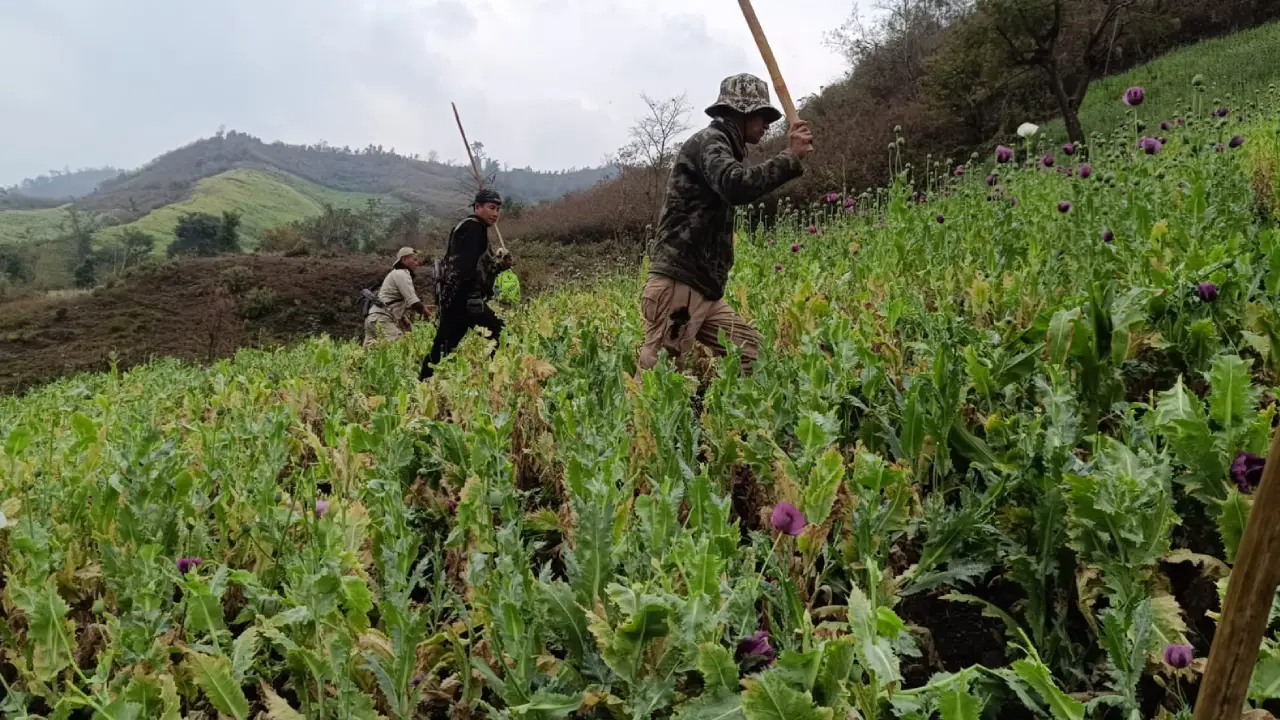
IMPHAL — Manipur Police, in partnership with the Narcotics Control Bureau, has launched a community-driven initiative titled "HinChi" in Churachandpur district, aiming to curb illicit poppy cultivation by promoting sustainable livelihood alternatives among farming households identified as vulnerable to illegal poppy farming. Translated as "Seeds of Life," the programme targets three sensitive areas in the district and has brought all village chiefs and 127 beneficiary households into a process of consultation and economic transition — but experts and analysts warn that the deep structural conditions sustaining poppy cultivation in Manipur's hill districts remain largely intact.
The initiative received ?28 lakh in funding through corporate social responsibility support from Segula Technologies. With that funding, authorities distributed agricultural inputs designed to provide farmers with commercially viable alternatives to poppy: approximately 55,000 kilograms of ginger seeds, 450 kilograms of pea seeds, and 6,500 banana saplings among participating households.
Manipur Police, in partnership with the Narcotics Control Bureau (NCB), has launched a community-driven initiative in Churachandpur district titled ‘HinChi’—meaning Seeds of Life, symbolising hope and new beginnings.
— Manipur Police (@manipur_police) April 21, 2026
As part of this initiative, three sensitive regions within the… pic.twitter.com/CQoOYBnPJz
Joint monitoring teams comprising Manipur Police, the Narcotics Control Bureau, and local NGO NARPS will conduct periodic reviews of the programme's implementation. The teams are tasked with ensuring accountability, providing technical guidance to participating farmers, and assisting in post-harvest management and market linkages — the latter widely regarded as one of the most critical, and most frequently neglected, elements of alternative livelihood programmes.
Officials described the initiative as a deliberate shift toward a community-based approach that combines enforcement with economic rehabilitation, rather than relying on eradication drives alone.
HinChi at a Glance
Programme Name: HinChi ('Seeds of Life')
District: Churachandpur, Manipur
Implementing Agencies: Manipur Police, Narcotics Control Bureau, NARPS (NGO)
Funding: ?28 lakh (CSR support from Segula Technologies)
Beneficiary Households: 127, across three sensitive areas
Agricultural Inputs Distributed: ~55,000 kg ginger seeds; 450 kg pea seeds; 6,500 banana saplings
Monitoring: Periodic joint team visits for accountability, technical guidance and market linkage support
Why Farmers Grow Poppy: The Economics of a Difficult Choice
Despite repeated state-led interventions over the years, illicit poppy cultivation has remained a persistent feature of parts of Manipur's hill districts. Studies consistently show that the practice is rooted not primarily in enforcement gaps but in the structural economic conditions that make poppy an overwhelmingly rational choice for many farming households.
For the farmers involved, the calculus is straightforward. A unit of land under poppy cultivation can yield five to seven kilograms of opium, with prevailing prices typically ranging from ?50,000 to ?70,000 per kilogram — figures that rise sharply during off-season periods when supply tightens. The income this represents is dramatically higher than what the same land and labour would generate under conventional crops.
?50,000–?70,000 per kilogram of opium — against the price volatility and uncertain markets that legal alternatives face.
More than half of surveyed farmers in field research have cited poverty and the absence of alternative livelihoods as the primary reason for cultivating poppy. Others point to specific pressures: education costs, accumulated debt, and healthcare expenditures that cannot be met from the returns that conventional agriculture provides in districts where infrastructure is weak and market access is limited.
Geography and the Golden Triangle: Why Location Matters
Churachandpur's location is not incidental to the problem. Manipur shares a long and porous border with Myanmar, which forms part of the so-called Golden Triangle — one of the world's principal opium-producing regions, encompassing Myanmar, Laos, and Thailand. The proximity to international trafficking routes, and the ease with which narcotics cross the Indo-Myanmar border, create a sustained and organised demand for opium produced on the Indian side.
State authorities have conducted annual eradication drives, destroying hundreds of acres of poppy fields each year. Available data, however, suggests that such efforts account for only a fraction of total cultivation, limiting their long-term deterrent effect. Experts note that poppy's logistical advantages — it is relatively easy to transport, stores well, and commands assured buyers — make it distinctly more attractive than most legal crops, regardless of eradication risk.
Lessons From Earlier Efforts: A Record of Limited Success
HinChi is not the first attempt to wean Churachandpur's farmers away from poppy. Previous state-led initiatives aimed at introducing alternative crops — cardamom, lemongrass, and a range of horticultural products — have achieved limited and inconsistent results. Analysts who have studied these interventions attribute their underperformance to a familiar cluster of implementation failures: inconsistent financial support, weak or absent market linkages, and delays in delivering the assistance that farmers were promised.
Research has also highlighted a counterintuitive consequence of forced eradication drives unaccompanied by viable economic alternatives. By destroying supply without addressing demand or improving livelihoods, such drives can temporarily spike market prices for opium, paradoxically strengthening the financial incentive for farmers who manage to avoid eradication to continue cultivating. The lesson that has emerged from this body of research is that enforcement and livelihood support must be deployed together, and with sustained commitment, to have any chance of producing durable change.
The Missing Link: Organised Networks That Sustain the Trade
One dimension that receives less policy attention than the economic hardship of individual farmers is the organised infrastructure that enables and perpetuates the illicit trade. Poppy cultivation in Manipur does not operate in isolation — it functions within a structured ecosystem facilitated by financiers who provide advance capital to farmers, intermediaries who handle procurement, and trafficking networks that manage distribution across the border and into wider markets.
These networks reduce risk and uncertainty for farmers in ways that legitimate agricultural markets cannot yet replicate. An assured buyer, and in some cases an advance payment, eliminates the market access problem that makes legal crops less attractive. Without dismantling these enabling structures — through targeted enforcement against traffickers and financiers, rather than solely against the farmers at the bottom of the chain — analysts say that alternative livelihood programmes are working against a structured competitor with deep resources and established relationships.
A Test Case for Policy Intent and Ground Reality
Officials maintain that HinChi represents a more integrated approach than past efforts, combining community participation, direct financial support, and structured monitoring. The involvement of all village chiefs in the consultation process, and the commitment to post-harvest market linkage support, address two of the most commonly cited gaps in previous initiatives.
Whether those intentions translate into outcomes will depend on factors that lie beyond the programme's formal design: the consistency and duration of support after the initial distribution, the ability of monitoring teams to provide meaningful technical and market assistance rather than merely compliance checks, and the degree to which parallel enforcement action targets the trafficking networks that give the illicit market its structural advantage over legal alternatives.
For now, HinChi stands as both an intervention and a test case — reflecting the ongoing challenge of aligning policy intent with ground realities in regions where economic survival and legal frameworks do not always point in the same direction. Its seeds have been planted. Whether they take root will depend on the depth of the soil the government is prepared to invest in cultivating.