South Korea President Lee Jae-myung and Prime Minister Narendra Modi concluded a landmark summit on Monday, signing 15 MoUs and four joint statements spanning shipbuilding, digital infrastructure, climate cooperation and defence. They set a target of doubling bilateral trade to $50 billion by 2030.
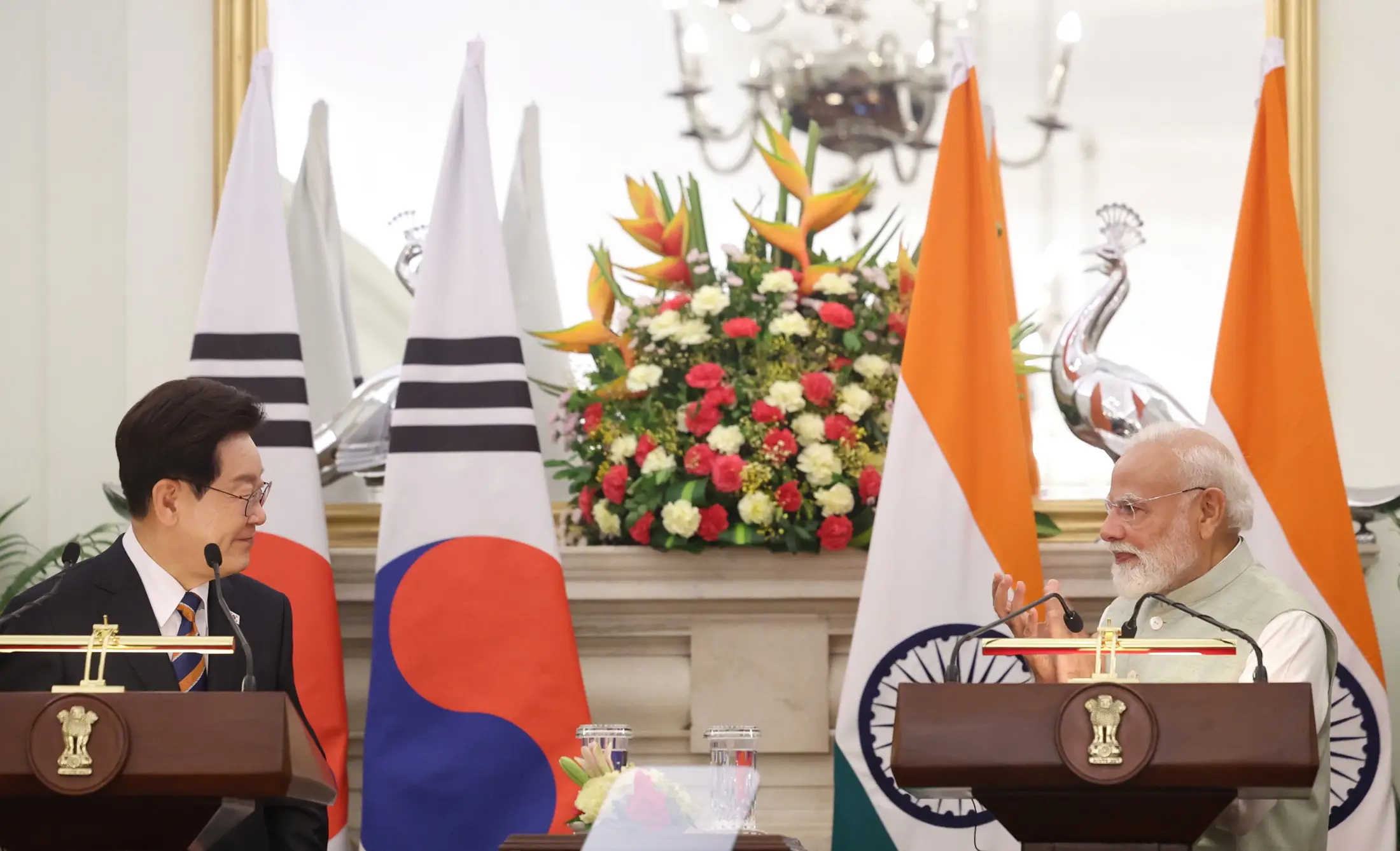
NEW DELHI — South Korean President Lee Jae-myung and Prime Minister Narendra Modi on Monday concluded a high-stakes bilateral summit at Hyderabad House in New Delhi, announcing what both governments described as a pivot to a “futuristic partnership” anchored in technology, maritime industry, clean energy and digital finance. The two leaders oversaw the exchange of 15 Memorandums of Understanding and four joint strategic documents, the most substantive outcome package in the history of the India–Republic of Korea (ROK) Special Strategic Partnership.
The summit marked the apex of President Lee’s three-day state visit to India — the first by a South Korean head of state since President Moon Jae-in’s visit in 2018 — and came against the backdrop of accelerating global supply chain disruption, ongoing conflict in West Asia, and a shared interest in reducing dependence on vulnerable trade routes.
“In the era of uncertainty, India and Korea can be the most ideal partners for comprehensive cooperation to promote mutual growth and innovation.” — President Lee Jae-myung
A Ceremonial Welcome and a Symbolic Tribute
President Lee, accompanied by First Lady Kim Hea-kyung, arrived in New Delhi on Sunday evening. He was received at the airport by Union Minister of State Harsh Malhotra, and on Monday morning was accorded a full ceremonial welcome at the forecourt of Rashtrapati Bhavan, where President Droupadi Murmu and Prime Minister Modi received the visiting delegation. Children in traditional costumes holding the South Korean flag and India’s Tricolour lined the reception, a moment that generated wide attention on social media.
President Lee subsequently paid tribute at Rajghat, the memorial to Mahatma Gandhi, before proceeding to Hyderabad House for the summit and business forum. External Affairs Minister S. Jaishankar, who had met President Lee the previous evening, described the visit as a defining step, expressing confidence that the talks would “further strengthen our Special Strategic Partnership.”
$50 Billion Trade Target and a Revived CEPA
At the heart of Monday’s summit was an ambitious economic agenda. Bilateral trade between India and South Korea currently stands at approximately $25.7 billion annually. Both sides announced a shared goal of nearly doubling that figure to $50 billion by 2030, describing it as achievable through a combination of upgraded trade terms, diversified cooperation and expanded market access.
List of Outcomes: State Visit of President of Republic of Korea to India
— PIB India (@PIB_India) April 20, 2026
??Joint Strategic Vision for the India-ROK Special Strategic Partnership
??India-ROK Comprehensive Framework for Partnership in Shipbuilding, Shipping & Maritime Logistics
??India-Republic of Korea Joint…
A key mechanism for reaching that target is the revival of the long-stalled upgrade to the Comprehensive Economic Partnership Agreement (CEPA), originally signed in 2010. A Joint Declaration on resuming CEPA upgrade negotiations was among the day’s formal outcomes. President Lee said the upgraded pact would “fully reflect new trade norms” and help both countries respond to shifting supply chains and green growth demands. South Korea’s sizeable trade surplus with India — approximately $12.8 billion last year, with Korean exports at $19.2 billion against imports of just $6.4 billion — has been a long-standing friction point that the revised framework is expected to partially address.
|
Economic Snapshot |
Figure |
|
Current Annual Bilateral Trade |
~$25.7 billion (2025) |
|
Target Bilateral Trade by 2030 |
$50 billion |
|
South Korea’s Trade Surplus (2025) |
$12.8 billion |
|
Indian Exports to South Korea |
$6.4 billion |
|
South Korean Exports to India |
$19.2 billion |
|
Relations Established |
1973 |
|
CEPA Signed |
2010 |
|
Partnership Elevated to ‘Special Strategic’ |
2015 |
Ships, Chips and Supply Chains: The Industrial Core
Among the most consequential agreements was the India–ROK Comprehensive Framework for Partnership in Shipbuilding, Shipping and Maritime Logistics, described by officials as a “foundational architecture” for transforming India into a globally competitive shipbuilding nation. South Korea commands approximately 40 percent of the global shipbuilding market, with HD Hyundai and Hanwha Ocean as its flagship builders. India, meanwhile, is pursuing an ambition to be among the world’s top five shipbuilding nations by 2047 under its Maritime Amrit Kaal Vision.
The framework builds on existing cooperation, including HD Hyundai’s announced $4 billion shipyard investment in Tamil Nadu, a September 2025 MoU between Cochin Shipyard Limited and HD Korea Shipbuilding for co-building tankers and bulk carriers, and an ongoing government-to-government Transfer of Technology agreement covering Fleet Support Ships and Mine Countermeasure Vessels. A separate MoU on cooperation in the field of ports and another on maritime heritage were also formalised.
Energy supply chain security added urgency to the maritime focus. Both nations are heavily reliant on imported energy and have been navigating disruption stemming from the ongoing conflict between the United States and Iran. President Lee confirmed that the two countries would “sustain cooperation for supply stability of energy resources and key commodities such as naphtha,” a critical petrochemical feedstock. A Joint Statement on Energy Resource Security was among the day’s four major strategic documents.
A Digital Bridge and Payments Integration
India and South Korea also formalised a Framework for the India–Korea Digital Bridge, aimed at deepening collaboration in artificial intelligence, digital infrastructure and emerging technologies. An MoU on cooperation in science and technology supplemented this framework.
In financial services, two agreements signal growing integration between the two economies’ payment architectures. The International Financial Services Centres Authority (IFSCA) signed an MoU with South Korea’s Financial Services Supervisory Commission (FSS) and Financial Services Commission (FSC) for regulatory cooperation. More concretely, NPCI International Payments Limited — the global arm of India’s Unified Payments Interface (UPI) operator — signed an agreement with the Korean Financial Telecommunications and Clearings Institute (KFTC), laying the groundwork for UPI-style digital payment interoperability between the two countries.
“From chips to ships — the India–Korea partnership is being rebuilt for the demands of a volatile, technology-driven global economy.”
Climate Cooperation and Multilateral Commitments
Climate and green energy featured prominently across several agreements. India and South Korea signed a Joint Statement on Cooperation in the Field of Sustainability as well as a standalone MoU on cooperation in climate and the environment. Notably, the two nations also signed an MoU under the Cooperative Approach framework of Article 6.2 of the Paris Agreement, which governs internationally transferred mitigation outcomes — a mechanism increasingly used by countries to meet their nationally determined contributions through cross-border carbon trading.
In a significant multilateral step, South Korea formally joined the Indo-Pacific Oceans Initiative (IPOI), India’s framework for maritime governance and ocean sustainability, and the International Solar Alliance (ISA). Reciprocally, India announced it would join South Korea’s Global Green Growth Institute (GGGI). A dialogue between the two countries’ foreign ministries on global themes — including climate change, Arctic affairs and maritime cooperation — was also announced.
Full List of Outcomes at a Glance
Joint Strategic Documents
• Joint Strategic Vision for the India–ROK Special Strategic Partnership
• Comprehensive Framework for Partnership in Shipbuilding, Shipping & Maritime Logistics
• Joint Statement on Cooperation in the Field of Sustainability
• Joint Statement on Energy Resource Security
MoUs and Frameworks Signed
• MoU on Cooperation in the Field of Ports
• MoU on the Establishment of the Industrial Cooperation Committee
• MoU on Cooperation in Technology and Trade for Steel Supply Chain
• MoU on Cooperation in the Field of Small and Medium-sized Enterprises
• MoU for Cooperation in the Field of Maritime Heritage
• Joint Declaration on Resuming CEPA Upgrade Negotiations
• MoU between IFSCA and FSS/FSC for Mutual Cooperation
• MoU between NPCI International Payments and Korean Financial Telecommunications & Clearings Institute
• MoU on Cooperation in the Field of Science & Technology
• Framework for India–Korea Digital Bridge
• MoU on Cooperation in the Field of Climate and the Environment
• MoU on Cooperative Approach under Article 6.2 of the Paris Agreement
• Cultural Exchange Programme for 2026–2030
• MoU on Cooperation in Cultural and Creative Industries
• MoU on Cooperation in the Field of Sports
Institutional Announcements
• Launch of Economic Security Dialogue
• Establishment of Distinguished Visitors Programme (DVP)
• Launch of Foreign Ministry Dialogue on Global Themes (Climate, Arctic, Maritime)
• ROK joining Indo-Pacific Oceans Initiative (IPOI)
• ROK joining International Solar Alliance; India joining Global Green Growth Institute (GGGI)
• Commemoration of 2028–29 as Year of India–ROK Friendship
Culture, Sports and People-to-People Ties
Beyond the strategic and economic architecture, the two governments placed visible emphasis on soft power and cultural exchange. A Cultural Exchange Programme covering 2026 to 2030 was signed, along with an MoU on cooperation in Cultural and Creative Industries — a reflection of South Korea’s growing global cultural footprint, including the popularity of K-drama and K-pop in India. A separate MoU on sports cooperation was also concluded.
The year 2028–2029 will be commemorated as the Year of India–South Korea Friendship, providing a structured platform for large-scale cultural, academic and tourism exchanges between the two countries over the following two years.
Korean Peninsula and Regional Stability
President Lee used the joint press statement to formally acknowledge India’s role in regional diplomacy, extending gratitude to the Indian government for its “consistent support” on the Korean Peninsula question. He expressed hope that India would “continue to play a constructive role for peace on the peninsula and within the region.” PM Modi in turn emphasised that India and South Korea stand as “pillars of stability” in an era of rising global tensions.
President Lee also invited Prime Minister Modi to visit South Korea, saying: “I really look forward to Prime Minister Modi’s visit to Korea, and I hope to continue to talk with you through various other opportunities.” Modi’s reciprocal visit, if confirmed, would represent a further milestone in an intensifying bilateral relationship. President Lee is scheduled to travel to Vietnam as the next stop in his broader South-East and South Asian regional tour.
Context: A Partnership Rebuilt for a New Era
India and South Korea established diplomatic relations in 1973. Economic engagement took a decisive leap forward with the CEPA in 2010, and ties were elevated to a “Special Strategic Partnership” in 2015. Since then, Korean companies including Samsung, LG, Hyundai and Kia have built deep manufacturing and retail roots in India. However, observers have long noted that political engagement has not kept pace with economic interdependence.
Monday’s outcomes, covering 15 formal agreements and six major institutional announcements across sectors from shipbuilding and semiconductors to climate and culture, represent the most concerted effort yet to bring the diplomatic relationship into alignment with its economic and strategic potential. Whether the ambitious $50 billion trade target by 2030 is met will depend substantially on the pace of CEPA renegotiation and the ability of both governments to translate agreement into implementation on the ground.