A landmark 2026 UNESCO assessment places India among the top ten countries by concentration of designated sites. The Western Ghats and Nilgiri Biosphere Reserve are identified as globally critical nodes for elephant migration, carbon storage, and community-led conservation.
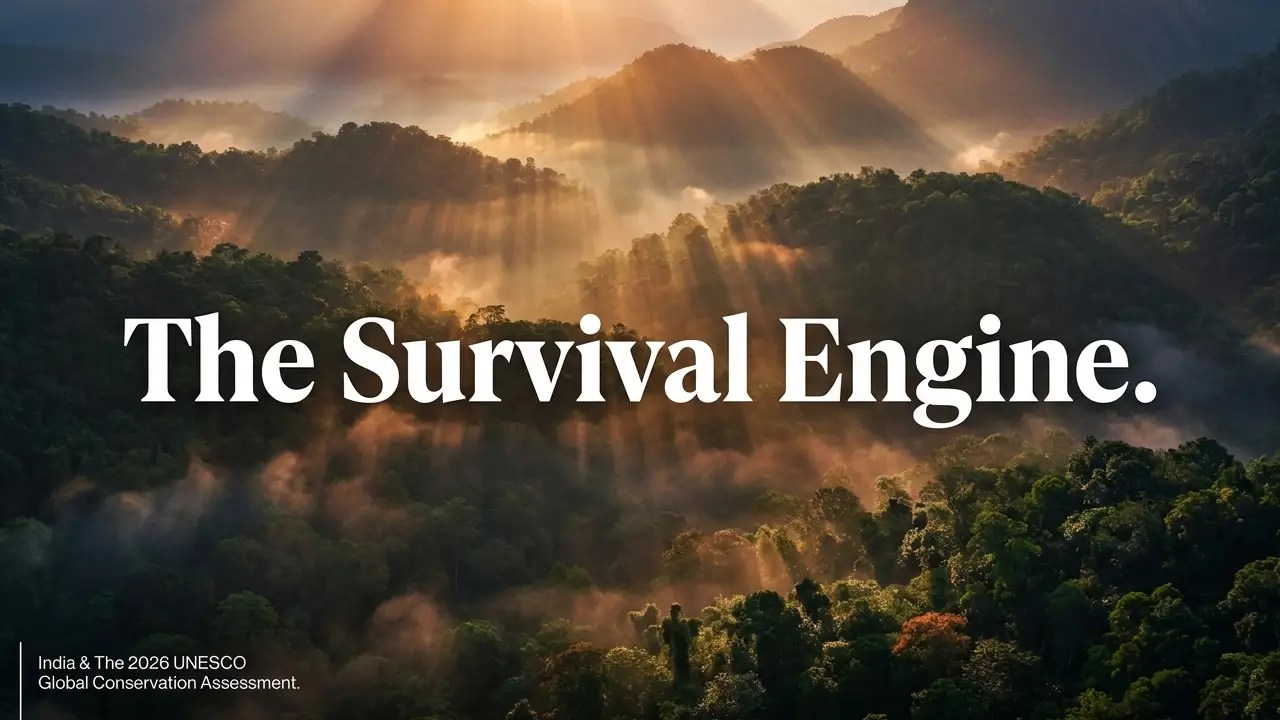
In a world facing unprecedented environmental degradation, a groundbreaking 2026 assessment by the United Nations Educational, Scientific and Cultural Organization has revealed that internationally designated protected sites are serving as the ultimate bulwark against climate change and biodiversity collapse. The comprehensive report, title "People and Nature in UNESCO-Designated Sites" — the first of its kind to evaluate World Heritage Sites, Biosphere Reserves, and Global Geoparks as a single, interconnected network — places India not merely as a participant in this global effort, but as a critical, high-impact player in the fight to preserve the planet's socio-ecological future.
The global network now comprises over 2,260 sites spanning more than 175 countries, covering over 13 million square kilometres — a territory larger than the landmasses of China and India combined. Even more striking is the density of crucial ecological zones concentrated within this network. The report notes that UNESCO sites harbour approximately 3 million square kilometres of globally recognised Key Biodiversity Areas — a protected area precisely equivalent to the entire landmass of India itself.
India ranks among the top ten nations worldwide by concentration of UNESCO-designated sites. As one of the world's most site-dense nations, India's protected territories are part of a global engine responsible for absorbing a net 700 million tonnes of carbon dioxide annually — equivalent to Germany's total annual fossil-fuel emissions — while collectively holding a staggering 240 gigatons of carbon in their biomass, soils, and sediments, representing over two decades of current global fossil-fuel emissions.

Image Credit: Wikimedia Commons
The 2026 UNESCO assessment paints a stark picture of global wildlife decline, noting that monitored wildlife populations globally have plummeted by 73% since 1970. In sharp contrast, wildlife populations within UNESCO-designated sites have remained comparatively stable on average over the same period, demonstrating the measurable efficacy of internationally protected zones.
India's role in this global wildlife stabilisation is explicitly highlighted through the lens of terrestrial migration. The report emphasises that many UNESCO sites act as vital stepping stones where migratory species can breed, feed, and rest — and that over two-thirds of species protected under the Convention on the Conservation of Migratory Species of Wild Animals rely on these designated sites for their survival.
Crucially, the report spotlights India's Western Ghats — recognised as both a World Heritage Site and a Biosphere Reserve — as one of the world's most central nodes for elephant migration routes. Alongside iconic African landscapes such as Botswana's Okavango Delta, the Sangha Trinational, and the Selous Game Reserve, the Western Ghats provide the essential, unbroken ecological corridors required for elephant herds to move safely across increasingly fragmented landscapes. By securing these ancient migration routes, the Western Ghats play an outsized role in the survival of the Asian elephant, shielding them from aggressive land-use changes, rapid urbanisation, and agricultural expansion that dominate surrounding, non-designated areas.

Image Credit: Wikimedia Commons
A core philosophy of the UNESCO framework is that humanity and the environment must be managed together; effective conservation is inextricably linked to sustainable development and the living knowledge of local communities. This is profoundly relevant across the Asia and the Pacific region, which, according to the report, is home to roughly 450 million people living in and around UNESCO sites — representing exactly half of the 900 million people living within the network globally.
The report underscores that protecting nature goes hand-in-hand with supporting the economies and traditions of these vast populations. Over half of the global economy is dependent on nature, and nature-positive initiatives have the potential to generate up to $10 trillion in economic value globally by 2030. To illustrate the successful synergy of ecology and local economy, the UNESCO assessment prominently features an Indian success story: the 'Women for Bees' initiative, operating across the forested landscapes of the Western Ghats and the Nilgiri Biosphere Reserve.
Supported by Guerlain, the programme is currently training 50 local Indian women in sustainable beekeeping practices, utilising the native Indian honeybee — Apis cerana indica — to ensure the enterprise is ecologically harmonious with the local environment. The initiative demonstrates a powerful model of community-driven conservation: on one hand, it empowers rural women with independent, nature-based livelihoods and entrepreneurial skills; on the other, it directly addresses the global decline of pollinators. With nearly 75% of global crops depending on pollinators — a service contributing an estimated $500 billion to global crop values — the localised efforts of women in the Nilgiris ripple outward, securing broader agricultural stability and biodiversity. This programme exemplifies UNESCO's vision of Biosphere Reserves as learning places that mobilise knowledge for both people and nature.

Despite the stability and success stories emerging from India and the broader network, the 2026 report issues a severe warning regarding the trajectory ahead. Environmental conditions are deteriorating rapidly, and nearly 90% of UNESCO-designated sites globally are currently experiencing high levels of environmental stress. The nature of these pressures is evolving: once driven primarily by agricultural expansion and logging, the leading threats have shifted dramatically. Wildfires are now the principal cause of forest loss within the global network, accounting for over 300,000 square kilometres of tree cover loss since 2001. Invasive species have infiltrated more than 80% of protected areas, disrupting delicate local ecosystems.
Climate change acts as the ultimate threat multiplier. The report reveals that 98% of sites have experienced at least one extreme climate condition since 2000, with extreme heat being the most pervasive. For India — a country deeply reliant on its monsoon systems and intricate river networks — the report's warnings of impending tipping points by 2050 carry particular weight. These tipping points include severe water stress, ecosystem reorganisation, and the risk of vital forests transitioning from carbon sinks into net carbon sources. If global warming trajectories continue unchecked, the number of sites exposed to major disruption could triple by the middle of the century.
To combat these escalating threats, UNESCO outlines several critical pathways for action — many of which align directly with practices already being pioneered within Indian territories.
On ecological restoration, the report identifies a massive and largely untapped potential, particularly within Biosphere Reserves, estimating that up to 150,000 square kilometres of degraded forest landscapes could be restored globally to capture an additional 1.2 gigatons of carbon. India's biosphere network is well positioned to contribute substantially to this target.
On traditional knowledge, UNESCO stresses the importance of integrating Indigenous and Local Knowledge into formal conservation strategies. Initiatives like the beekeeping traditions of the Nilgiris demonstrate how local understanding of native species such as Apis cerana indica is vastly more effective than top-down, generalised agricultural directives — and that such knowledge must be recognised, funded, and protected at both national and international levels.
On integrated management, the report calls for a decisive shift away from fragmented conservation approaches. The success of the Western Ghats as a functioning elephant corridor relies on managing not only the core reserve areas, but also the buffer zones and transition landscapes where human communities reside. Ecosystems do not observe administrative borders, and conservation strategies must reflect this reality.
The 2026 UNESCO assessment ultimately proves that while the environmental challenges of the 21st century are formidable, designated sites remain humanity's most effective mechanism for building resilience. By protecting biodiversity hubs like the Western Ghats and investing in the socio-economic empowerment of local guardians in the Nilgiris, India is actively demonstrating how humanity can survive, adapt, and thrive in a rapidly changing world. Secure, well-funded, and community-led conservation in India is no longer a national priority alone — it is a critical pillar of global ecological stability.
— End of Special Report —