Reports allege that petroleum products brought into the state for public use are being systematically purchased by black marketers and smuggled across the border into Myanmar. On April 25, security forces intercepted seven vehicles carrying 48 containers of petrol and diesel headed towards Moreh
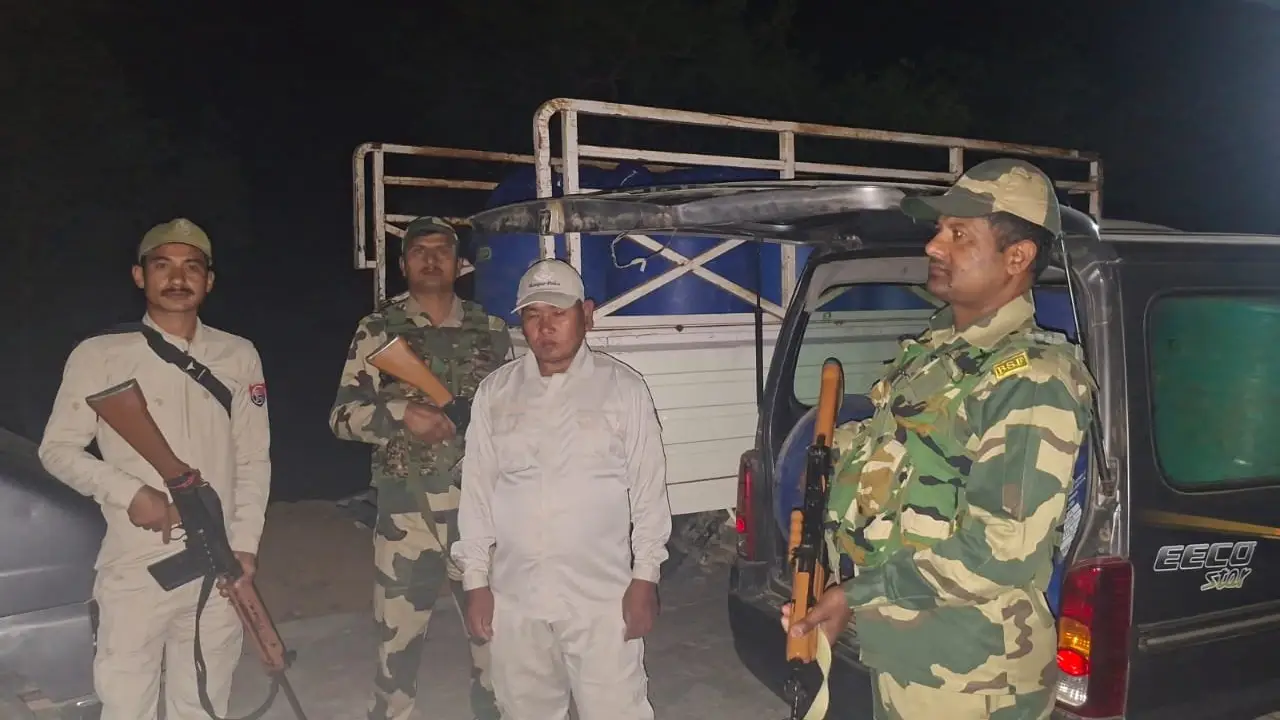
IMPHAL — Is fuel being smuggled out of Manipur into Myanmar? According to reports, on April 25, security forces intercepted seven vehicles near Moreh, loaded with 48 plastic containers filled with petrol and diesel, all heading for the border. Does this mean is fuel being smuggled across the border and how extensive it is, who is enabling it.
The April 25 interception points towards possible smugggling of fuel. Security forces stopped a convoy of seven vehicles — Eeco vans, a Yodha, and a Bolero pick-up — on a route leading toward Moreh, Manipur's primary border crossing with Myanmar. Inside: 48 plastic containers of suspected petroleum and diesel products. The drivers, from Chandel and Tengnoupal districts — the two districts with the most direct routes to the border — were detained. Their details are below.
On 25.04.2026, security forces intercepted 07 (seven) vehicles and seized 48 plastic containers having suspected Petroleum/diesel products that were being transported towards Moreh.
— Manipur Police (@manipur_police) April 25, 2026
Details of the seized vehicles and their respective drivers are as follows:
i. One Eeco Van… pic.twitter.com/K5Zkm281Wj
|
# |
Vehicle / Reg. No. |
Driver |
Age |
Address |
|
1 |
Eeco Van · WB06J-4685 |
Kh. Angking |
38 |
New Lamkang Khunthak, Chandel |
|
2 |
Eeco Van · SK01T-6770 |
John Shilshi |
39 |
New Lamkang Khunthak, Chandel |
|
3 |
Eeco Van · WB908-7729 |
Lenmang Haokip |
26 |
Senam Village, Tengnoupal |
|
4 |
Yodha · MN09B-0071 |
Marcus Chothe |
28 |
Khongkhang Village, Tengnoupal |
|
5 |
Eeco Van · WB06K-3089 |
Jamkhogin Haokip |
31 |
Saivom Village, Tengnoupal |
|
6 |
Bolero Pick-up · MN01AA-5411 |
Mojim Makunga |
45 |
Koijam Village |
|
7 |
Eeco Van · MN06LA-7568 |
Mangvung Jamminthang |
— |
Details pending |
Beyond the April 25 seizure, the broader circumstantial picture is consistent with systematic diversion. Retail outlets in Chandel, Thoubal, Bishnupur, and Kakching — the districts identified as primary sourcing points — are reporting black marketers visiting in numbers, buying fuel up to the transaction limits set by Oil Marketing Companies, and leaving. The fuel does not go to vehicles. It goes into containers. And the containers, reports suggest, go toward Moreh.
¦ Why Myanmar? What Makes Cross-Border Diversion So Profitable?
The financial logic is straightforward. Petroleum products sold legally within Manipur are priced at regulated Indian rates. If those same products were to be exported legally across the Myanmar border, an export tax of ?55.50 per litre would apply to petrol and diesel, and ?42 per litre to Aviation Turbine Fuel. Smugglers pay none of it — and the margin that differential creates, multiplied across dozens of containers per convoy, is the engine of the entire operation.
Myanmar's proximity and the porous nature of the border make the trade logistically feasible. Cross-border smuggling networks in this region — established over decades for other commodities — already have the infrastructure, border knowledge, and buyer contacts to absorb fuel diversion with minimal additional overhead. The Indo-Myanmar border in Manipur has never been easy to seal. Under current conditions, with enforcement resources stretched across multiple security priorities, it is easier to exploit than ever.
If petroleum were exported legally, the export levy alone would be ?55.50 per litre. Smugglers pay none of it.
¦ How Do They Get the Fuel in the First Place?
The transaction caps introduced by Oil Marketing Companies — ?5,000 per purchase for petrol, ?50,000 for diesel — were designed to prevent bulk hoarding at any single outlet. They have not prevented organised procurement. A buyer with multiple vehicles and knowledge of which outlets are still open can circulate across several stations, staying within the per-transaction limit at each, and consolidate substantial volumes before the consignment moves toward the border.
Reports indicate this is precisely what is happening at outlets in Chandel, Thoubal, Bishnupur, and Kakching. The black marketers are not walking in and demanding 200 litres at a single pump. They are working the system — methodically, across multiple outlets — in a pattern that individual station operators may recognise but feel unable to stop.
A further structural vulnerability compounds the problem. Under a current Oil Marketing Companies policy, any retail outlet that sells more fuel this month than in the same month last year has its supply suspended. The effect is perverse: outlets that remain open and serve customers — including customers who are black marketers — risk having their own supply cut off. The incentive to close early, or to ration strictly, leaves fewer open outlets, concentrating both legitimate consumers and smuggling procurement at the stations that stay open longest.
¦ The Key Facts
Vehicles intercepted on April 25: 7
Containers seized: 48 — suspected petrol and diesel
Destination of seized convoy: Moreh, Indo-Myanmar border
Driver home districts: Chandel and Tengnoupal — both border-adjacent
Primary fuel sourcing districts: Chandel, Thoubal, Bishnupur, Kakching
Export levy avoided per litre (petrol/diesel): ?55.50
Export levy avoided per litre (ATF): ?42.00
Petrol transaction cap at retail outlets: ?5,000 per purchase
Diesel transaction cap at retail outlets: ?50,000 per purchase
¦ So — Is It Happening?
The convoy was caught moving toward the border with containers of fuel. That is not circumstantial. That points to possible evidence of cross-border fuel diversion in progress. What remains uncertain is the scale. A single convoy of seven vehicles, caught once, does not define the full extent of the problem. The sourcing pattern across multiple districts, the consistent reports of black marketers at retail outlets, and the existence of established cross-border trade networks all point to something more systematic than a one-off opportunistic run.
Authorities have been warned. The Government of India has issued special instructions for the three Myanmar-border states — Manipur, Nagaland, and Mizoram — precisely because the risk of cross-border diversion was anticipated. The April 25 interception confirms that those warnings were warranted. Whether enforcement can now move from a single seizure to a sustained, intelligence-led operation against the networks behind it is the question that comes next.