The Council of Higher Secondary Education, Manipur (COHSEM) declared the 2026 Higher Secondary Examination results on Sunday, April 20, with 28,829 of 31,259 candidates clearing the examination. Tthe data reveals a nuanced story of gender achievement gaps, and stream disparities.
IMPHAL – The wait ended at 2:00 pm on Sunday for tens of thousands of students, parents and educators across Manipur as the Council of Higher Secondary Education, Manipur (COHSEM) officially declared the results of the 2026 Higher Secondary Examination. A total of 28,829 candidates cleared the examination out of 31,259 who appeared, yielding an overall pass percentage of 92.23%.
The results are accessible online at www.cohsemresults.nic.in and www.cohsem.nic.in. While the aggregate figure reflects strong academic performance across the state, a closer reading of the data uncovers significant trends in gender achievement, stream-wise difficulty, community-level performance, and a strict administrative framework governing appeals, certifications and re-examination — all of which carry immediate, practical consequences for thousands of young candidates.
|
Key Indicator |
Figure |
|
Total Candidates Appeared |
31,259 |
|
Total Candidates Passed |
28,829 |
|
Overall Pass Percentage |
92.23% |
|
Science Stream Pass % |
93.28% |
|
Arts Stream Pass % |
89.87% |
|
Commerce Stream Pass % |
82.57% |
|
Results Website |
cohsemresults.nic.in |
Female Students Set the Standard Across Streams and Categories
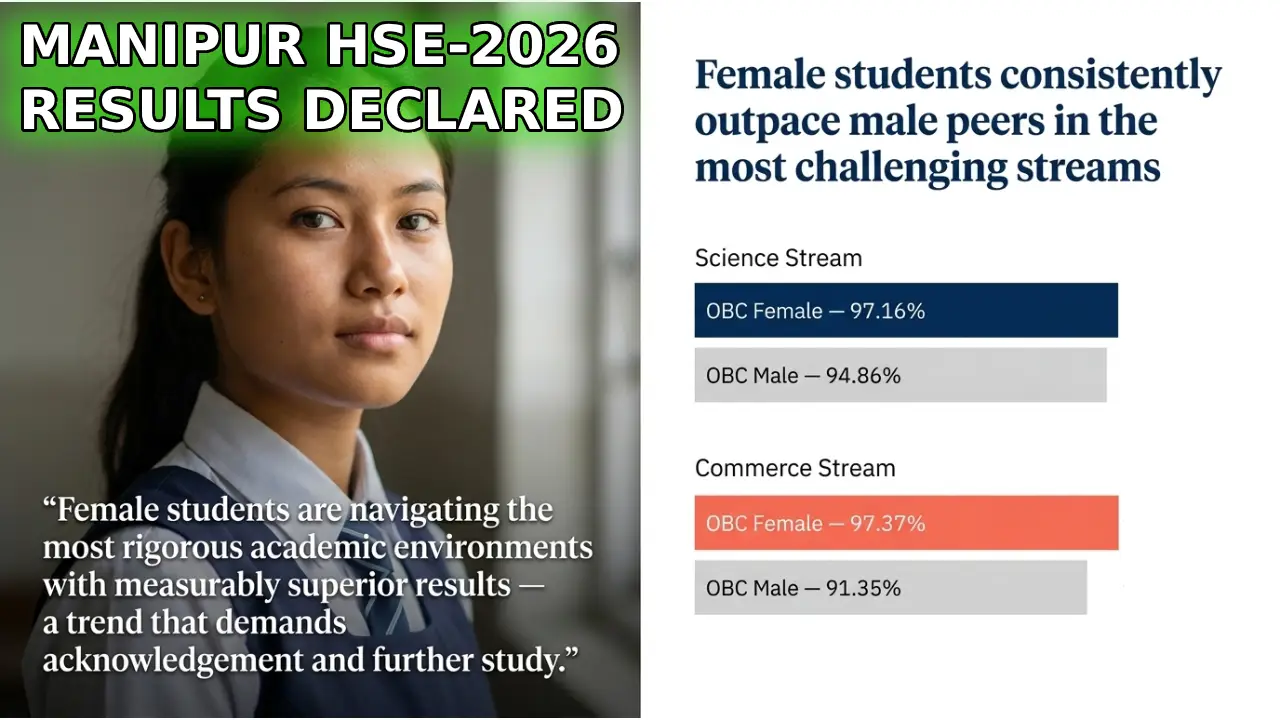
One of the most consistent and compelling narratives to emerge from this year’s data is the strong performance of female candidates. Women outperformed men across every stream and social category, with the gap proving widest in the areas of greatest academic difficulty.
In the Science stream, OBC female students achieved a pass rate of 97.16%, compared to 94.86% for their male counterparts. The most striking divergence emerged in Commerce, widely regarded as the most challenging stream of the three. Here, OBC female candidates posted a pass rate of 97.37%, surpassing OBC males (91.35%) by more than six percentage points.
“Female students are navigating the most rigorous academic environments with measurably superior results — a trend that demands acknowledgement and further study.”
Educationists and gender equity advocates are likely to find these figures significant, noting that the female performance advantage is most pronounced precisely where overall pass rates are most compressed. The pattern holds not just in percentage terms but across multiple social categories, suggesting a structural rather than incidental shift in academic outcomes.
Commerce Proves Most Difficult; ST Students Face Acute Struggles
The 2026 results confirmed a clear hierarchy of difficulty across the three streams. Science led with a pass rate of 93.28%, followed by Arts at 89.87%. Commerce, however, returned the lowest success rate of any stream at just 82.57%, making it statistically the most challenging pathway for candidates this year.
Within that already-difficult landscape, the performance of Scheduled Tribe (ST) students in Commerce is the single most alarming data point in the entire results profile. While ST students performed creditably in Arts (91.76%) and adequately in Science (84.63%), their Commerce pass rate collapsed to 66.40% — a drop of nearly 25 percentage points compared to their Arts result.
|
Category |
Stream |
ST Pass % |
|
Scheduled Tribe (ST) |
Arts |
91.76% |
|
Scheduled Tribe (ST) |
Science |
84.63% |
|
Scheduled Tribe (ST) |
Commerce |
66.40% |
The near-25-point collapse in ST pass rates between Arts and Commerce points to a specific pocket of educational disadvantage that targeted institutional support — through remedial Commerce coaching, financial literacy programmes, and dedicated mentorship in hill districts — could meaningfully address ahead of 2027.
Re-Checking Window Opens May 4; Students Warned of ‘No Re-Evaluation’ Rule
For the thousands of students who narrowly missed a passing grade or a preferred division, the Council’s rules on re-checking carry a critical warning: the process constitutes a strictly administrative audit, not a qualitative reassessment of their work.
Under Section 9(h) of the Council’s regulations, re-checking is limited to verifying that all answers were marked and that totals were correctly computed. No examiner will revisit the academic quality or completeness of any answer. The official guidelines state unambiguously that there is no provision for re-evaluation of answer scripts.
Applications for re-checking will be accepted only between May 4 and May 13, 2026. The cost is Rs. 2,400 per subject, in addition to a non-refundable Rs. 120 application form fee. Students and guardians are advised to weigh these costs carefully given the limited scope of the process.
Certificates and Marksheets: Fees, Hours, and a Key Office Closure
Successful candidates seeking official documentation — including Provisional Statements of Marks and Provisional Certificates — must navigate a narrow set of operational parameters at the Office of the Controller of Examinations.
Eligibility: Provisional documents are issued strictly to candidates who have passed. Failed candidates are not entitled to these certificates.
Document Fees: Provisional Statement of Marks: Rs. 720. Provisional Certificate: Rs. 720 (normal) or Rs. 960 (emergency). A separate Rs. 120 application form fee applies to every document request.
Office Hours: Applications are processed between 10:00 a.m. and 1:00 p.m. only.
Correction Window: Any clerical error on an Original Statement of Marks must be reported to the Controller within 15 days of issue to be rectified free of charge.
Office Closure: The office will be closed on Tuesday, May 21, 2026 (Compensatory Holiday). Students should plan their visits accordingly.
Improvement Examination in May Offers Structured Second Chance
Candidates who failed in up to two subjects have a structured pathway to qualification through the May 2026 Improvement Examination. The process, however, follows a precise sequential logic that students must understand before applying.
A student with two failed subjects may attempt only one in the May examination. Upon passing that subject, they receive a Qualifying Certificate. Only at that point are they eligible to sit the remaining failed subject as an Improvement Candidate in the next main examination cycle. The deadline to submit application forms for the May 2026 Improvement Examination is May 20, 2026. Missing this date forecloses the structured pathway entirely for this cycle.
“The Improvement Examination is not a loophole — it is a carefully sequenced, time-bound process with consequences at every step.”
Looking Ahead
Beyond the celebrations that Sunday’s announcement has rightly triggered, the 2026 HSE data presents the state’s educational establishment with a clear agenda. The consistent outperformance of female students, the acute difficulty facing ST candidates in Commerce, and the eight-percentage-point gap between government and non-government institutional pass rates all signal areas where targeted policy intervention could meaningfully shift outcomes before the 2027 cohort appears.
For the class of 2026, however, the immediate priority is practical: students should check their results at cohsemresults.nic.in, note the applicable deadlines for re-checking, documentation and improvement examinations, and begin the next chapter of their academic or professional journey with the knowledge that the door is, for most, now open.