Lok Sabha MP Dr. Bimol launched a sharp attack on the central government at the AICC office, citing three years of governance failure in Manipur, unconstitutional buffer zones, expanding ethnic conflict, and demanding a 12-point charter of remedial measures.
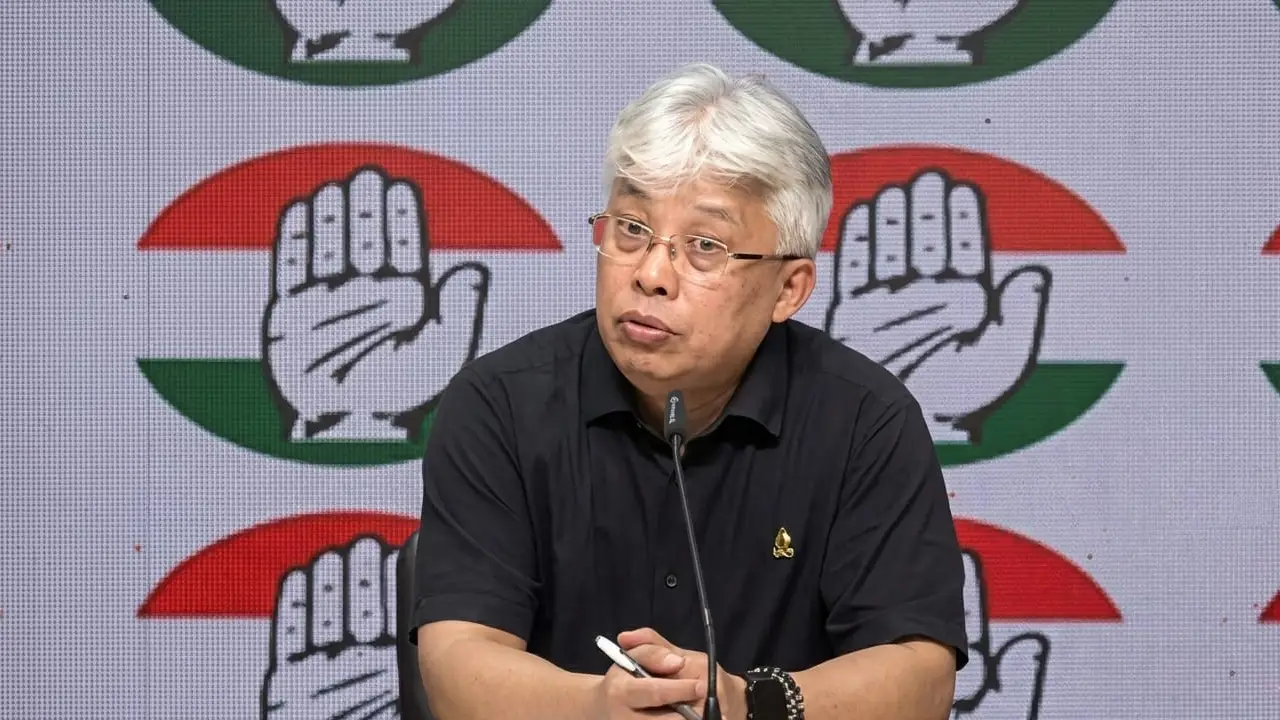
NEW DELHI — In an emotionally charged and politically explosive address at the AICC office on Monday, Lok Sabha MP Dr. Angomcha Bimol Akoijam delivered a comprehensive and scathing indictment of the central government's handling of the Manipur crisis. Characterising New Delhi's approach as a three-year-long "abdication of responsibility," the Congress MP painted a grim picture of a state descending into "complete chaos," where security agencies work at cross-purposes, fundamental rights are suspended through what he called unconstitutional "buffer zones," and the political leadership in New Delhi governs with a "colonial mentality" and "emperor-like arrogance."
Bimol opened his briefing by drawing attention to the devastating attack that unfolded on April 7 in Tronglaobi, Bishnupur district, where a projectile — reportedly an RPG — struck a family's bedroom while they lay sleeping, killing a five-year-old boy and his five-month-old sister. The human cost was made starkly personal when Bimol shared the account of the survivors: the mother, a nurse working in Assam, only learned of her children's deaths after regaining consciousness in hospital.
"She said, before they went to sleep, the young boy, five years old, said, 'Mama, I love you.'"
The father, a BSF soldier, was posted in Bihar at the time of the attack. Bimol cited the tragedy as a direct rebuttal to government claims that the situation in Manipur was normalising, reminding the press that infants had been killed and ambulances burned. "This is part of a pattern," he said.
Security Apparatus in Disarray
Bimol pointed to a glaring contradiction between national agencies over the use of drones in the conflict. While Indian Armed Forces generals denied that drones were being deployed, the NIA had filed charges citing drone usage. "We are hearing this chaotic schizophrenic statement," he said, describing the security apparatus as "disoriented" and "fragmented."
He further condemned the imposition of buffer zones as illegal and unconstitutional. While acknowledging that separating warring groups may be standard practice in foreign peacekeeping missions, he argued that deploying the same tactic within India — to prevent citizens from accessing their own homes, hospitals, and airports — represented a fundamental failure of the state's duty to protect citizens' rights. He added that even in his capacity as a sitting MP, he is barred from visiting his own constituency.
The response time of security forces during the April 7 attack was also brought into sharp focus. Despite a CRPF detachment being located barely kilometres away, forces reportedly took three to four hours to arrive, leaving villagers to transport the injured on their own. This delay, Bimol warned, has hardened a "suspicion towards central armed forces of colluding with these armed groups" — a sentiment he called deeply dangerous for national integrity.
Conflict Widens: Kuki-Naga Tensions Emerge
Among the most alarming developments Bimol raised was the expansion of the conflict well beyond Kuki-Meetei fault lines. On April 18, an ambush near Litan resulted in the deaths of two men from the Tangkhul Naga community, one of them a former army soldier. The incident triggered the burning of Tangkhul houses and forced the closure of the Imphal-Ukhrul road to civilian traffic.
Bimol warned that the sphere of conflict was visibly widening, now drawing in the Naga tribes and threatening a "complete collapse of law and order" across larger portions of the state.
A Charter of Demands
On behalf of the Manipur Pradesh Congress Committee, Bimol presented a formal charter of demands submitted to the Prime Minister and state leadership. Key among them:
Restoring Law and Order: The Manipur Police must be reorganised and empowered as the primary institution for maintaining law and order, a subject constitutionally under state jurisdiction.
Judicial Inquiry: An immediate inquiry commission under the Commission of Inquiry Act, 1952, to investigate the April 7 killings and the violence in Ukhrul and Kamjong.
Reining in Armed Groups: A firm government mandate to halt the free movement of armed groups in the hills, particularly those under Suspension of Operations agreements who are routinely seen moving armed in the presence of central forces.
Constitutional Order: An end to "remote control" governance from Delhi and the full restoration of state authority over law and order, which Bimol argued has been reduced to a vassal relationship.
Economic Relief: The formulation of a relief package for what he described as a shattered economy, contrasting the Centre's flood relief announcements for election-bound states with its silence on Manipur.
Census and Immigration: A deferral of the census process until a reliable mechanism to distinguish citizens from non-citizens is established, citing decadal population growth rates of 160 percent in some hill areas against 14 percent in the valley.
'The Arrogance of the Emperor'
Bimol reserved his harshest words for the political leadership in New Delhi. He contrasted Prime Minister Modi's brief stopover to inaugurate projects in Manipur with Rahul Gandhi's multiple, unpublicised visits to relief camps. "In their minds, Manipur is not part of India," he said. "If they thought India was part of it, they would do a good job."
He described what he called a "colonial mentality" that treats Manipur as an excluded territory, citing the Prime Minister and Governor's reported failure to even acknowledge the Speaker of the Manipur Assembly at a high-level meeting as an "impropriety of the highest order." Responding to those who labelled his criticism a "blame game," Bimol argued that as an opposition MP, he was performing a "national duty" of oversight.
Economic Despair and Personal Sacrifice
The MP condemned the absence of any financial or material compensation for victims who have languished in relief camps since May 2023, some of whom he said had taken their own lives. "The government must take a clear, fair, and judicious measure to deliver justice to these victims," he demanded.
On a personal note, Bimol — a former university professor — confirmed that he has refused to accept his MP salary or allowances, viewing his political work as public service. He said he remained committed to this stance despite being called "too idealist," in the face of what he described as the government's contempt for his people.
A Warning to the Republic
In closing, Bimol linked Manipur's neglect to a wider threat to India's democratic foundations. He accused the government of quietly pushing legislation such as the Women's Bill and delimitation measures to secure long-term political dominance — moves he warned could politically marginalise the North East and widen the divide between North and South India.
He ended with a direct appeal to the national media to "awaken the conscience of the nation," warning that continued neglect was fuelling dangerous separatist sentiment. "People are saying, 'leave us alone. We were a kingdom, we had an army... we would have handled it ourselves.' That kind of a feeling should not come," he cautioned. His message was unambiguous: for Manipur to remain a part of India in spirit, New Delhi must first begin treating its people as citizens of the Republic rather than subjects of a distant administration.