The World Bank’s MIND Project for Manipur, approved in 2023 and backed by a $46 million IBRD loan, has disbursed only 0.26% of its funds as of April 2026, earning a “Moderately Unsatisfactory” rating due to a near two-year delay in becoming effective.
A newly released World Bank Implementation Status and Results Report, dated April 17, 2026, has revealed that the Manipur Infotech eNabled Development (MIND) Project is facing serious implementation challenges, nearly three years after its approval. The project, aimed at transforming Manipur’s digital economy, has been rated “Moderately Unsatisfactory” on both progress toward its development objectives and overall implementation, with financial disbursement standing at a negligible 0.26% of the total loan amount.
|
Development Objective Progress |
Moderately Unsatisfactory |
|
Overall Implementation Progress |
Moderately Unsatisfactory |
|
Overall Risk Rating |
Substantial ↑ (from Moderate) |
|
Total Project Cost |
$57.5 million |
|
IBRD Loan (Active) |
$46 million |
|
Disbursed to Date |
$120,000 (0.26%) |
|
Undisbursed Balance |
$45.89 million |
|
Project Closing Date |
September 30, 2028 |
Project Overview and Financial Structure
The MIND Project (Project ID: P176733) was approved on July 6, 2023, as a major Investment Project Financing initiative backed by the World Bank’s International Bank for Reconstruction and Development (IBRD). It is being implemented by the Cyber Corporation of Manipur Limited (CCML) and carries a total project cost of $57.5 million, with a $46 million active IBRD loan.
The project’s three primary development objectives are to promote digital skills and entrepreneurship, increase access to broadband connectivity in designated project areas, and enhance the foundational security of digital government services across Manipur.
The project is structured around four components:
|
Foundations of Digital Government |
$29.5 million |
|
Digital Industry, Skills, and Jobs |
$18.3 million |
|
Broadband Connectivity, Access, and Use |
$8.59 million |
|
Project Management & Coordination |
$1 million |
|
Front-end Fee |
$110,000 |
A Near Two-Year ‘Effectiveness Gap’
The most critical factor behind the project’s poor ratings is a severe delay between its approval and its actual commencement. Although approved in July 2023, the MIND Project did not reach effectiveness until June 19, 2025 — a gap of approximately 23 months — and the loan agreement was signed only on May 9, 2025. This delay has significantly compressed the timeline available to achieve the project’s ambitious targets before its closing date of September 30, 2028.
|
Of the $46 million IBRD loan, only $120,000 has been disbursed to date, leaving an undisbursed balance of $45.89 million. The project now faces the considerable challenge of deploying nearly its entire capital in the final portion of its lifespan, requiring an unprecedented pace of execution. |
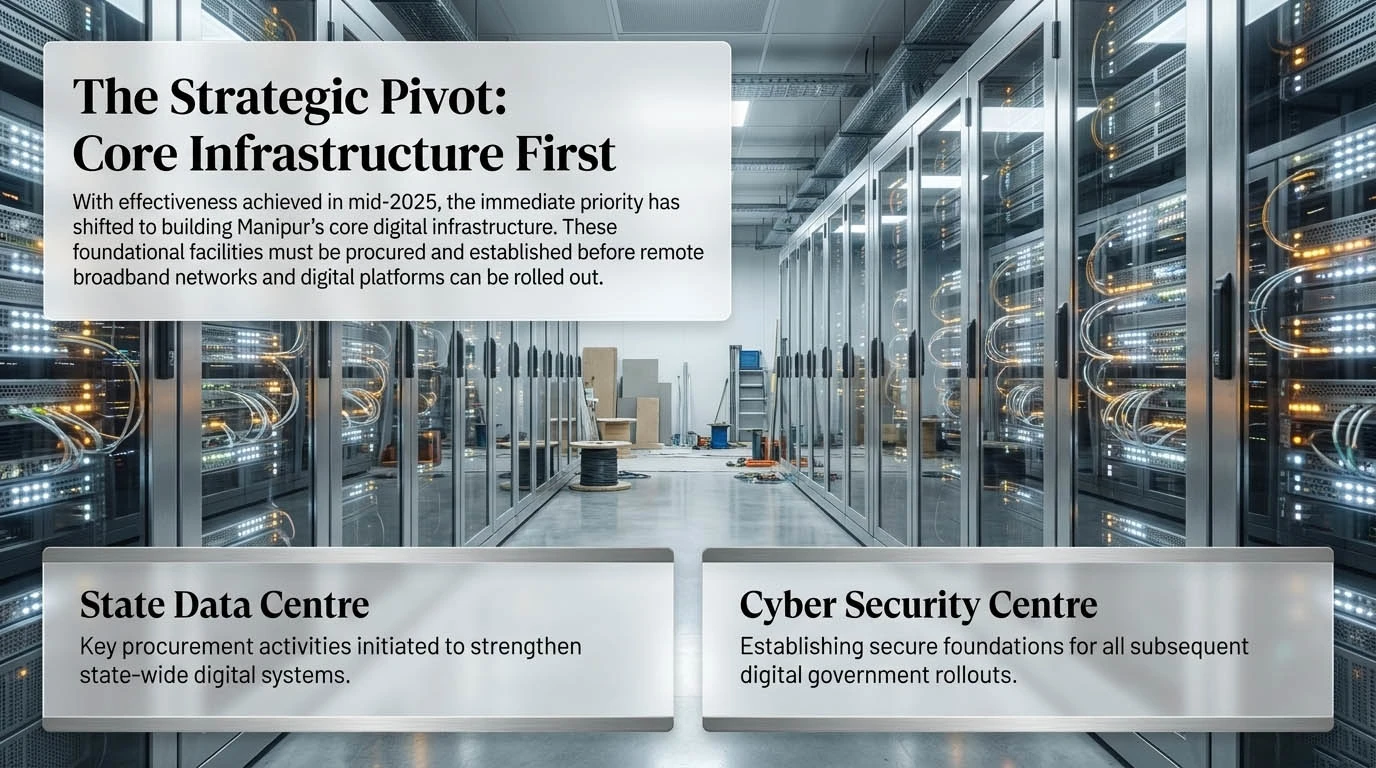
With foundational work still underway, current implementation efforts are concentrated on procuring a state-of-the-art data centre and a dedicated cybersecurity centre. Both facilities are viewed as essential prerequisites for the subsequent rollout of digital platforms and networks, particularly in Manipur’s remote and hilly terrains.
Component Targets and Inclusion Benchmarks
Despite the slow start, the MIND Project has set rigorous targets across its core components, all to be achieved by June 2028.
Digital Industry, Skills & Jobs
|
Total beneficiaries through job-focused interventions |
7,500 |
|
Trainees securing employment or entrepreneurship (12 months) |
80% by June 2028 |
|
Female beneficiaries |
40% of total |
|
Beneficiaries with disabilities |
5% of total |
|
Participants registering new tech-oriented businesses |
25% |
|
Female-led businesses among new registrations |
50% |
|
User satisfaction across skills programmes |
80% |
Broadband Connectivity, Access, and Use
|
Individuals with new or enhanced broadband access |
250,000 by June 2028 |
|
Female users among broadband beneficiaries |
100,000 |
|
Persons with disabilities with broadband access |
1,000 |
|
Private capital attracted for broadband infrastructure |
$5 million |
|
People trained through digital literacy programmes |
10,000 |
|
Women’s participation in digital literacy programmes |
50% |
Foundations of Digital Government
|
State government services migrated to new data centre |
70 by December 2027 (from baseline of 35) |
|
Cybersecurity Centre operational with public procedures |
June 2028 |
|
Private capital investments targeted |
$5 million |
|
IT equipment installations to be energy-efficient |
90% |
|
User satisfaction across broadband quality & e-services |
80% |
|
Registered grievances receiving response within 30 days |
80% |
Risk Profile Remains Elevated
The project’s risk profile has worsened since its approval. The Systematic Operations Risk-Rating Tool shows the overall risk rating elevated from “Moderate” at approval to “Substantial” in the current reporting period.
|
Overall Risk (at Approval) |
Moderate |
|
Overall Risk (Current) |
Substantial ↑ |
|
Institutional Capacity for Implementation & Sustainability |
Substantial |
|
Environment and Social Factors |
Substantial |
|
Stakeholder Risks (previously High) |
Substantial ↓ (improved) |
|
Fiduciary Risk (previously Substantial) |
Moderate ↓ (improved) |
|
Political and Governance Risk |
Moderate |
|
The report underscores that the successful procurement and establishment of the data centre and cybersecurity centre will be the defining test of CCML’s institutional capacity to bring this digital transformation initiative back on course before the 2028 deadline. |