Nagaland topped the Northeast in CBSE Class X results 2024-25 with 97.19%, while Arunachal Pradesh trailed at 66.33%, exposing a 30-percentage-point regional divide as the Guwahati region recorded 84.14% against the national average of 93.66%.
GUWAHATI – The CBSE Class X results for 2024-25, declared on May 13, laid bare a sharp educational divide across the Northeast, with Nagaland leading the region at 97.19% and Arunachal Pradesh recording the lowest pass rate at 66.33% — a gap of more than 30 percentage points that underscores the uneven state of secondary education across India's frontier states.
Mizoram came in second regionally at 96.61%, followed by Assam at 95.13% and Meghalaya at 90.69%. Manipur recorded 88.93%, with 4,443 of 4,996 students clearing the examination. Tripura posted 86.92%, while Sikkim stood at 79.97%. Arunachal Pradesh, with 12,398 of 18,692 students passing, recorded the sharpest underperformance in the region.
The Guwahati CBSE region, which administers the board's Northeast operations, recorded an overall pass percentage of 84.14% — nearly 9.5 percentage points below the national average of 93.66% and the weakest performing among all regional board offices in the country, trailing even the next-lowest region by a considerable margin.
The national results, covering 2,371,939 students across 26,675 schools, showed a marginal improvement from 93.60% in 2024 to 93.66% in 2025. The top-performing CBSE regions nationally were Trivandrum and Vijayawada, both at 99.79%, followed by Bengaluru (98.90%), Chennai (98.71%), and Pune (96.54%).
The contrast between the Northeast's performance and those top-tier regions raises pointed questions about resource allocation, teacher availability, and infrastructure in states that continue to grapple with geographic remoteness and connectivity challenges. Arunachal Pradesh and Sikkim, in particular, present cases where the gap with national benchmarks demands targeted pedagogical and policy intervention.
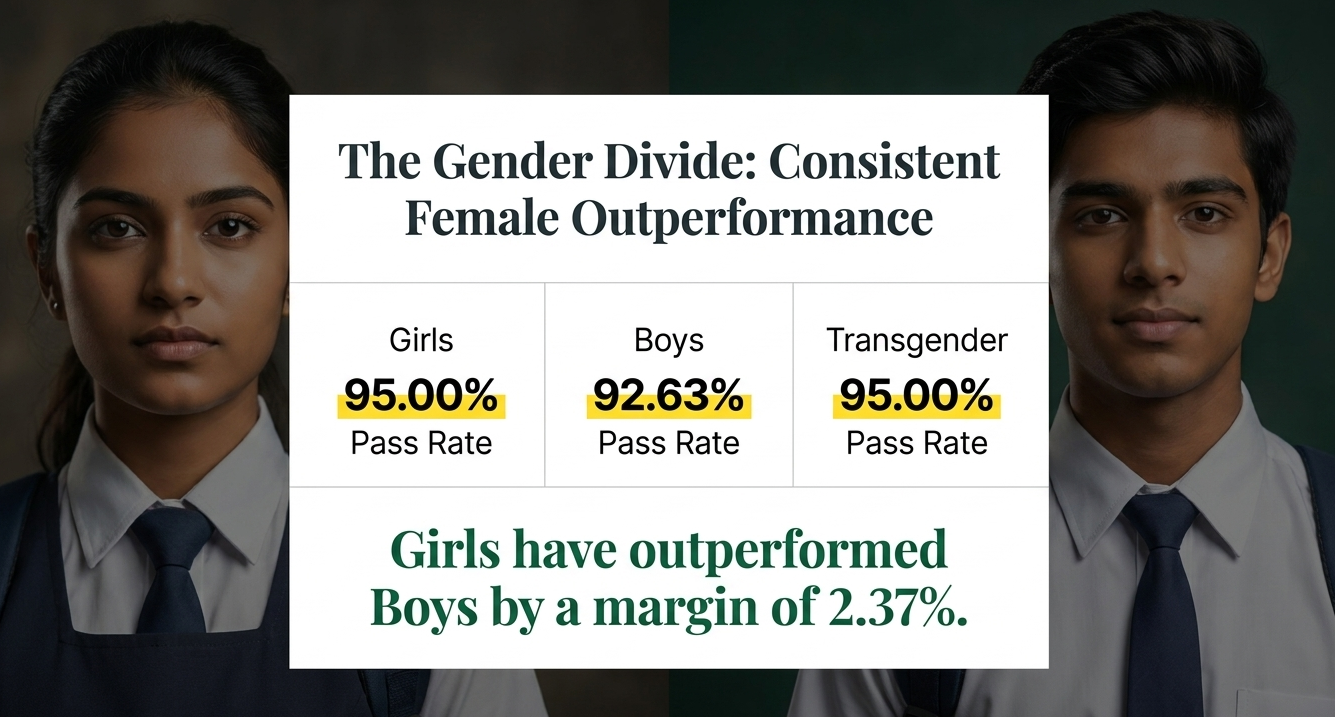
Across the country, girls and transgender students passed at 95.00%, outperforming boys at 92.63% by 2.37 percentage points. Jawahar Navodaya Vidyalayas led institution-wise at 99.49%, followed by Kendriya Vidyalayas at 99.45% — both of which have a presence in Northeast states and tend to anchor regional academic performance. Government schools nationally passed at 89.26%, while government-aided schools recorded the lowest institutional rate at 83.94%.
Nationally, 141,353 candidates — 5.96% of those who appeared — were placed in the Compartment category, a marginal rise from 5.91% the previous year. In states like Arunachal Pradesh and Sikkim, where pass rates are significantly lower, the proportion requiring supplementary assessments is likely to be considerably higher.
Results are accessible through cbse.gov.in, results.nic.in, and the DigiLocker and UMANG mobile applications. Mark sheets and certificates are hosted on the board's digital repository, Parinam Manjusha.