A two-day Human Rights Awareness Programme focusing on women’s economic empowerment began in Imphal, with NHRC member Vijaya Bharati Sayani highlighting rising female workforce participation while stressing persistent gaps in leadership, wages, and opportunities.
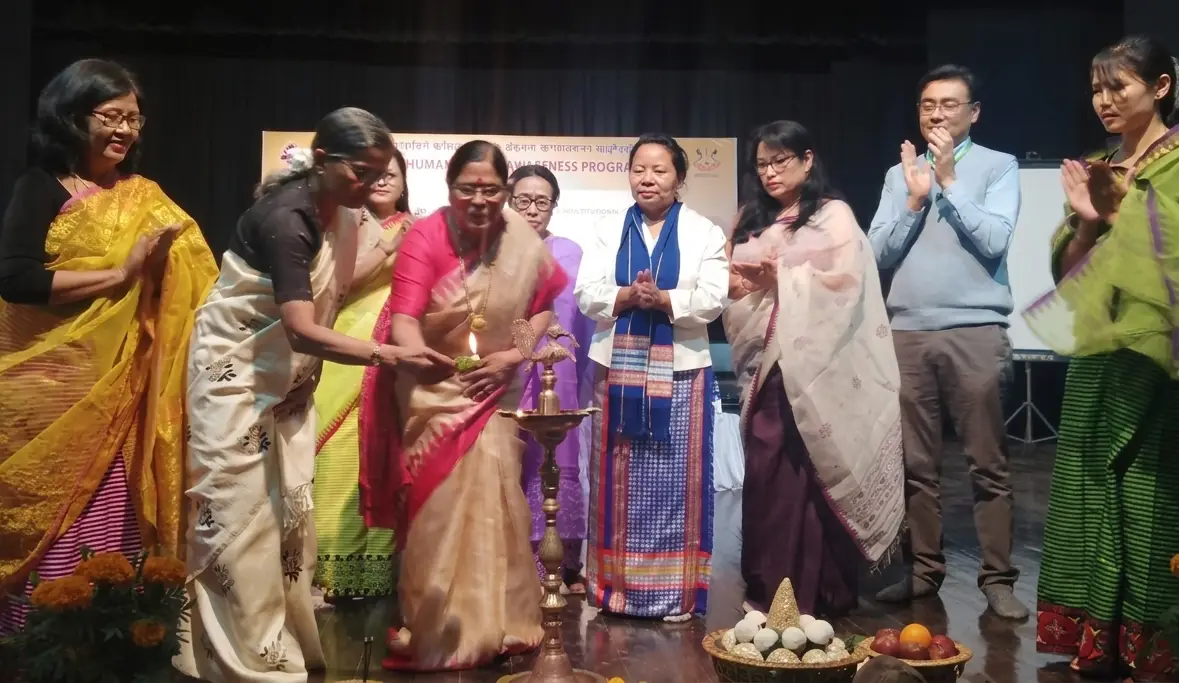
IMPHAL – A two-day Human Rights Awareness Programme, jointly organised by Samvardhinee Nyas and Khenjonglang, commenced at the auditorium of the Jawaharlal Nehru Manipur Dance Academy on Tuesday, with a focus on the theme “Economic Empowerment of Women.”
The inaugural session featured Vijaya Bharati Sayani, Member of the National Human Rights Commission, as Chief Guest, who underscored the centrality of women’s economic participation in achieving the vision of a developed India by 2047.
Addressing the gathering, Sayani highlighted encouraging trends in female workforce participation while cautioning against structural inequalities that continue to limit women’s full potential.
“No dream of a developed and inclusive India can ever be realised without the full and equal participation of women in our economy,” she said.
Citing official data, she noted that the female Labour Force Participation Rate (LFPR) for persons aged 15 years and above has risen to 40 percent, up from 33.9 percent in 2022. However, she pointed out that the figure remains below the global average of 49 percent.
She further observed that women’s representation in leadership roles remains limited, with around 21 percent of board seats in major companies held by women, and approximately 14 percent representation in Parliament.
“While the floor is rising, the glass ceiling still needs to be shattered,” Sayani remarked.
Emphasising the economic implications, she stated that increasing women’s participation could significantly accelerate India’s growth trajectory, noting that women currently contribute only about 17 percent to the country’s GDP.
Policy push and grassroots mobilisation
Sayani also outlined various government initiatives aimed at strengthening women’s economic empowerment, including Mission Shakti, the Deendayal Antyodaya Yojana under the National Rural Livelihoods Mission, and skill development programmes such as the Pradhan Mantri Kaushal Vikas Yojana.
She highlighted that over 90 lakh self-help groups involving more than 10 crore women have been mobilised nationwide, fostering entrepreneurship and financial inclusion.
“Economic empowerment is not an act of charity. It is smart economics that benefits every citizen,” she said, stressing that women’s earnings directly improve household outcomes in nutrition, education, and health.
The NHRC, she added, has been actively linking women’s economic rights with constitutional guarantees under Articles 14, 15, and 21, while addressing issues such as workplace safety, wage gaps, and discrimination.
Local focus and upcoming sessions
Earlier, Director of Khenjonglang, Thanil Leima, said the programme aims to explore practical pathways to enhance women’s income and economic independence.
“Despite women playing significant roles in various fields, their economic condition remains poor. This session will examine feasible ways to improve their earnings,” she said.
She added that the second day of the programme would focus on “Peaceful Co-existence, Social Harmony, and Constitutional Morality,” highlighting the role of women in fostering harmony in society.
The inaugural session was chaired by Madhuri Marathe, All India Organising Secretary of Samvardhinee Nyas, while Th. Tiningpham Monsang, Chairperson of the Manipur State Commission for Women, attended as Guest of Honour.
The programme brings together stakeholders, activists, and community members to deliberate on the intersection of human rights, economic inclusion, and social cohesion, with a particular emphasis on women’s role in shaping a more equitable and harmonious society.