NIT Rourkela researchers have patented an FTIR spectroscopy and machine learning-based system that detects and quantifies spice adulteration within seconds, offering a rapid, cost-effective alternative to conventional laboratory methods.
KEY HIGHLIGHTS
• Spice adulteration, driven by cost-cutting, compromises food quality and poses serious health risks.
• Unlike conventional methods that only detect the presence of adulteration, the new technology measures the level of adulteration within seconds.
• The patented system is suitable for real-time deployment in quality control laboratories and industrial processing units.
Researchers at the National Institute of Technology (NIT) Rourkela have secured a patent for a system capable of rapidly detecting and measuring adulteration in spices and other food products. The technology, developed by the Department of Food Process Engineering, combines Fourier Transform Infrared (FTIR) spectroscopy with advanced machine learning models to deliver accurate, near-instant results, addressing a significant gap in food safety monitoring.
Food and spice adulteration poses serious health and economic risks in India and globally, often driven by cost-cutting practices and inadequate enforcement of food safety standards. Traditional detection methods such as chromatography or molecular techniques are resource-intensive, require extensive manpower and chemical reagents, and take considerable time to yield results, making them ill-suited for rapid, routine screening.
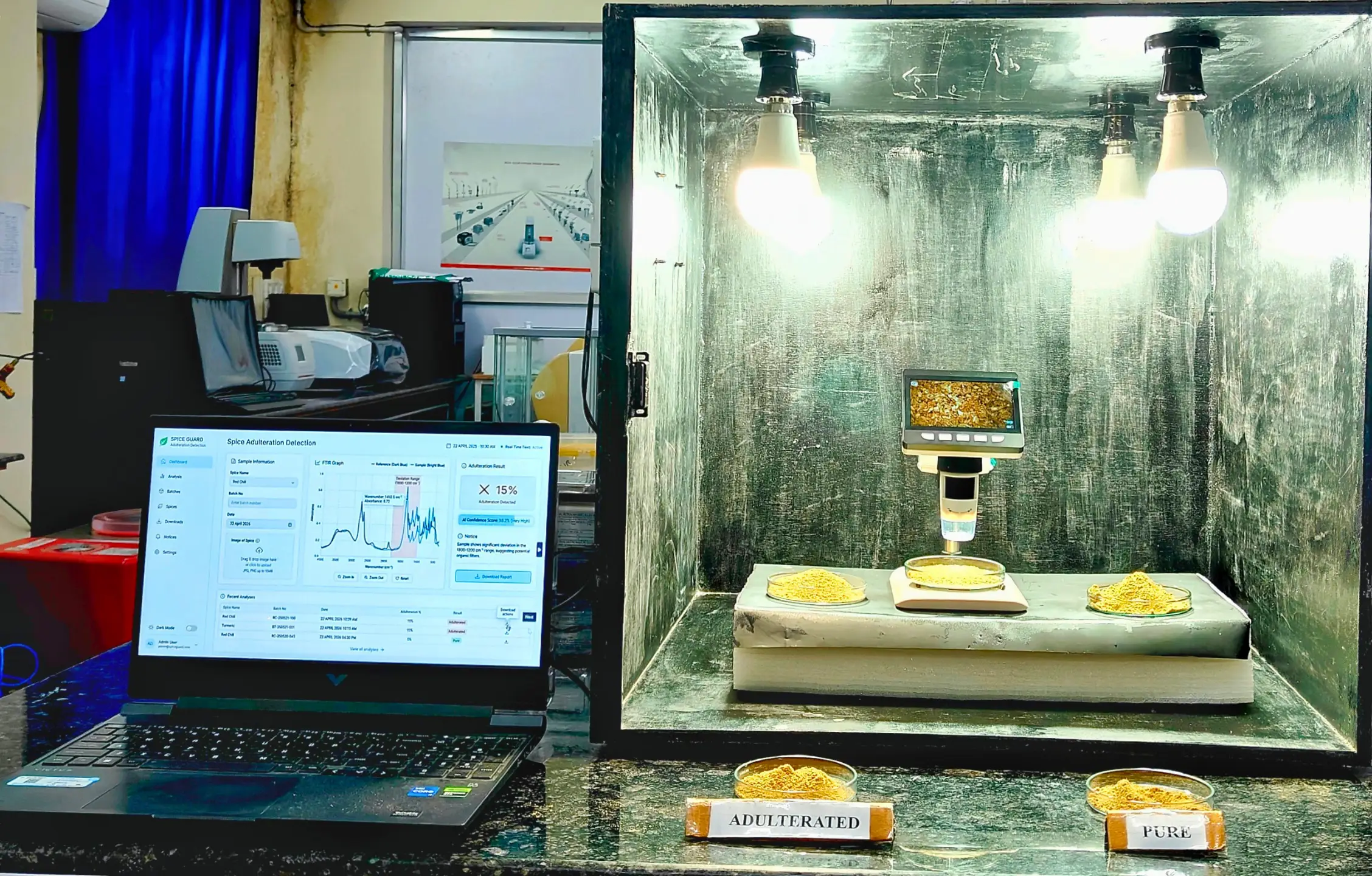
FTIR spectroscopy identifies organic and some inorganic materials by measuring how they absorb infrared light. The NIT Rourkela system collects these spectral patterns from a food sample and processes them through machine learning models that analyse complex, non-linear patterns to detect abnormalities. Critically, unlike conventional methods that only indicate whether adulteration is present, this system quantifies the level of adulteration — all within seconds. This precision is essential for food processing industries and regulatory bodies that require accurate measurements to ensure compliance and maintain product quality.
The research was conducted by Prof. Sushil Kumar Singh (Assistant Professor), the late Prof. Poonam Singha, and M.Tech. graduate Rishabh Goyal, all from the Department of Food Process Engineering at NIT Rourkela. The findings were published in the prestigious journal Food Chemistry. The team has been granted a patent titled “Method and System for Detecting and Quantifying Adulteration in Food Stuff” (Patent No. 581403; Application No. 202431050538).
As a key validation of the technology, the research team applied the system to one of the most common and concerning adulteration practices: the mixing of sawdust into coriander powder. Using machine learning models integrated with FTIR spectroscopy, the team achieved approximately 92% accuracy in detecting this type of adulteration, while also establishing a methodological framework for identifying multiple types of adulterants across various food products.
Prof. Singh highlighted that the system can seamlessly integrate into existing quality control workflows across food companies at any stage of spice processing. By eliminating the need for complex sample preparation and lengthy analysis, the technology reduces production delays and operational costs — a significant advantage in price-sensitive markets like India, where large-scale, affordable food safety solutions are critically needed. Its scalability makes it viable for both large enterprises and small and medium enterprises (SMEs).
As a next step, the team plans to collaborate with industry partners for pilot-scale studies and to extend the system’s detection capability beyond spices through experiments under varied real-world conditions. As food safety concerns continue to grow, innovations such as this are expected to play a pivotal role in strengthening accountability and public health across the food supply chain.