Northeast India's grievance redressal performance remains critically uneven, with Nagaland and Manipur posting near-total pendency rates above 99%, while Tripura leads the region with an 18-day turnaround, per CPGRAMS March 2026 report.
Most of India's eight northeastern states continue to struggle with high backlogs of unresolved public grievances, with Nagaland and Manipur posting pendency rates above 99%, according to the 44th monthly CPGRAMS report released Thursday by the Department of Administrative Reforms and Public Grievances.
The Centralized Public Grievance Redress and Monitoring System, or CPGRAMS, logged 83,365 public grievance cases for states and union territories in March 2026, of which 75,245 were redressed. Total pending cases across the country stood at 2,01,088 as of March 31.
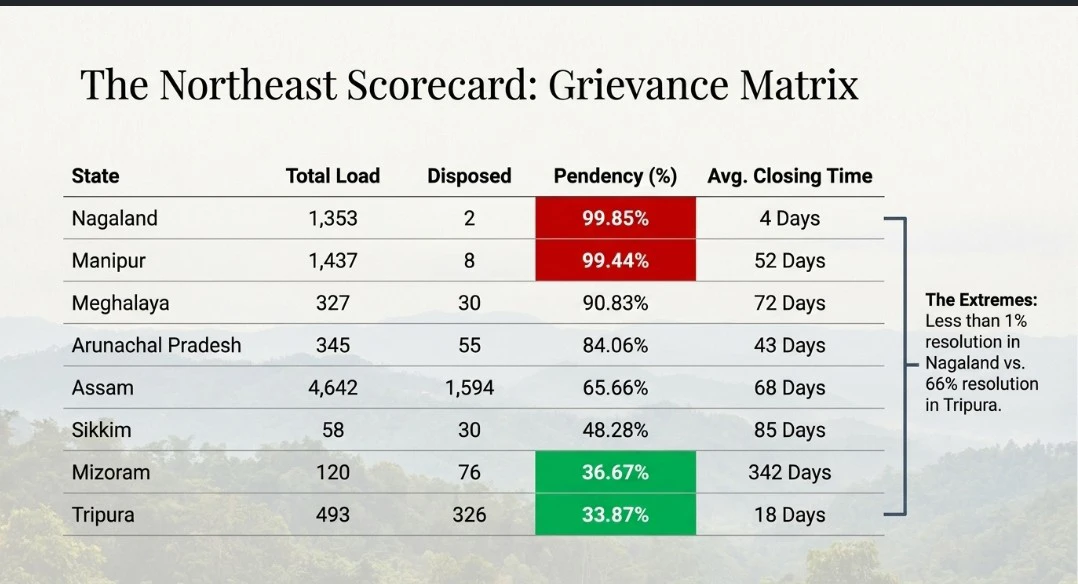
In the Northeast, performance varied sharply across the eight states, with Tripura and Mizoram emerging as the region's best performers while Nagaland, Manipur and Meghalaya posted the worst resolution rates.
Nagaland disposed of just two of its 1,353 total grievances between January and March 2026, recording the region's highest pending percentage at 99.85%. The state received 32 new cases in the quarter, all carried over against a backlog of 1,321 cases brought forward from the previous period. Its Average Closing Time, however, was the region's fastest at four days — indicating that the rare cases that are resolved are handled quickly, but that the bulk of cases remain untouched.
Manipur's situation was similarly dire. Of 1,437 total grievances — 1,297 carried forward and 140 new receipts — the state disposed of only eight cases, leaving a pending rate of 99.44%. The state's Average Closing Time stood at 52 days. Manipur is currently allocated three instalments of the Sevottam Scheme financial grant for FY 2025-26, a central program that funds state administrative training institutes to improve grievance redressal capacity. It recorded 140 new user registrations on the CPGRAMS portal in March.
Tripura posted the Northeast's best performance, disposing of 326 of 493 total grievances for a pending rate of 33.87% — the lowest in the region. The state's Average Closing Time of 18 days also placed it among the top national performers for rapid disposal. Tripura added 148 new users to CPGRAMS in March.
Mizoram was the second-best performer by pendency rate, resolving 76 of 120 total cases for a pending percentage of 36.67%. However, its Average Closing Time of 342 days — by far the highest in the region — signals that cases that do get closed take an extremely long time to reach resolution. Mizoram's Administrative Training Institute conducted nine training courses for 300 participants under the Sevottam Scheme, for which the state has been approved for four grant instalments. It recorded 37 new user registrations in March.
Assam carried the heaviest grievance burden in the region, with 4,642 total cases — 2,430 brought forward and 2,212 new receipts — in the January-March quarter. The state disposed of 1,594 cases, leaving 3,048 pending at a rate of 65.66%, with an Average Closing Time of 68 days. Assam, which is receiving four Sevottam grant instalments for FY 2025-26, saw 1,132 new CPGRAMS user registrations in March, the highest among the eight northeastern states.
Meghalaya distinguished itself as the only northeastern state with full integration with the CPGRAMS portal. The state disposed of 30 of 327 total grievances, leaving a pending rate of 90.83% and an Average Closing Time of 72 days. Its Meghalaya Administrative Training Institute conducted 14 training courses for 380 participants. Meghalaya is receiving two Sevottam grant instalments and added 52 new portal users in March.
Arunachal Pradesh handled 345 total grievances — 246 carried forward and 99 new — and disposed of 55, leaving a pending rate of 84.06% with an Average Closing Time of 43 days. The state recorded 62 new user registrations in March.
Sikkim handled the region's smallest volume with 58 total grievances and disposed of 30, bringing its pending rate to 48.28%. Its Average Closing Time stood at 85 days. The state added 28 new CPGRAMS users in March.
Nationally, Uttar Pradesh recorded the highest number of grievance disposals in March with 22,985 cases, followed by Gujarat with 5,417 cases and Maharashtra with 4,286 cases. UP also led in new CPGRAMS registrations with 12,865 of the 75,853 total new users added in March.
The CPGRAMS Feedback Call Centre collected 74,069 responses in March, of which 28,095 related to states and union territories. Of 12,493 cases marked resolved by the call centre, more than 63% of citizens expressed satisfaction with the outcomes, while 37% — or 4,630 cases — remained dissatisfied.
CPGRAMS, which is integrated with over five lakh Common Service Centres and linked to 2.5 lakh Village Level Entrepreneurs, received 12,763 CSC-registered grievances in March. Karnataka dominated that channel, accounting for 45% of all CSC-registered cases nationwide with 5,738 filings.
Under the Sevottam Scheme, 1,134 training courses were completed over the four financial years from FY 2022-23 through FY 2025-26, training approximately 37,620 officers across the country.
Twenty-two states and union territories currently carry more than 1,000 pending grievance cases each on the CPGRAMS portal.