Thousands of Nagas across multiple districts held candlelight vigils on April 23 to honour S.W. Chinaoshang and Yaruingam Vashum, killed in an NH-202 ambush on April 18. The vigils, spanning Ukhrul, Senapati, Chandel, and Imphal, marked the close of a UNC-called three-day shutdown
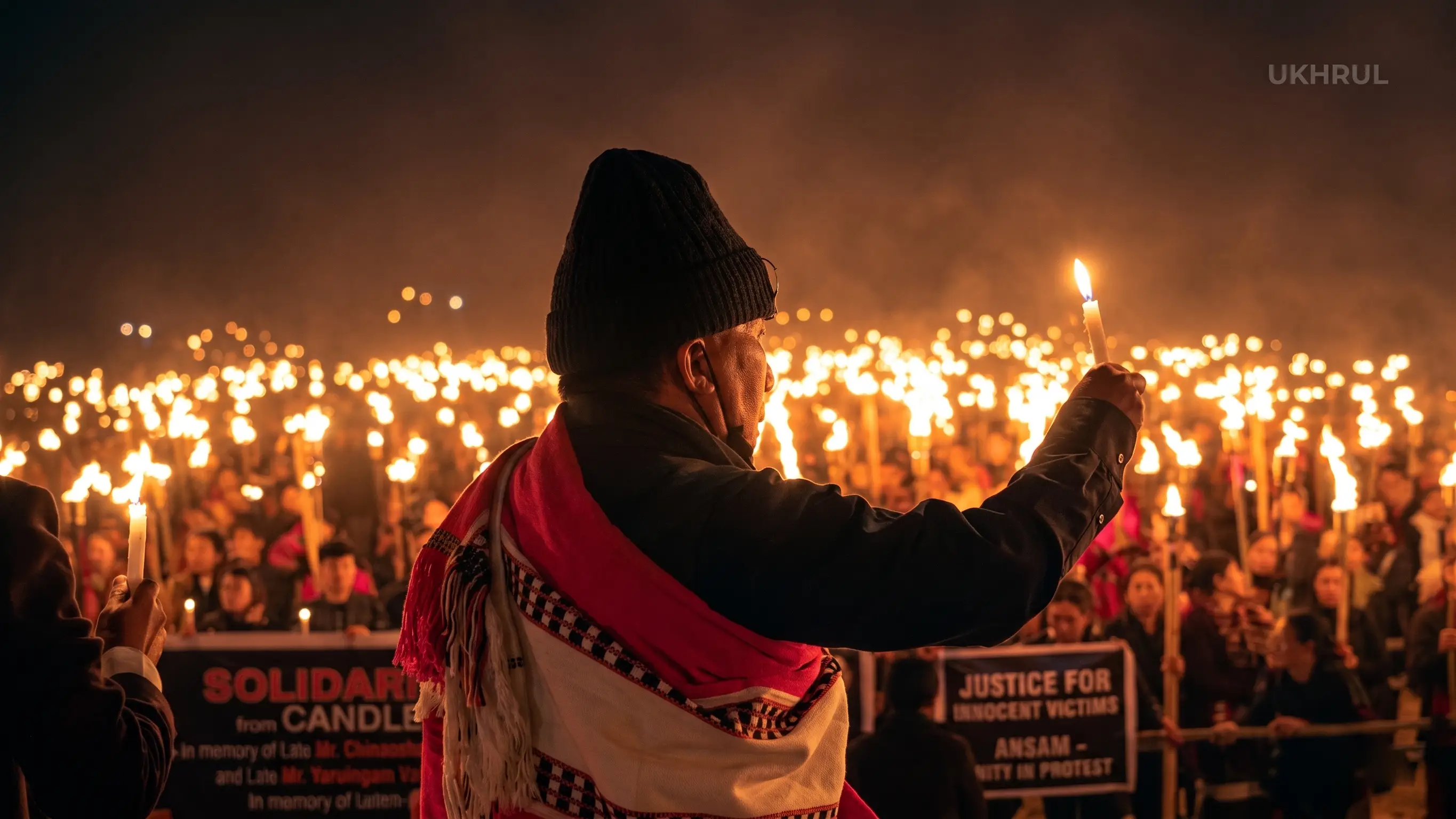
IMPHAL – A mammoth gathering converged on Ukhrul Headquarters Ground on the evening of April 23, 2026, for a Solidarity March cum Candlelight Vigil organised jointly by Tangkhul civil society organisations. The event was held in honour of Late S.W. Chinaoshang and Late Yaruingam Vashum — two Tangkhul Naga civilians killed in a brutal ambush along NH-202 in Ukhrul district on April 18, 2026. Participants assembled at two separate points — the Mini Secretariat and Awontang — at 4:00 p.m. before proceeding in a solidarity march to the venue. The Zarmei Kashar, women torch-bearers carrying traditional Zarmei torches, formed a prominent and symbolic part of the procession. As evening fell, the ground was illuminated by thousands of traditional flames, transforming the space into a powerful expression of collective mourning and solidarity.
Nagas in Solidarity - One Naga
— SpeakNaga_X (@SpeakNaga_X) April 23, 2026
Candle light Vigil - Ukhrul HQs
Candlelight Vigil Service honouring Late SW Chinaoshang and Late Yaruingam Vashum, who lost their lives in a merciless ambush by Kuki narco-terrorists on 18 April 2026 along NH-202, Ukhrul District.#Manipur… pic.twitter.com/hLVGueHKjP
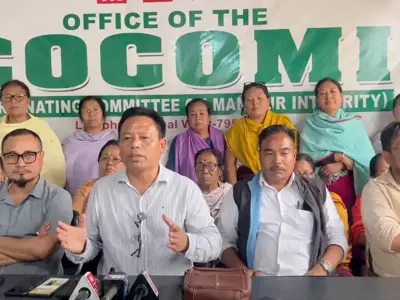
Addressing the gathering, Ramreichan Ningshen, President of the Tangkhul Katamnao Saklong (TKS), said that the deaths had brought not only Tangkhuls together but Nagas beyond, noting that the community did not choose its identity but was given it with a purpose. He singled out the presence of mothers in the crowd for special recognition, saying their unwavering love continued to keep the community on the right path during times of extreme trial.
A message from Ng. Lorho, President of the United Naga Council (UNC), characterised the April 18 incident as a cold, orchestrated ambush — not a casualty of conflict. Lorho directed sharp criticism at the Government of India, questioning the efficacy of central security forces and the Suspension of Operations (SoO) agreement, arguing that the silence of those who must protect civilians had become louder than gunfire. He emphasised that the three-day mourning period observed across Naga areas was a reminder that Naga identity transcends state and international borders. Addressing the Kuki community, Lorho clarified that the suspension of ties was a traditional form of grief and mourning — not an act of hatred — while firmly cautioning that Naga patience must not be mistaken for weakness. The proceedings concluded with the rhythmic cry of "Kuknalim" — a collective expression of hope for a peace rooted in dignity and the protection of Naga lives on their own soil.
More than 5,000 people assembled at the Traffic Island in Senapati on the evening of April 23 for a candlelight vigil held in memory of the two victims. The solemn programme, which commenced at 6:30 p.m., was jointly organised by the Naga People's Organisation (NPO), the Senapati District Students' Association (SDSA), and the Senapati District Women Association (SDWA), under the aegis of the United Naga Council. UNC leaders, Naga women's representatives, ANSAM, district frontal organisations, village headmen, church leaders, and members of various organisations were among those in attendance. A one-minute silent prayer was led by Rev. A. Pfokrelo, Executive Secretary of the Mao Baptist Churches Association.
Kuba Peter, President of the Naga People's Organisation, described the gathering as a solemn declaration that the victims would not be forgotten. He conveyed that each candle held that evening was a symbol of the victims' memory — a quiet but powerful stand against violence and injustice. He extended deepest condolences to the bereaved families on behalf of the NPO and all district frontal organisations, stating that their loss was a shared one. He called upon concerned authorities to ensure that justice is delivered swiftly and fairly, asserting that such acts must not go unanswered and that the rule of law must prevail to restore faith and security among the people.
UNC President Ng. Lorho, also addressing the Senapati gathering, described S.W. Chinaoshang and Yaruingam Vashum as innocent passengers on an ordinary journey home whose lives were cut short between Litan and T.M. Kasom in a cold, orchestrated ambush. He stated that NH-202 is not a war zone but a lifeline, and that the spilling of blood on it reflected the failure of those tasked with protecting civilians. Lorho held the Government of India directly accountable, stating that armed groups had moved freely along highways under the shadow of the SoO agreement while central forces were present, yet Nagas were killed in broad daylight on national highways. He called the three-day shutdown a collective show of the weight of the loss — a demonstration that when one Naga falls, all Nagas feel the ground shake. He urged the youth to keep their hearts disciplined, and appealed to all to make a promise that the living would be protected so that no more mothers waited for sons who would never come home.
In Chandel district, the three-day shutdown called by the United Naga Council concluded with candlelight vigils held across multiple locations. At Maha Union Government Higher Secondary School Ground, Japhou, a grand vigil was jointly organised by CNPO, the 11 Naga Tribe Hohos, NSUC, and NCAC. Representatives of all eleven Naga tribes in the district — Anal, Lamkang, Monsang, Moyon, Tarao, Khoibu, Maring, Aimol, Chothe, Kom, and Tangkhul — gathered in full traditional attire, reflecting both cultural pride and collective solidarity. The programme was moderated by CNPO General Secretary Sh. Kalenchung, with the opening prayer delivered by Pastor Alembert Langhu of the District HQ Baptist Church. CNPO President Db. Thamdok expressed appreciation to all participating tribes and leaders for their support throughout the shutdown period. Wng. Kohring Victor, Speaker of the UNC, conveyed a message of solidarity from UNC President Ng. Lorho. NSUC President RL Elly underscored the importance of preserving and upholding Naga identity. Thousands lit candles in silent tribute, and the programme concluded with a condolence prayer by Rev. Sh. Shrimon, Vice President of the Chandel District Prayer Fellowship.
In Chakpikarong subdivision, Anal civil society organisations held a similar vigil at Chakpikarong Bazaar, led by ALT Chakpikarong Branch President RT Saineal. In Tuishimi Pallel, Maring frontal organisations held a separate candlelight vigil, led by Mrs. Molung Darshim Kanshawa, General Secretary of MNY. Across all locations in Chandel, the vigils served as a unified expression of collective grief and shared commitment.
A candlelight vigil was held at Mao Market near the MBC Church in Chingmeirong, Imphal, organised by the All Naga Students' Association Manipur (ANSAM) and the Naga People's Union Imphal under the aegis of the United Naga Council. The event was notable for the cross-community solidarity it drew, with both Nagas and Meiteis — described as the indigenous peoples of Manipur — coming together to pay their respects and express shared grief. MLA Leishiyo Keishing, MLA Khashim Vashum, and Ex-MLA Victor Keishing were among the prominent attendees.
Manipur: Candlelight Vigil in Imphal Over Killing of 2 Children and 2 Tangkhul Nagas#Manipur #CandlelightVigil #northeastlive #northeast pic.twitter.com/ipijKnnLVV
— Northeast Live (@NELiveTV) April 23, 2026
ANSAM President Th. Angteshang Maring cautioned the Indian and Manipur governments not to mistake Naga silence for weakness. He stated that people had gathered to mourn two friends mercilessly killed by Kuki terrorists and to share in the pain of their bereaved families. He noted that the incident had occurred while central forces were on duty, characterising the attack on unarmed civilians as the conduct of militants rather than a confrontation with state forces. He called for an end to ongoing violence and urged all to stand firm for justice.
Kh. Tarankumar, Vice President of the Uripok Apunba Lup, also participated in the vigil, stressing the historical bond between the indigenous communities of Manipur. He stated that peoples who have lived together for generations must share both their joys and their struggles. He also cited the recent Tronglaobi tragedy, in which two children were killed in an RPG attack, and the subsequent deaths of three civilians at the hands of CRPF personnel during protests, as further examples of the violence engulfing the state. He called upon both state and central governments to apprehend those responsible for the killing of the two Tangkhul civilians and ensure the strictest punishment under the law.
The Angami Students' Union (ASU) issued a strong condemnation of the April 18 killings, describing the attack as a grave violation of the sanctity of life and an assault on the shared security of the entire Naga family. The ASU stated that the right to live in peace is non-negotiable, the bedrock of civilised society, and called upon concerned authorities to ensure justice is served with transparency and urgency. The union reaffirmed its commitment to standing firmly against the culture of violence in all its forms.
Similarly, the Ao Kaketshir Mungdang (AKM) expressed its strongest condemnation of the attack at TM-Kasom, describing it as a heinous and barbaric assault on innocent civilians and a gross violation of human dignity and fundamental rights. The AKM called upon concerned authorities to initiate an immediate, impartial, and thorough investigation and ensure that the perpetrators are brought to justice without delay. It urged all sections of society to remain united and not allow such acts to divide the people, and appealed to all responsible stakeholders to act with urgency to prevent the recurrence of such tragedies.
In a separate development, the Zomi Council, the apex body of the Zomi communities, issued an appeal to Naga and Kuki communities to rise above the cycle of violence, stating that ongoing clashes were devouring more than a decade of economic and developmental gains in the region. The Council described the vicious cycle of violence and verbal abuses as shaking the fragile embers of mutual trust and social stability. It called upon all communities to embrace forgiveness, uphold respect for one another, and commit to peace and reconciliation in the spirit of brotherhood, urging all stakeholders to begin a dialogue to end the violence.