The United Kingdom and France signed a landmark bilateral agreement on April 23 to step up patrols, intelligence operations, and infrastructure in northern France to reduce illegal Channel crossings. The deal commits £500 million in core funding and a further £161 million in results-based spending.
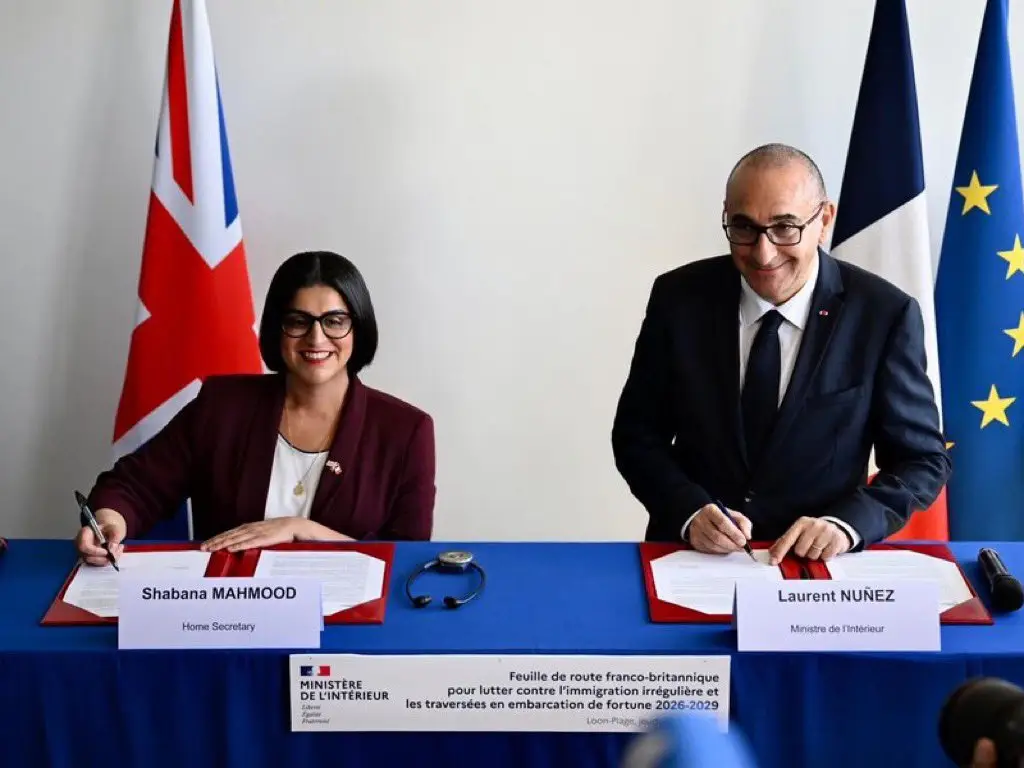
LONDON – Home Secretary Shabana Mahmood and French Minister of the Interior Laurent Nunez signed a landmark bilateral agreement on April 23, 2026, committing both countries to a significant strengthening of operations to combat illegal migration across the English Channel. The agreement, described as historic by the UK Home Office, will substantially increase the human, technological, and intelligence resources dedicated to preventing illegal crossings from northern France to the United Kingdom over the 2026–2029 cycle.
The signing builds upon existing cooperation that has already produced measurable results. Since the 2024 UK general election, joint UK-France action has prevented more than 42,000 illegal migrants from crossing the Channel. The joint intelligence and policing unit known as the GAO — comprising 18 personnel — led to the arrest of 480 smugglers in 2025 alone. Both governments described these as encouraging results and said the new agreement is designed to go significantly further.
The financial architecture of the new partnership is structured in two distinct components. A core commitment of £500 million (approximately €580 million) will be invested to strengthen the overall control system in northern France, funding personnel, infrastructure, and surveillance capabilities. An additional £161 million (approximately €187 million) has been set aside to fund new actions, but this tranche is explicitly tied to impact: if the new measures do not yield sufficient results, based on a joint annual evaluation, the funding will be redirected toward alternative actions proven to be more effective.
Interior Minister @LaurentNunez signed a triennial France-UK agreement for 2026-2029 yesterday with @ShabanaMahmood, to step up cooperation between our two States and boost the fight against illegal and dangerous Channel & North Sea crossings. pic.twitter.com/byydUGXpoT
— Hélène Duchêne (@AmbDuchene) April 24, 2026
For the first time in the history of UK-France Channel migration cooperation, the UK funding will include a flexible component specifically designed to support actions that strengthen the overall effectiveness of the scheme. Both governments will conduct regular joint evaluations to analyse the impact of all measures on reducing the flow of illegal immigration across the Channel.
One of the most significant elements of the new agreement is the planned 53% increase in personnel deployed on the ground in northern France. Under the outgoing 2023–2026 cycle, 907 personnel from the French police force, intelligence services, and maritime prefecture have been deployed. Under the incoming 2026–2029 cycle, this will rise to 1,392 — a net addition of 485 officers dedicated to preventing illegal crossings.
As part of this expansion, a new specialised unit is being created: the SIPAF (Interministerial Border Police), comprising 80 personnel dedicated specifically to the fight against illegal immigration along the northern French coast. In parallel, the existing GAO intelligence and judicial police unit — which drove the arrest of 480 smugglers in 2025 — will be expanded from 18 to 30 personnel to intensify operations against smuggling networks in the northern zone. A dedicated CRS unit managed by France will also be established for the fight against illegal immigration.
The new partnership will see the deployment of a range of new technologies specifically aimed at reducing the number of departures of small boats — including water taxis — from the French coast. This includes enhanced use of drones, helicopters, and electronic surveillance means to better detect and prevent crossing attempts before they occur.
Significant real estate and infrastructure investments are also included in the agreement. The completion of a new administrative detention centre in Dunkirk and the construction of a new CRS cantonment facility in Calais are part of the package, both designed to increase the operational efficiency of police forces in the two key departure zones along the northern French coast. French Interior Minister Nunez noted that a large portion of the new resources will be concentrated from the beginning of summer and throughout the summer period, which is traditionally the busiest season for small craft crossings.
Beyond the immediate focus on northern France, the agreement also reflects a shared commitment to tackling illegal immigration further upstream — in countries of origin and transit. Both governments have expressed a desire to strengthen joint actions at these earlier stages of migration routes to reduce the overall flow toward the Channel before migrants reach France.
Both the UK and France acknowledged the broader European dimension of the Channel migration challenge. As the Channel serves as an external border of the European Union, the bilateral partnership is framed as part of wider European cooperation. French Interior Minister Nunez specifically welcomed the commitment of Frontex — the EU border and coast guard agency — and expressed a desire for its involvement to be amplified as part of stronger European-level surveillance of the EU's external frontier. Both countries stated their intention to deepen this European collaboration alongside the bilateral framework.
Home Secretary Mahmood stated that collaboration with France had already prevented tens of thousands of illegal migrants from boarding boats bound for Britain, while acknowledging the need to go further. She described the new agreement as one that would prevent illegal migrants from making the perilous journey and put smugglers behind bars.
The agreement was also framed by the UK government as complementing a wider set of domestic immigration reforms undertaken since coming to power. The UK Home Office noted that nearly 60,000 illegal migrants and foreign criminals have been returned or deported since the current government took office — an increase of 31%. Immigration enforcement measures targeting illegal working have reached levels described as unprecedented in British history, with an 83% increase in arrests and a 77% increase in police interventions. The government is also closing all reception hotels for asylum seekers and transferring them to accommodation centres, particularly those on former military sites.