More than 30 nations met at the UK’s Northwood headquarters to draft a UK-France-led plan to reopen the Strait of Hormuz, focusing on command, mine-clearing and deployment amid ongoing disruption to energy markets and supply chains.
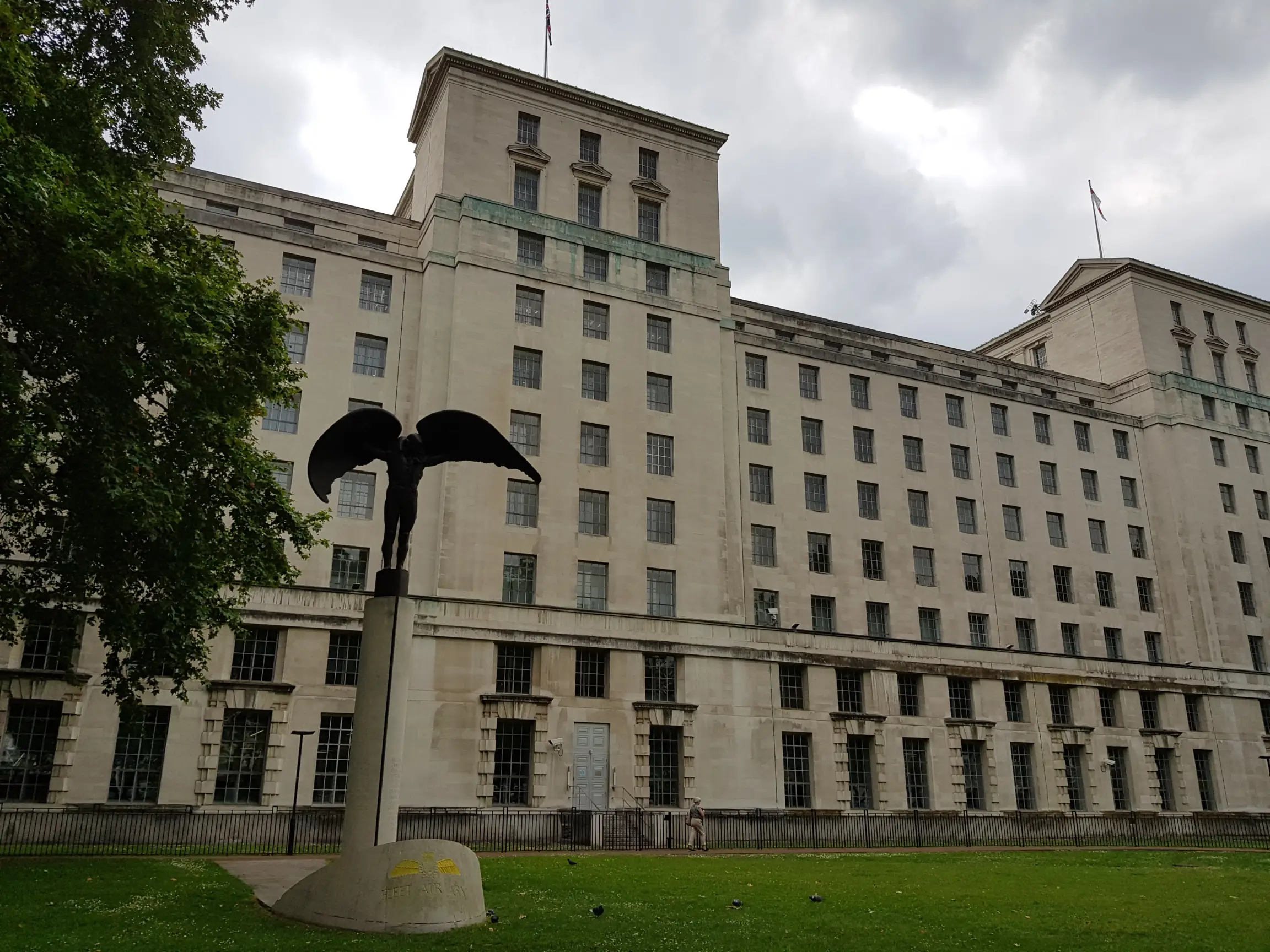
Photo Credit: Wikimedia Commons
LONDON — Military planners from more than 30 nations gathered at the United Kingdom’s Permanent Joint Headquarters in Northwood, North London on Wednesday for a two-day conference co-led by the United Kingdom and France, as Western powers and their partners move from diplomatic consensus to operational planning in response to the effective closure of the Strait of Hormuz. The conference, announced by the UK Ministry of Defence, represents the most concrete multilateral military coordination effort since the crisis in the strait intensified, and is designed to produce an actionable plan that can be triggered once a sustainable ceasefire is in place.
The sessions follow a major international summit convened in Paris last week by UK Prime Minister Keir Starmer and French President Emmanuel Macron, at which representatives of 51 nations endorsed a call for the immediate and unconditional reopening of the Strait and agreed to the formation of a strictly defensive multinational maritime mission. The London conference is tasked with converting that political commitment into a coherent operational architecture.
|
London Conference — Key Facts |
|
|
Venue |
Permanent Joint Headquarters, Northwood, North London |
|
Date |
April 22–23, 2026 (two days) |
|
Co-hosts |
United Kingdom and France |
|
Participants |
Military planners from 30+ nations |
|
Preceded by |
51-nation Paris Summit, week of April 14, 2026 |
|
Mission type |
Strictly defensive multinational maritime mission |
|
Key tasks |
Protecting commercial shipping, mine-clearing, restoring safe passage |
|
Activation trigger |
Sustainable ceasefire in the Strait region |
|
Strait’s global role |
Handles approximately one-fifth of global oil supply |
From the Paris Summit to Northwood: Translating Diplomacy into Action
The Northwood conference represents a deliberate escalation in pace and specificity from the Paris summit of the previous week. Where the Paris gathering produced political declarations and a framework of shared intent among 51 countries, the London sessions are focused on the harder operational questions that any real-world mission would require: who commands, how forces are deployed, how mine-clearing assets are coordinated, and what the communication and escalation protocols look like when the mission goes live.
UK Defence Secretary John Healey framed the conference’s purpose in unambiguous terms, emphasising that the urgency derives from economic as much as strategic considerations.
“Today’s multinational planning conference matters. The task is to translate diplomatic consensus into a joint plan to safeguard freedom of navigation in the Strait and support a lasting ceasefire.”
— John Healey, UK Defence Secretary
Healey underscored that global trade, energy security and economic stability are directly tied to uninterrupted passage through the Strait, and that the disruption attributed to Iran’s actions has already driven up energy prices and strained supply chains across the world. The conference, in his framing, is as much about preventing further economic damage as it is about projecting military readiness.
Strategic and Economic Stakes: One-Fifth of Global Oil Supply at Risk
The Strait of Hormuz, the narrow waterway between Iran and Oman connecting the Persian Gulf to the Gulf of Oman and the wider Indian Ocean, is the world’s single most critical energy chokepoint. Approximately one-fifth of global oil supply — and a significant share of liquefied natural gas exports from Qatar and the UAE — transits the Strait in normal conditions. Its effective closure to commercial traffic has sent ripple effects through energy markets worldwide, with consequences felt acutely in import-dependent economies across Asia, Europe and beyond.
For countries like India, which rely heavily on Gulf energy imports and whose companies have extensive maritime trade through the Strait, the disruption carries immediate economic consequences. The India–South Korea bilateral summit in New Delhi earlier this week specifically referenced the need to stabilise energy supply chains in response to the situation, with the two governments agreeing to cooperate on naphtha supply security as a direct response to the Hormuz disruption.
?? Why the Strait of Hormuz Matters
The Strait of Hormuz is the only sea passage from the Persian Gulf to the open ocean. At its narrowest, it is approximately 33 kilometres wide. Roughly 21 million barrels of oil pass through it daily in normal conditions, representing about 21% of global petroleum liquids consumption. Its closure affects energy prices, shipping insurance rates and supply chains across every major economy.
Mission Design: Defensive, Multinational and Triggered by Ceasefire
Officials have been careful to characterise the proposed mission as strictly defensive in nature, emphasising that its purpose is the protection of commercial shipping and the restoration of safe passage rather than any offensive posture toward Iran. The mission’s three core tasks as endorsed at the Paris summit are: protecting commercial vessels transiting the Strait, reassuring maritime operators and insurers sufficiently to restore normal shipping traffic, and conducting mine-clearing operations to physically remove hazards to navigation.
The crucial design feature of the mission is its activation trigger: it is explicitly intended to be deployed only after a sustainable ceasefire has been achieved. This framing is intended to prevent the multinational military force from itself becoming a source of escalation, while ensuring that the coalition is operationally ready to move swiftly the moment diplomatic conditions allow. Analysts have noted that the speed of deployment in the immediate post-ceasefire window could be decisive in determining whether global shipping confidence is restored quickly or whether the economic damage of the closure persists long after the military conditions for reopening have been met.
Coalition Building and the Road Ahead
The conference’s two-day agenda covers the full spectrum of operational planning requirements: command and control structures determining which nation’s headquarters assumes overall coordination; force generation and deployment logistics specifying which countries contribute which assets; and coordination mechanisms ensuring that vessels from 30 or more different national navies can operate together seamlessly in a confined and contested waterway.
Officials said the UK and France are working to ensure the broadest possible international participation, leveraging the specific operational expertise and geographic reach of partner nations. Countries with significant naval capabilities in the Indian Ocean and Gulf region, experience in mine-clearing operations, and existing maritime patrol infrastructure are understood to be particularly valued contributors to the planning process.
The outcome of the Northwood conference is expected to form the basis for a military plan that can be presented to political leaders for endorsement, and subsequently placed on standby pending the diplomatic breakthrough that would authorise its execution. Analysts warn that the longer the Strait remains effectively closed, the deeper the structural damage to global supply chains, and that the economic case for ensuring readiness to reopen it quickly is at least as compelling as the strategic one.
? Regional Context
The current Hormuz crisis has been attributed to Iranian actions amid ongoing regional tensions, and coincides with the conflict between the United States and Iran referenced in multiple diplomatic communiqués this week. India and South Korea, both energy-import-dependent nations, separately flagged cooperation on supply chain resilience as a direct response to the disruption at their bilateral summit in New Delhi on April 20.