A landmark 2026 UNESCO global assessment reveals its 2,260-site network — spanning 13 million square kilometres — is buffering biodiversity collapse, storing 240 gigatons of carbon, yet 90% of sites face critical environmental stress by 2050.
PARIS – In the first comprehensive global assessment of its kind, the United Nations Educational, Scientific and Cultural Organization has released findings that frame its internationally designated sites network as one of humanity's most vital instruments against environmental collapse. Examining World Heritage Sites, Biosphere Reserves, and Global Geoparks as a single, interconnected system for the first time, the landmark April 2026 report title "People and Nature in UNESCO-Designated Sites" presents a sobering contrast between the deterioration unfolding across the broader planet and the relative stability maintained within UNESCO-protected territories.
The most striking finding is demographic in scale and ecological in significance. While monitored wildlife populations globally have plummeted by 73% since 1970, populations within UNESCO-designated sites have remained comparatively stable on average. This divergence establishes the network not merely as a repository of scenic landscapes or cultural monuments, but as an active, functioning mechanism for sustaining planetary life-support systems at a time when those systems are under acute and accelerating strain.
The network now encompasses more than 2,260 sites across over 175 countries, covering an extraordinary 13 million square kilometres — an area larger than China and India combined — and spanning all of the world's biomes. These territories sustain the livelihoods of approximately 900 million people, roughly 10% of the global population, while areas containing these sites generate approximately 1% of global Gross Domestic Product.
The network operates through three distinct but mutually reinforcing designations. World Heritage Sites, numbering more than 1,240, represent the highest tier of global protection for places of Outstanding Universal Value to humanity, encompassing both cultural and natural heritage. Biosphere Reserves, with more than 780 sites covering the largest spatial footprint of over 7.5 million square kilometres, function as living laboratories, using a unique zonation system of core, buffer, and transition areas to balance strict conservation with community-driven sustainable development. UNESCO Global Geoparks, established in 2015 and now numbering more than 220, protect Earth's geological heritage while fostering sustainable local economies through geotourism.
In exceptional cases, single regions carry multiple designations that together manage the full complexity of their ecological and cultural values. Jeju Island in the Republic of Korea, for instance, holds all three designations simultaneously, protecting volcanic landscapes while sustaining the centuries-old traditions of the island's haenyeo women divers. The Serengeti-Ngorongoro landscape in Tanzania similarly holds all three, safeguarding the world's most celebrated animal migration routes alongside the pastoral way of life of the Maasai people.
The ecological significance of the network is immense. Over 60% of all globally mapped species can be found within it, and 40% of those are endemic. The network harbours roughly 3 million square kilometres of Key Biodiversity Areas, an expanse equivalent to the size of India. For the planet's most threatened and iconic megafauna, these territories often represent a last viable refuge. The report estimates that UNESCO-designated sites support up to one-third of the last remaining wild elephants, tigers, and giant pandas, and at least 10% of all great apes, giraffes, lions, rhinos, and dugongs.
The results of sustained, community-driven conservation efforts within the network are measurable. In the Democratic Republic of the Congo's Virunga National Park, local tracker programmes and community monitoring have produced a 5% annual population growth over the past decade for endangered mountain gorillas. The sites also serve as critical nodes along global migration corridors. Mexico's Monarch Butterfly Biosphere Reserve provides the essential overwintering habitat for up to a billion butterflies migrating annually from as far as Canada, while the Wadden Sea and Yellow Sea areas anchor vital global bird migration flyways.
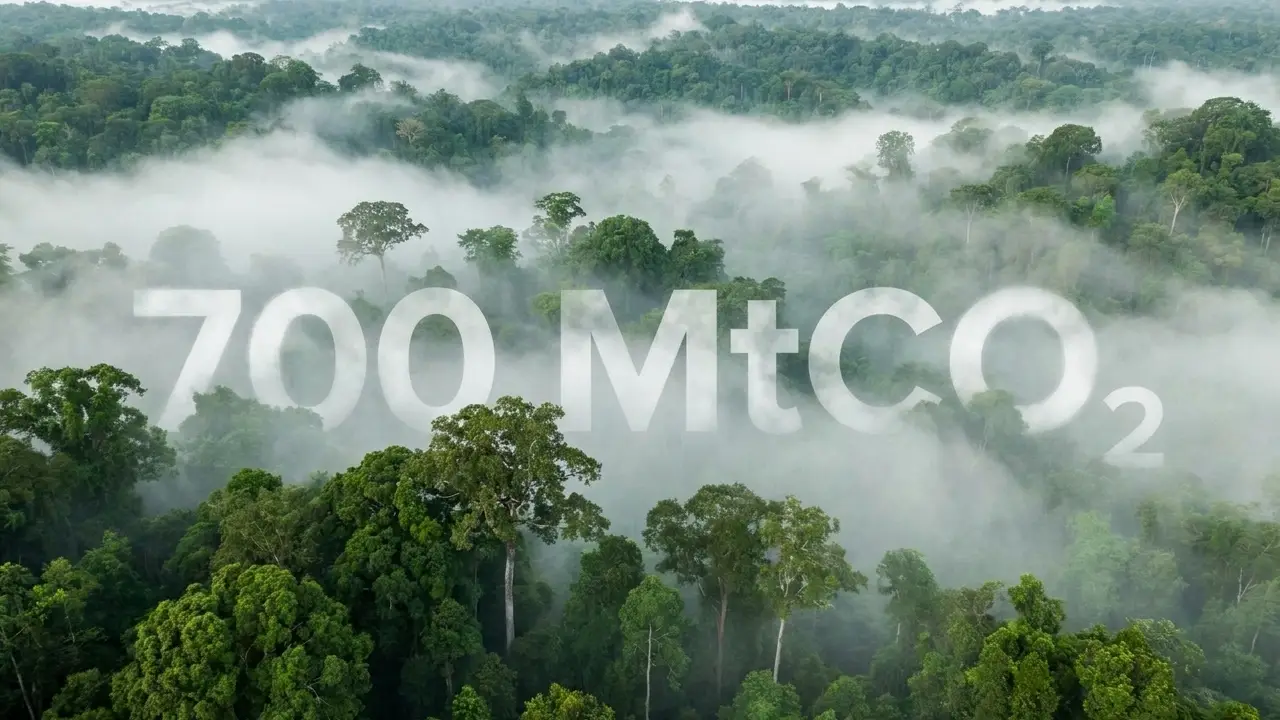
The network's role in global climate stabilisation is equally significant. UNESCO-designated sites absorb an estimated 700 million tonnes of CO2 net each year, an amount equivalent to the total annual fossil-fuel emissions of Germany. Cumulatively, the forests, soils, and sediments within these territories store 240 gigatons of carbon — more than two decades' worth of the world's current total fossil-fuel CO2 emissions.
Beyond their function as living carbon stores, the sites serve as irreplaceable archives of the planet's 3.5-billion-year evolutionary history. More than 30,000 fossil species have been identified within the network, representing approximately 10% of all described fossils to date. From the ancient stromatolites in Australia's Shark Bay to the Chicxulub asteroid impact record preserved in Denmark's Stevns Klint, and from early human remains to the oldest known art in Spain's Cave of Altamira, the network holds the essential testimony of life on Earth.
The relationship between nature and human culture is inseparable within UNESCO territories. The network is home to more than 1,000 languages, representing roughly 15% of the world's living languages. Critically, at least 25% of UNESCO-designated sites encompass Indigenous Peoples' Lands and Territories, and the report underscores how Indigenous knowledge and traditional stewardship are foundational — not supplementary — to ecological resilience in these areas.
In Cameroon's Dja Faunal Reserve, the Baka people's deep ecological knowledge sustains a way of life in harmony with the forest. In Japan's Toya-Usu Global Geopark, Ainu families map their landscape through spiritual and linguistic practices. In the Solomon Islands, the East Rennell site is managed under customary ownership by Polynesian communities whose seasonal knowledge guides sustainable fishing and agriculture. Living cultural practices such as the construction of reed Al-Mudhifs by Marsh Arab communities in the Ahwar of Southern Iraq, and the ancient tree beekeeping traditions of the Bialowieza Forest in Belarus and Poland, further demonstrate the enduring synergy between traditional human ingenuity and natural ecosystems.
Despite the network's proven resilience, the 2026 assessment delivers a stark warning. Nearly 90% of UNESCO-designated sites are currently experiencing high levels of environmental stress. While agricultural expansion and logging were historically the primary pressures, the threat landscape has evolved rapidly. Fires are now the leading driver of forest loss, with over 300,000 square kilometres of tree cover lost across the network since 2001. Invasive species have penetrated more than 80% of all sites.
Climate change is amplifying every existing pressure. Since the year 2000, 98% of UNESCO sites have experienced at least one extreme climate event, most commonly extreme heat. Glaciers within the network have lost more than 2,500 gigatons of ice since 2000, contributing over 5% to global mean sea level rise, while mountain glaciers have shed 9% of their total volume. The oceans surrounding designated sites are approximately 10% more acidic than they were at the turn of the millennium.
The report's most urgent finding is this: if current trajectories hold, natural systems in more than one in four sites could reach critical and potentially irreversible tipping points by 2050. These include the functional disappearance of tropical glaciers, the collapse of coral ecosystems through annual severe bleaching, and the transformation of forests from carbon sinks into net carbon sources. However, the report also offers a note of cautious hope, stating that every 1 degree Celsius of warming avoided could halve the number of sites exposed to major disruption by the end of the century.
UNESCO's assessment concludes with concrete pathways for action. Up to 150,000 square kilometres of degraded forest within Biosphere Reserves could be restored, potentially sequestering 1.2 gigatons of carbon over the next three decades. Transboundary cooperation — where the number of joint sites has more than doubled since 2000 to over 50 — must expand further, as seen in the trinational ecological corridor work of the Trifinio-Fraternidad Biosphere Reserve spanning El Salvador, Guatemala, and Honduras.
The network must also be more strategically mobilised to translate global policy commitments into local action. Over 80% of countries' National Biodiversity Strategies already reference UNESCO sites, and nearly half of all Nationally Determined Contributions under the Paris Agreement explicitly include them. Scientific capacity must be strengthened in tandem, building on initiatives such as the UNESCO eDNA citizen science expeditions that have already demonstrated the ability to detect 10 to 20% of expected marine species in single sampling campaigns.
The ultimate conclusion of the assessment is unambiguous: protecting and investing in UNESCO-designated sites is no longer a matter of cultural heritage or conservation preference. It is an existential imperative — one that safeguards humanity's most proven mechanisms for surviving the deepening crises of the 21st century.