When institutions fail and grievances go unheard, people turn to civil society. Not because it holds power, but because it has earned trust. That trust, however, is not permanent — and some will work hard to destroy it.
Civil society organisations (CSOs) are, in many ways, the connective tissue of a healthy democracy. They give ordinary people a collective voice where individual voices go unheard. They hold the state accountable without being part of it. They carry community concerns into rooms where communities themselves are rarely invited. In places like Manipur — where identity, public sentiment, and political tension run deep — CSOs are often the only organised force standing between a citizen's grievance and official silence. Without them, legitimate anger has nowhere to go except inward, or toward chaos.
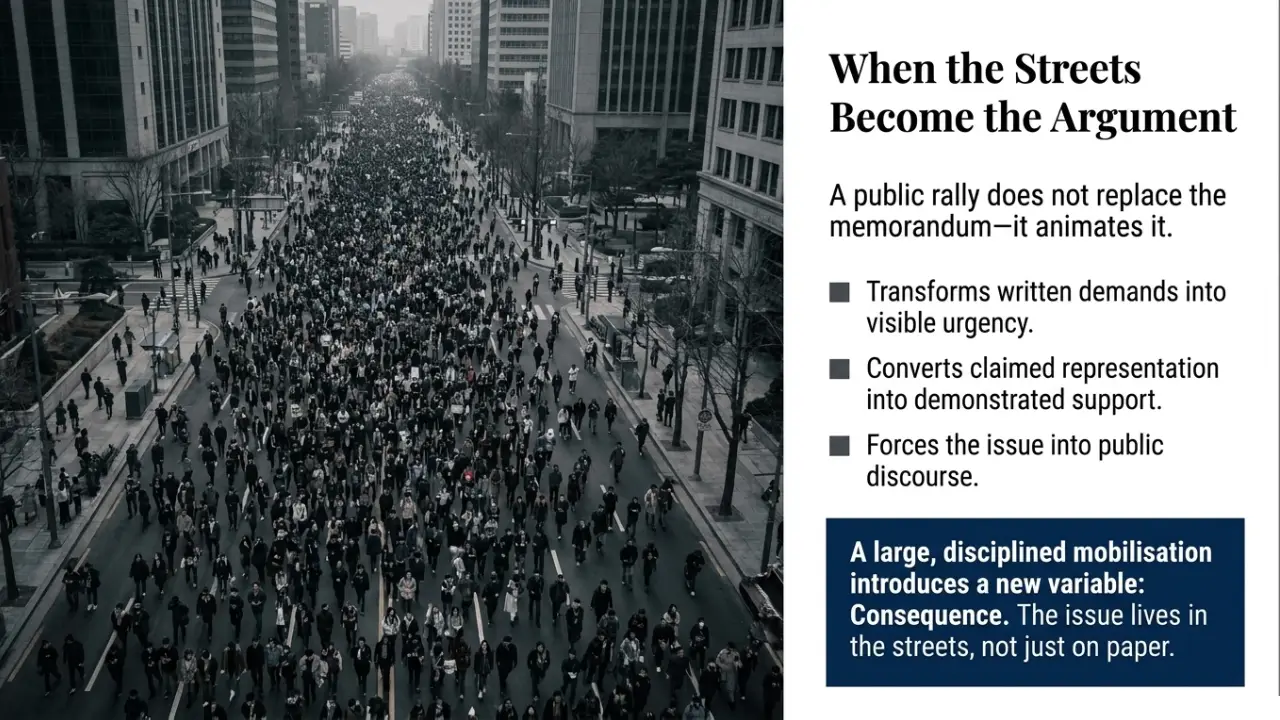
Public rallies are the visible expression of that collective voice. They are not simply theatre. When people gather in numbers — peacefully, purposefully — they send a signal that cannot be easily ignored or reframed. A rally says: this is real, this is widespread, and this will not quietly disappear. It shifts the political calculus. It reassures those who feel isolated that they are not alone. And it reminds the state that public patience has limits. History is filled with turning points that began not in negotiation rooms, but in the streets.
But that power comes with responsibility.
The attacks on CSOs rarely come head-on. They begin as whispers — allegations of bias, insinuations about leadership, suggestions of hidden agendas. None of it needs to be proven. Repetition alone does the damage. Suddenly, the public conversation shifts from the original grievance to whether the organisation raising it can be trusted. The cause is sidelined. The messenger is on trial.
More dangerous still is infiltration. When outside actors embed themselves in a movement, the results are predictable: mixed messages, inconsistent tactics, emotional outbursts that overshadow strategy. A disciplined public voice starts to sound chaotic. Supporters grow uncertain. The state, which was under pressure to respond, now has an excuse to stall.
This is how movements are quietly dismantled — not by force, but by manufactured doubt.
Civil society's greatest strength — its openness — is also its vulnerability. It cannot fall back on legal authority or institutional inertia. It runs on belief. And belief is fragile.
But fragility is not the same as weakness.
CSOs must now lead on two fronts at once. The first is familiar: articulate the grievance clearly, mobilise public support, and engage the state with both reason and pressure. The second is newer and less comfortable: actively protect the integrity of the movement itself.
That means monitoring the narrative, correcting misinformation quickly, and distinguishing genuine public anger from engineered disruption. Silence is not neutrality — it is an open door.
Mobilisation still matters, but numbers alone are not enough. A large, undisciplined gathering can do more harm than good. Methods must match the message. The CSO's job is not just to gather people — it is to keep the movement coherent.
The uncomfortable truth is this: governments rarely act on reason alone. They act when reason is backed by sustained, visible, organised pressure. That pressure must be maintained without losing discipline or moral authority.
The future of civil society will not be won by the loudest voice. It will be shaped by the most consistent one — evidence-based, ethically grounded, and resilient in the face of attempts to break it.
A CSO must be spine, compass, and now shield. Without all three, movements collapse from within — not because their cause was wrong, but because they were unprepared for the fight they were actually in.