On the boundary between enforcement and excess — and what it costs a state to cross it
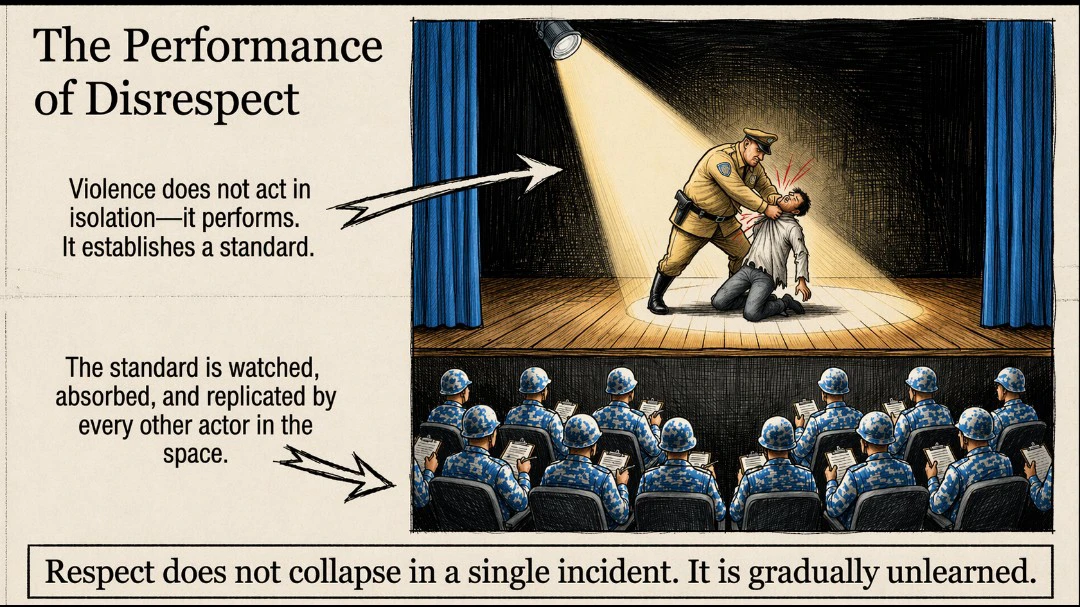
There is a moment in every protest when the State must decide what it stands for. Not when slogans rise, or when crowds press forward. But when a protester is already subdued—hands restrained, resistance spent—and the blows continue anyway. That moment draws a line between enforcement and excess, between authority and its abuse.
In Manipur’s valley, that line has been crossed too often to call it an aberration.
What is happening is not simply the use of force. It is the normalisation of force after control has already been secured. That distinction matters enormously. Once a citizen is in custody, the law permits no further punishment in the name of order. Any violence beyond that point is not policing. It is the quiet erosion of constitutional duty.
But the deeper damage is rarely recorded in official reports.
Respect does not collapse in a single incident. It is gradually unlearned.
When a force treats its own people with diminished restraint, it does not act in isolation—it performs. It establishes a standard, one that is watched, absorbed, and replicated by every other actor operating in the same space. Respect does not collapse in a single incident. It is gradually unlearned.
And from that unlearning, a troubling logic follows.
If local lives appear negotiable at the hands of local authority, why would those arriving from outside feel bound to treat them differently? When the first lesson is delivered not in words but in boots pressed against subdued bodies, the message travels well beyond the street. It settles into assumption: that the worth of these citizens is conditional, that their dignity is available for revision.
This is how institutional disrespect takes root—not through policy alone, but through precedent.
To be clear: policing protests is not simple. Officers work under pressure, confronting provocation, uncertainty, and genuine risk. The State has both the right and the responsibility to maintain order. But that responsibility does not extend beyond the moment control is established. Discipline is not tested in chaos—it is revealed in the exercise of power over those who can no longer resist.
When power forgets that boundary, it begins to forfeit its legitimacy.
A society that watches its own people handled without dignity cannot be expected to believe in the fairness of the institutions that govern it.
The cost, if this continues, will not be measured only in injuries. It will be paid in something far harder to rebuild: public trust. A society that watches its own people handled without dignity cannot be expected to believe in the fairness of the institutions that govern it. Once that belief fractures, even legitimate authority will be met with suspicion—and will have earned it.
The question, then, is not whether force may be used.
It is whether the State still knows where it must stop.
Because the true measure of authority is not the firmness with which it controls its people. It is the restraint it exercises when those people can no longer fight back.