A child does not understand why her eyes will not stop streaming, why the sound split through her sleep, or why her mother is pulling her under a wet cloth in the dark. She understands only one thing: that her home is no longer safe. And that understanding, once formed, does not easily leave.
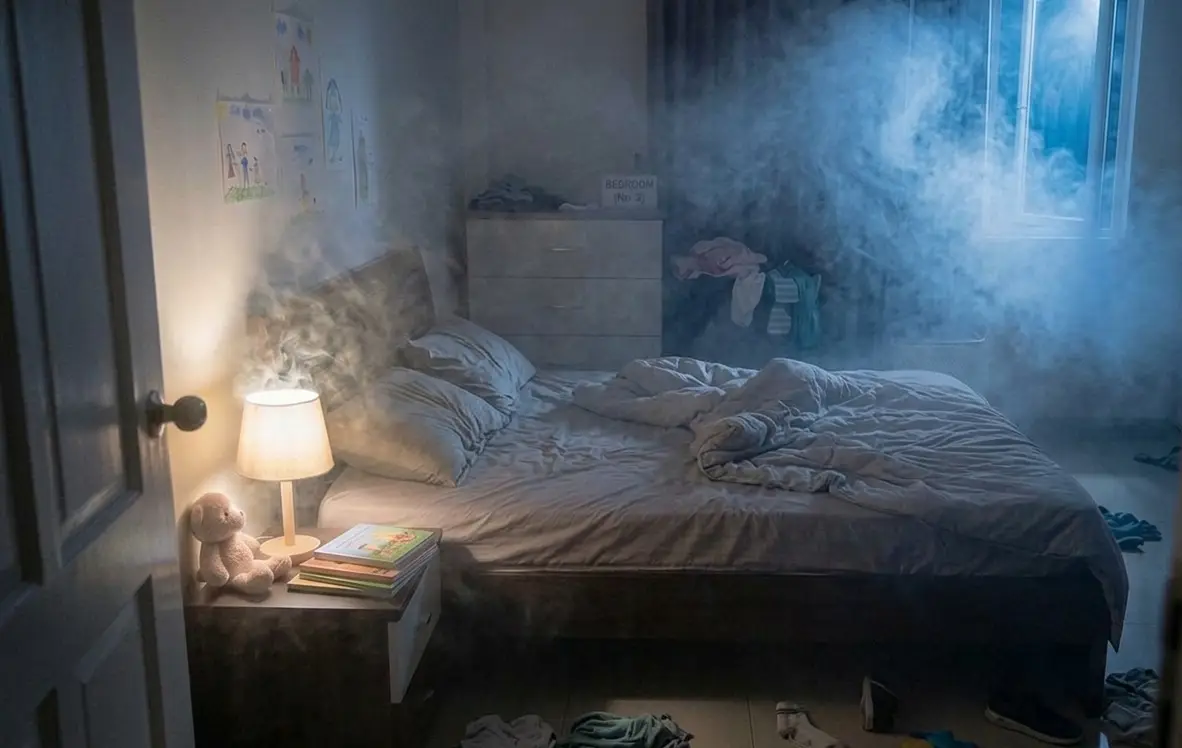
Across several localities in Manipur, children are living through exactly this. Tear gas shells, smoke bombs, and explosive dispersal devices deployed during late-night clashes are extending well beyond protest sites into the residential neighbourhoods that surround them — reaching through walls, through windows, and into homes where children are sleeping. The Manipur Commission for Protection of Child Rights has taken suo motu cognizance of the issue after a minor sustained injuries from tear gas exposure, describing the use of force as indiscriminate and calling for restraint in areas where civilians are present. Its advisory is welcome. But it is also, at this stage, an understatement of the problem.
¦ WHAT THE SCIENCE SAYS
The classification of tear gas and related riot control agents as "non-lethal" has long been a bureaucratic convenience that the clinical evidence struggles to sustain. That classification was derived largely from studies conducted on healthy young men under controlled conditions — not on children sleeping in their homes, not on infants, not on elderly residents with compromised respiratory systems. Real-world exposure data tells a different story. Research published in BMC Public Health found that 93.3 percent of those exposed to riot control agents reported immediate physical symptoms, and 86.1 percent experienced persistent or delayed effects one to two days later. Eye burning was reported by 95 percent of respondents. Among those with respiratory distress, more than half described what they called a life-threatening choking sensation.
Critically, the data also establishes a dose-response relationship: health outcomes worsen significantly with repeated exposure. For children in conflict-affected localities in Manipur, where crowd-control deployments have become a recurring feature of daily life rather than an exceptional response, this is not a theoretical concern. It is the lived reality. And for developing bodies — lungs still growing, nervous systems still forming — the implications are more serious than for adults exposed under the same conditions.
Chemical irritants banned in warfare under the Geneva Protocol are being routinely deployed in residential neighbourhoods where children sleep.
¦ THE PSYCHOLOGICAL WOUND
The physical harm is measurable. The psychological damage is harder to quantify — and easier, as a result, to ignore. Child psychology research is consistent on this point: sudden loud noise, chemical irritation, and visible panic among trusted adults are among the most potent triggers for acute fear responses in children. When these events occur not once but repeatedly, in the environment a child has been taught to regard as safe, the damage compounds in ways that persist long after the physical symptoms resolve.
Research on protest-affected communities in the United States found that 56.3 percent of those who were merely incidentally exposed to crowd-control environments — bystanders, not protesters — suffered psychological injuries. That figure is significant because it underscores something that is often overlooked in the debate about crowd control: the harm does not stay at the protest site. It travels home. It sits in the bedroom. It wakes children at 3 am when a sound outside sounds like what they heard last week. Sleep disturbances, heightened anxiety, and hypervigilance can develop after a single severe incident. Repeated exposure shifts the clinical picture toward something that more closely resembles childhood post-traumatic stress.
Experts warn that prolonged exposure to such stressors, without adequate psychological support, can interfere with cognitive development and social behaviour. Manipur does not currently have any systematic programme to monitor or address the psychological impact of the ongoing conflict on children in affected areas. This is a gap that must be named for what it is: a policy failure.
¦ THE ACCOUNTABILITY QUESTION
Security forces maintain that crowd-control measures are necessary to manage escalating protest situations. This editorial does not dispute that crowd management has a legitimate role in public order. What it disputes is the framing that treats residential deployment of chemical irritants as an unavoidable consequence of that role, rather than as a choice — one with documented, serious, and disproportionate consequences for people who are not part of any protest.
There is also a strategic argument, not merely a humanitarian one, for calibrated restraint. Research modelling protest dynamics has found that deployments of kinetic impact projectiles and chemical dispersal agents, rather than reducing unrest, have been statistically associated with significant increases in subsequent protest activity. The Department of Justice's assessment of the Ferguson, Missouri response reached the same conclusion: heavy-handed tactics escalated, rather than resolved, social tension. The evidence that force-first crowd management is counterproductive — on its own terms, as crowd management — is substantial. Manipur's authorities would do well to engage with it.
¦ WHAT MUST FOLLOW
The MCPCR advisory is a starting point. It should be followed by three concrete steps. First, mandatory exclusion zones must be established around residential buildings, schools, and hospitals when crowd-control devices are deployed — and those zones must be enforced, not merely stated as policy. Second, systematic monitoring of health impacts on children and other vulnerable populations must begin, with data collected, published, and acted upon. The current monitoring vacuum is not a neutral absence; it is an active facilitation of ongoing harm. Third, psychological support must be made available to children in affected localities as a public health measure, not a charity. The state has an obligation to children it has harmed through the conduct of security operations in their neighbourhoods. Acknowledging that obligation is the minimum required. Acting on it is what will matter.
The MCPCR has spoken. The research is unambiguous. What remains is the will to protect children as though their wellbeing were a legal obligation — because it is.
Manipur's crisis is political, ethnic, constitutional, and humanitarian all at once. But it is also, right now, a child rights crisis — one unfolding not at the front of any march but in the lungs and the sleeping minds of children who had no say in any of it. Institutional acknowledgement is not enough. What these children are owed is a state that operates within its own laws, exercises force with proportionality, and takes seriously the damage it is doing to the youngest people in its care.