Amidst Manipur’s humanitarian crisis, narcotics trafficking has transitioned into a sophisticated, militarized industry. Intelligence indicates a shift toward localized production, standardized logistics, and the exploitation of infrastructure to fund insurgent activities
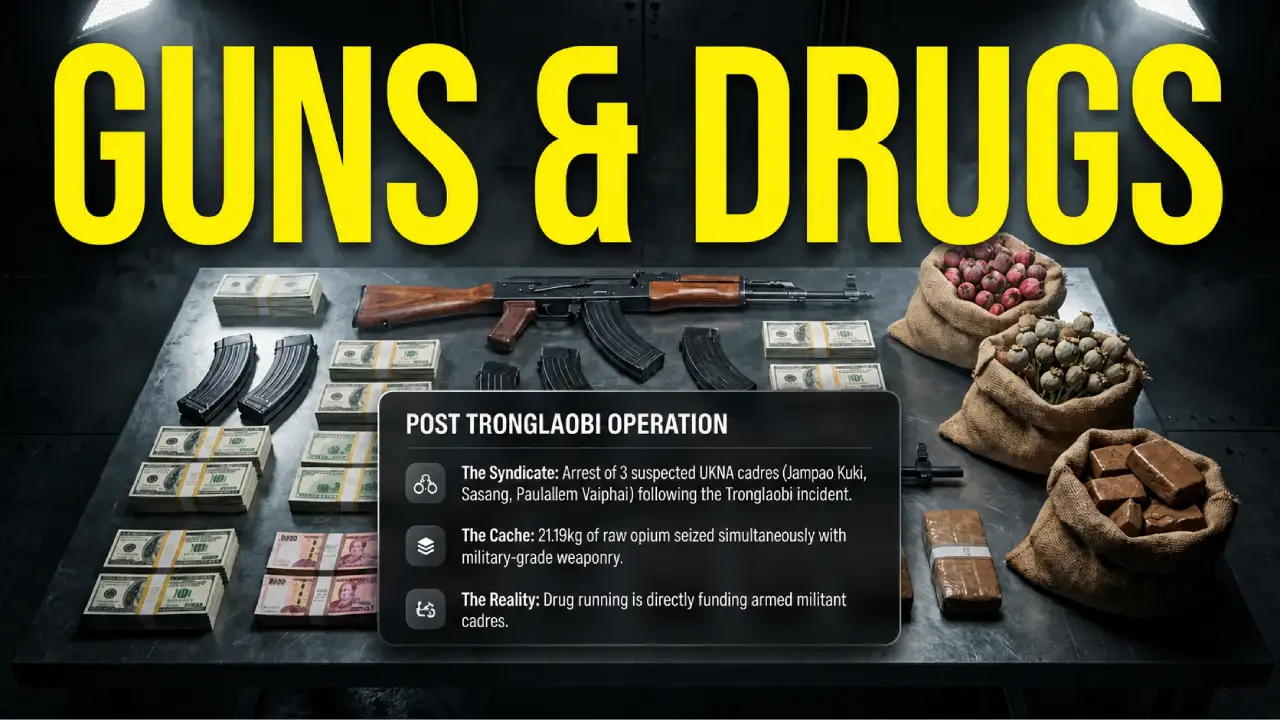
Representational Image
The analytical data from the first four months of 2026 reveals a fundamental transformation in Manipur’s illicit economy, operating against the backdrop of the humanitarian crisis triggered on May 3, 2023. No longer a series of disjointed smuggling attempts, the trade has achieved industrial-scale maturity. This is evidenced by the "Soap Case Paradigm," where standardized packaging units for Heroin No. 4 indicate mid-level repackaging hubs with established quality control. Furthermore, traffickers have adopted a "Two-Tier Logistics Strategy": utilizing heavy commercial vehicles for bulk raw opium on National Highways, while deploying "social camouflage" through premium civilian SUVs—such as the Mahindra Thar and Hyundai Creta—to evade profiling at security interdiction points.
The most critical escalation is the militarization of the supply chain. The co-seizure of AK-47 assault rifles and Pumpi cannons alongside narcotics consignments confirms that trafficking is now a primary revenue stream for armed insurgent groups. This narco-insurgency nexus suggests that territorial control is being leveraged to protect transit corridors, essentially transforming drug logistics into defended insurgent infrastructure. Additionally, the recurring exploitation of Tulihal International Airport as a high-speed corridor to metropolitan hubs like Bangalore and Delhi demonstrates a sophisticated understanding of enforcement gaps. As the state grapples with ongoing social volatility, this convergence of high-value synthetic stimulants, industrial agricultural precursors (1,800 kg of poppy seeds), and transnational procurement networks represents a systemic threat to the sovereignty and stability of the region.
Between January and April 2026, security forces in Manipur carried out an unprecedented volume of narcotics interdictions, revealing a trafficking ecosystem that has crossed the threshold from disorganized smuggling into a fully industrialized, militarized, and nationally integrated supply chain. The diversity and volume of contraband—spanning raw opium, high-purity Heroin No. 4, crystal methamphetamine, and industrial quantities of diverted pharmaceuticals—confirm that the state simultaneously functions as a production zone, a transshipment hub, and a retail distribution terminus.
The enforcement climate of early 2026 is defined by a demonstrable shift in operational posture: multi-agency joint operations have replaced static Naka checkpoints as the primary interdiction mechanism. The operational dividends are directly correlated to enhanced interoperability between the Manipur Police, Assam Rifles (AR), Central Industrial Security Force (CISF), Narcotics Control Bureau (NCB), and the Directorate of Revenue Intelligence (DRI). Despite these successes, the resilience of trafficking networks—evidenced by a constant flow of contraband despite daily arrests—raises a critical analytical question: if security forces are intercepting this volume of product, the true scale of the undetected trade is likely several multiples larger.
|
Metric |
Recorded Figure |
Analytical Significance |
|
Total Raw Opium Seized |
213.09 kg (4 months) |
Bulk transit + localized production |
|
Heroin & Derivatives (weight) |
53.21 kg + 806 unweighed soap cases |
Refined export-grade product |
|
Poppy Seeds |
1,800 kg (April) |
Signals localized manufacturing scale-up |
|
WY (Amphetamine) Tablets |
41.49 kg |
Industrial synthetic distribution |
|
Crystal Methamphetamine |
13.4 kg (March alone) |
High-purity bulk transit node at Moreh |
|
Ganja (Cannabis) |
22.9 kg |
Persistent secondary consumer market |
|
Pharmaceutical Diversions |
56,216 SP capsules; 1,361+ cough syrup bottles; 84.57g Methadone |
Established, diversified consumer base |
|
Arms Recovered (drug-linked) |
AK-47, MP-9, 3 pistols, modified carbine, Pumpi, Lethode tubes |
Narcotic-insurgency nexus confirmed |
|
Cash Seized alongside drugs |
Rs. 4,33,300 (documented instances) |
Direct funding trail for trade operations |
The month-by-month breakdown of seized narcotics reveals pronounced seasonal and operational patterns. Notably, the April surge in raw opium (85.93 kg versus near-zero in March) is directly correlated to the 1,800 kg poppy seeds recovery, signaling a harvesting cycle and a shift toward localized manufacturing. The consistency of heroin seizures across all four months, by contrast, confirms a steady-state transit operation that is independent of seasonal agricultural patterns.
|
Drug Category |
Total Seized Quantity |
|
Opium |
63.954 kg |
|
Heroin & Derivatives |
6.305 kg + 240 unweighed soap cases |
|
WY Tablets (Amphetamine) |
14.244 kg |
|
Pharmaceuticals |
84.57 g Methadone | 46 bottles Cough Syrup (Delstal & Berrycof) | 1 box Nitrazepam tablets |
January establishes the baseline character of the trade: opium-dominant with a significant synthetic stimulant (WY) component. The early appearance of Methadone—a synthetic opioid—confirms that specialized pharmaceutical intoxicants have already penetrated Manipur's local market by the first month of the reporting period.
|
Drug Category |
Total Seized Quantity |
|
Opium |
63.634 kg |
|
Heroin & Derivatives |
24.213 kg + 5 unweighed soap cases |
|
WY Tablets (Amphetamine) |
5.9 kg |
|
Pharmaceuticals |
730 bottles Codeine Phosphate Syrup |
February registers the single largest monthly heroin seizure of the period at 24.21 kg—nearly four times January's figure. The 730 bottles of Codeine Phosphate Syrup seized in Thoubal (February 21) represent the largest single pharmaceutical interception of Q1, underscoring a robust demand for liquid opioid substitutes. The Tulihal Airport interception (4.8 kg heroin, February 27) marks the first confirmed instance of traffickers using domestic aviation as a high-speed distribution corridor.
|
Drug Category |
Total Seized Quantity |
|
Opium |
2.502 kg |
|
Heroin & Derivatives |
9.971 kg + 265 unweighed soap cases |
|
WY Tablets (Amphetamine) |
4.63 kg |
|
Ganja (Cannabis) |
21.8 kg |
|
Crystal Methamphetamine |
13.4 kg |
|
Pharmaceuticals |
56,216 capsules SP (Spasmo Proxyvon) tablets |
March marks a dramatic compositional shift. The near-total collapse of bulk opium seizures (from ~64 kg to 2.5 kg) is offset by the introduction of two entirely new categories: crystal methamphetamine (13.4 kg at Moreh, March 20) and ganja (21.8 kg). This signals either a deliberate operational pivot toward high-value synthetic products or a successful temporary disruption of the primary opium transit route. The 56,216-capsule SP tablet interception (March 17) confirms industrial-scale pharmaceutical distribution into the urban Imphal market (Thangal Bazar).
|
Drug Category |
Total Seized Quantity |
|
Opium |
85.929 kg |
|
Poppy Seeds |
1,800 kg |
|
Heroin & Derivatives |
12.72 kg (+ 0.078 g additional) + 296 unweighed soap cases |
|
WY Tablets (Amphetamine) |
16.72 kg |
|
Ganja (Cannabis) |
1.1 kg |
|
Pharmaceuticals |
631 bottles Cough Syrup (Codeine & CODIVA) |
April represents the most operationally complex and analytically significant month of the period. The 51 kg opium seizure on NH-37 (April 27) and the 1,800 kg poppy seed recovery (April 10) together account for most of the month's opium-category figures. The Tronglaobi incident and subsequent Molphei Tampak operations link narcotics directly to armed UKNA insurgent cadres, confirming the narcotic-insurgency nexus. April also records the period's highest single-month WY tablet seizure (16.72 kg), indicating that amphetamine demand follows an upward trajectory.
|
Drug Category |
Q1 Total |
April 2026 |
Jan–Apr Total |
|
Opium |
130.09 kg |
85.93 kg |
216.02 kg |
|
Poppy Seeds |
— |
1,800 kg |
1,800 kg |
|
Heroin & Derivatives (wt.) |
40.49 kg + 510 soap cases |
12.72 kg + 296 soap cases |
53.21 kg + 806 soap cases |
|
WY Tablets |
24.774 kg |
16.72 kg |
41.49 kg |
|
Crystal Methamphetamine |
13.4 kg |
— |
13.4 kg |
|
Ganja (Cannabis) |
21.8 kg |
1.1 kg |
22.9 kg |
|
Pharmaceuticals |
776 cough syrup bottles; 56,216 SP caps; 84.57g Methadone; 1 box Nitrazepam |
631 cough syrup bottles |
1,407+ bottles; 56,216 caps; 84.57g Methadone |
A diagnostic analysis of the commodity mix confirms a multi-layered trafficking economy. The region serves simultaneously as a production zone for raw opium, a transit corridor for refined heroin destined for the Indian mainland, and a consumption hub for synthetic stimulants and diverted pharmaceuticals. The following tables highlight the highest-impact individual interdictions and their strategic significance.
|
Date |
Location |
Substance |
Quantity |
Significance / Logistics |
|
07.01.2026 |
Churachandpur |
Heroin No. 4 |
4.3 kg (320 soap cases) |
Intercepted by combined Police/DRI team; standardized soap case packaging confirms mid-level repackaging hub |
|
03.02.2026 |
Sangaikot (CCP) |
Raw Opium |
57.7 kg |
Bulk transit intercepted inside a commercial bus; confirms use of public transport for large consignments |
|
23.02.2026 |
Senapati (NH-2) |
Heroin Powder |
840 g |
Arrest of Abu Mohammad Tahir (Assam); inter-state carrier on primary northward highway |
|
27.02.2026 |
Tulihal Airport |
Heroin Powder |
4.8 kg |
Arrest of Suresh & Vijay Singh (Madhya Pradesh); first major airport interception of the period; checked baggage concealment |
|
28.03.2026 |
Ngathal |
Heroin |
Est. batch (DI Tata + Scorpio) |
Combined operation intercepts two high-clearance SUVs; confirms rugged-terrain transport logistics |
|
14.04.2026 |
Tulihal Airport |
Brown Sugar |
6.74 kg |
Md. Sabir Ahamed; 6 containers in checked baggage; CISF-AR-Manipur Airport Police joint operation; confirms repeat exploitation of air corridor |
|
23.04.2026 |
Singhat / Bolkot (CCP) |
Heroin No. 4 |
5.43 kg (474 soap cases) |
Arrest of Hangkhanlian (Gurgaon, Haryana); peak soap case volume interception; direct NCR-Manipur supply chain link |
|
27.04.2026 |
Jiribam (NH-37) |
Raw Opium |
51 kg |
Arrest of Sukhvinder Singh (Punjab) & Sandeep Singh (UP); Tata truck; confirms NH-37 as primary bulk opium exit route to Indian mainland |
|
27.04.2026 |
Tulihal Airport |
Heroin No. 4 |
84 g |
Two passengers bound for Bangalore; confirms Imphal-to-metro air trafficking route as an established corridor |
In the logistics architecture of Manipur's narcotics trade, the soap case has become the definitive unit of measurement and the clearest indicator of operational sophistication. These plastic containers—each holding approximately 10 to 12 grams of Heroin No. 4 or Brown Sugar—are not improvised; they represent a standardized, industrial-scale repackaging system. The table below maps the escalation of soap case volume across the reporting period.
|
Date |
Location |
Soap Cases |
Est. Weight |
Transport Used |
|
07.01.2026 |
Churachandpur |
320 |
4.3 kg |
Not recorded |
|
Jan 6,7,10,13,21,23 |
Multiple districts |
240 (unweighed) |
~2.4–2.9 kg est. |
Mahindra Bolero (recurring) |
|
01.04.2026 |
Churachandpur |
232 |
~2.6 kg est. |
Not recorded |
|
23.04.2026 |
Bolkot / Singngat (CCP) |
474 (PEAK) |
5.43 kg |
Not recorded |
|
PERIOD TOTAL |
Jan–Apr 2026 |
806+ |
~9.6 kg+ est. |
Bolero dominant |
The Mahindra Bolero emerged as the unequivocal workhorse of the soap case trade, appearing in major seizures on January 6, 7, 10, 13, 21, and 23. This vehicle consistency—rugged, high-clearance, and visually commonplace in hill district terrain—reflects a deliberate selection strategy. The standardization of both the packaging unit and the transport vehicle is the hallmark of a mid-level repackaging hub with established operational protocols.
|
Date |
Location |
Substance |
Quantity |
Significance |
|
13.01.2026 |
Thoubal |
Methadone |
84.57 g |
Specialized synthetic opioid confirmed in local market |
|
30.01.2026 |
Tengnoupal IVR |
WY Tablets (Amphetamine) |
8.3 kg |
Large-batch transit via interior rural road |
|
21.02.2026 |
Thoubal (Lilong) |
Codeine Phosphate Syrup |
730 bottles |
Largest single pharmaceutical seizure of Q1 |
|
17.03.2026 |
Thangal Bazar, Imphal |
SP (Spasmo Proxyvon) Capsules |
56,216 capsules |
Industrial urban distribution; |
|
20.03.2026 |
Chavangphai, Moreh |
Crystal Methamphetamine |
13.4 kg |
High-purity bulk; Rs. 2,00,000 cash seized; Moreh confirmed as ATS transit node |
|
29.04.2026 |
Tengnoupal IVR |
WY Tablets (Amphetamine) |
12 kg |
Peak-month WY seizure; confirms interior road-based synthetic supply |
Spatial analysis of interdiction data distinguishes between Transit Districts, which facilitate the bulk movement of contraband, and Consumption/Distribution Hubs, which manage the terminal stages of the trade. The following framework maps Manipur's narcotics geography across these functional categories.
|
District / Node |
Classification |
Primary Substance(s) |
Key Intelligence Indicator |
|
Churachandpur (CCP) |
Strategic Epicenter — Transit & Processing |
Heroin No. 4, Raw Opium, Poppy Seeds |
1,800 kg poppy seed recovery (Apr 10) signals localized agrarian-industrial scale-up beyond simple transshipment |
|
Tengnoupal / Moreh |
High-Value ATS Transit Node |
Crystal Meth, WY Tablets, Heroin |
13.4 kg crystal meth recovered at Chavangphai; Rs. 2,00,000 cash confirms high-value commercial hub at the Myanmar border |
|
Imphal West (Tulihal Airport) |
High-Risk Vulnerability Node |
Heroin No. 4, Brown Sugar |
Three confirmed interceptions (Feb 27, Apr 14, Apr 27); air corridor directly links periphery to Indian metro centers |
|
Imphal East & West (Urban) |
High-Value Terminal Distribution Hub |
Pharmaceuticals, Heroin, WY |
Thangal Bazar SP capsule bust (56,216 units); inter-state criminal coordination (Bihar residents arrested) |
|
Jiribam (NH-37) |
Bulk Export Corridor |
Raw Opium |
51 kg opium in Tata truck (Apr 27); Punjab/UP operators; primary exit route to North Indian market |
|
Senapati / NH-2 (Mao) |
Northward Transit Filter |
Heroin Powder, Opium |
T. Khullen and Mao Naka Points intercept out-of-state carriers; 840g heroin (Assam resident, Feb 23) |
|
Thoubal |
Pharmaceutical Diversion Hub |
Codeine Syrup, Heroin, Methadone |
730 Codeine bottles (Feb 21) and arms-drug co-seizures confirm dual function as distribution and armed transit node |
|
Chandel |
Rural Entry Point / Militarized Zone |
Brown Sugar, Opium |
Mombi (Molcham-PS) cash-drug seizure (Jan 19); proximity to armed group operational areas |
The most alarming tactical shift in the reporting period is the growing and sustained exploitation of Tulihal International Airport (Imphal). The infiltration of a high-security aviation environment represents either a sophisticated intelligence failure on the part of traffickers regarding enforcement gaps, or a deliberate operational response to increasingly effective road-based Naka interdiction. Three confirmed interceptions within a 59-day window (February 27 to April 27) confirm that this is not opportunistic but an established trafficking route.
|
Date |
Individuals Arrested |
Origin / State |
Substance & Qty |
Destination / Method |
|
27.02.2026 |
Suresh, Vijay Singh |
Madhya Pradesh |
4.8 kg Heroin Powder |
Pre-boarding interception; checked baggage |
|
14.04.2026 |
Md. Sabir Ahamed |
Not specified |
6.74 kg Brown Sugar (6 containers) |
CISF-AR-Airport Police joint operation; checked baggage |
|
27.04.2026 |
Two passengers (unnamed) |
Destination: Bangalore |
84 g Heroin No. 4 |
Bangalore-bound flight; confirms metro-link distribution model |
The 2026 data provides unambiguous confirmation that narcotics trafficking in Manipur is not merely a criminal enterprise: it is a primary funding and logistics mechanism for armed insurgent organizations. The integration of high-grade weaponry into drug seizures—not as coincidental contraband but as purpose-deployed defensive and offensive armaments—confirms that 'logistics' and 'security' are treated as a single operational package by trafficking syndicates with militant links.
|
Date |
Arms & Ammunition Recovered |
Accompanying Drugs |
Location |
Arrested / Affiliation |
|
15.02.2026 |
1 Single Barrel Gun + ammunition belt with 6 live rounds |
~397 g Heroin No. 4 (10 soap cases) |
Thoubal district |
Md. Jayad Khan |
|
14.03.2026 |
1 × 9mm Pistol (with magazine) + 7 × 9mm live rounds |
494 g Brown Sugar (Heroin) |
Thoubal district |
Md. Abdul Gafar, Md. Boicha, Kh. Akip |
|
10.04.2026 |
1 Modified Carbine + 1 × 9mm Pistol |
1,800 kg Poppy Seeds (36 sacks) |
Churachandpur |
Letjakai Haokip, Lunkhohao Haokip |
|
April 2026 (Tronglaobi) |
1 AK-47 (mag + 25 rounds) + 1 Pistol (2 mags + 15 rounds) |
21.19 kg Raw Opium (2 sacks) + Rs. 20,100 cash |
Churachandpur |
Jampao Kuki, Sasang, Paulallem Vaiphai (suspected UKNA cadres) |
|
Post-Tronglaobi (Molphei Tampak) |
MP-9 Automatic Rifle + pistol (mag) + 2 Lethode Tubes + 1 Pumpi (local cannon) + 5 × 70mm cartridges |
(Secondary haul — specific accompanying drugs not listed) |
Churachandpur (Molphei Tampak) |
UKNA-linked (Tronglaobi operation) |
The Pumpi as Strategic Indicator: The recovery of a locally manufactured Pumpi cannon during the Molphei Tampak operations is not merely an unusual weapons cache entry. It is a symbolic and substantive indicator of territorial ambition. A Pumpi is not an offensive weapon of maneuver; it is a weapon of position. Its presence alongside narcotics confirms that the trade is embedded within an active effort to establish and defend territorial control—transforming drug logistics routes into insurgent-defended corridors.
The arrest of three suspected United Kuki National Army (UKNA) cadres—Jampao Kuki, Sasang, and Paulallem Vaiphai—following the Tronglaobi incident provides the clearest single evidentiary link between organized narcotics revenue and armed insurgency in the 2026 reporting period. The combined recovery of 21.19 kg of raw opium (valued at several lakhs of rupees), two military-grade firearms, and Rs. 20,100 in cash from the same operation draws a direct transactional line: narcotics revenue funds weapons acquisition, and those weapons are deployed to protect and expand the narcotics trade.
The AK-47's presence is particularly significant. This is not a locally manufactured weapon or a converted agricultural tool; it is a battle-proven assault rifle that requires an established international supply chain to procure. Its appearance in the context of a narcotics seizure confirms that the UKNA—and by extension, the syndicates it is associated with—have access to sophisticated transnational procurement networks that mirror the sophistication of the drug supply chains they protect.
Section 6 — Trafficking Logistics, Demographics & the Pan-Indian Network
Interdicting the human element of the narcotics trade reveals a high level of logistical adaptability and a geographic recruitment pool that spans the Indian subcontinent. The arrest logs of January–April 2026 read less like a regional crime blotter and more like a map of the Indian national railway and highway network, with carriers originating from Punjab, Uttar Pradesh, Bihar, Assam, Madhya Pradesh, Haryana, Tripura, and beyond.
Financial intelligence derived from co-seized cash provides a direct window into the commercial infrastructure of the trade—identifying payment nodes, courier compensation points, and the scale of individual transactions.
|
Date |
Cash Seized |
Accompanying Drugs |
Location |
Arrested / Notes |
|
19.01.2026 |
Rs. 2,800 |
22 soap cases Brown Sugar (~300 g) |
Mombi, Chandel |
Letkhothang & Robert L. Haokip |
|
03.02.2026 |
Rs. 5,200 |
5.60 kg Opium |
Martyrs Park, Mao-PS |
Athikho Elokho |
|
08.03.2026 |
Rs. 2,00,200 |
2.3 kg WY Tablets |
Hotel, Moreh |
Letminlun Khongsai + 2 others |
|
20.03.2026 |
Rs. 2,00,000 |
13.4 kg Crystal Methamphetamine |
Chavangphai, Moreh |
No arrests — house recovery |
|
23.03.2026 |
Rs. 5,000 |
174 g Brown Sugar |
Mao Check Post |
Firoz |
|
April 2026 (Tronglaobi) |
Rs. 20,100 |
21.19 kg Raw Opium + AK-47 + Pistol |
Churachandpur |
UKNA cadres (Kuki, Sasang, Vaiphai) |
|
TOTAL (documented) |
Rs. 4,33,300 |
Across six documented cash-drug seizures |
— |
— |
The two Moreh-adjacent seizures (March 8 and March 20) account for Rs. 4,00,200 of the total—92.4% of all documented cash recovered. Moreh's status as a Myanmar border town and established commercial hub makes it the most financially intensive node in the trade. The absence of arrests in the March 20 crystal meth recovery (Rs. 2,00,000 and 13.4 kg found in an empty house) suggests a sophisticated operational security protocol where product and cash are stored in 'dead drops' inaccessible to any single courier.
|
Individual / Group |
Origin State |
Substance & Quantity |
Route / Significance |
|
Suresh, Vijay Singh |
Madhya Pradesh |
4.8 kg Heroin Powder |
Tulihal Airport — establishes MP as a source/transit state for airport-based trafficking |
|
Abu Mohammad Tahir |
Assam |
840 g Heroin Powder |
NH-2 (Senapati) — confirms Assam as northeastern transit state |
|
Hangkhanlian |
Gurgaon, Haryana (NCR) |
5.43 kg Heroin No. 4 (474 soap cases) |
Churachandpur/Bolkot — direct NCR-to-periphery supply chain; most geographically distant carrier of the period |
|
Sukhvinder Singh, Sandeep Singh |
Punjab + Uttar Pradesh |
51 kg Raw Opium (Tata truck) |
NH-37 (Jiribam) — bulk interstate transit; Bihar-Punjab-Manipur corridor confirmed |
|
Ankit Rai, Aman Kumar |
Bihar |
Not specified |
North AOC area, Imphal — confirms Imphal as inter-state coordination hub for Bihar-linked networks |
The vehicle analysis of 2026 seizures reveals a deliberate two-tier transport strategy. Bulk raw materials (opium, poppy seeds) move in heavy commercial vehicles—Tata trucks and DI vehicles—which offer maximum payload capacity along major highways. Refined, high-value products (Heroin No. 4, crystal meth) are transported in civilian SUVs designed to blend into normal traffic at Naka checkpoints. The Mahindra Bolero dominates the mid-tier, while premium 'social camouflage' vehicles like the Mahindra Thar and Hyundai Creta are deployed at high-scrutiny checkpoints to deflect suspicion through perceived socioeconomic status.
|
Vehicle Type |
Primary Function |
Substances Typically Carried |
Key Incidents |
|
Mahindra Bolero (recurring) |
Mid-tier soap case transport |
Heroin No. 4 (soap cases), Brown Sugar |
6 major seizures: Jan 6, 7, 10, 13, 21, 23 — designated 'workhorse' of the soap case trade |
|
DI Tata / Mahindra Scorpio |
Rural-terrain drug transport |
Heroin, Poppy Seeds (1,800 kg) |
Ngathal (Mar 28) interception; Apr 10 vehicle with modified carbine and 1,800 kg poppy seeds |
|
Tata Truck (commercial) |
Bulk opium on national highways |
Raw Opium (51 kg, NH-37) |
Apr 27 — largest single-vehicle seizure of the period; operated by Punjab/UP carriers |
|
Mahindra Thar / Hyundai Creta |
Social camouflage at Naka points |
Crystal Meth, Heroin (high-value) |
Moreh (Thar, Mar 8); Thoubal (Creta, Mar 14) — premium vehicles to deflect profiling |
Section 7 – MANIPUR SEIZURES vs. THE GOLDEN TRIANGLE: A Quantitative & Contextual Comparison
January – April 2026 Interdiction Data in the Context of UNODC Golden Triangle Trade Volume Estimates
7.1 — ANALYTICAL FRAMEWORK & METHODOLOGY
This supplement places Manipur's January–April 2026 narcotics seizure data in direct quantitative context against Golden Triangle production estimates.
|
Substance |
Production |
Export |
Source |
|
Raw Opium |
~1,010 mt |
SEA routes |
UNODC 2025 |
|
Heroin |
65–116 mt |
Global export |
UNODC 2025 |
|
Meth |
Unquantified |
236 mt seized |
UNODC 2025 |
7.2 — OPIUM COMPARISON
|
Metric |
Value |
Annual |
Notes |
|
Seizure |
216 kg |
648 kg |
Jan–Apr |
|
GT Production |
1,010,000 kg |
- |
UNODC |
|
% Share |
0.064% |
- |
Low |
7.3 — HEROIN COMPARISON
|
Metric |
Low |
Central |
High |
|
Seizure |
- |
53.21 kg |
- |
|
Annual |
159 kg |
186 kg |
- |
|
% Share |
0.25% |
0.21% |
0.16% |
7.4 — METHAMPHETAMINE
|
Metric |
Manipur |
Regional |
|
Seizure |
13.4 kg |
- |
|
Annual |
40 kg |
- |
|
Regional Total |
- |
236,000 kg |
7.5 — CONSOLIDATED COMPARISON
|
Substance |
Seizure |
Annual |
% of GT |
|
Opium |
216 kg |
648 kg |
0.064% |
|
Heroin |
62 kg |
186 kg |
0.16–0.25% |
|
Meth |
13.4 kg |
40 kg |
0.017% |
Small seizure percentages in Manipur, when set against the vast output of the Golden Triangle, point not to marginality but to the region’s role as a key transit gateway into India. Even limited interceptions translate into substantial volumes, implying a steady and largely undetected flow of narcotics through the Northeast. This sustains a parallel cash economy, heightens corruption risks, and provides financing channels for criminal or insurgent networks, while the shift from opiates to synthetic drugs such as methamphetamine and WY tablets reflects alignment with broader regional production trends and enables faster, lower-volume trafficking.
Measured against the same production scale, these figures underscore Manipur’s position as a high-volume corridor feeding India’s internal market rather than a peripheral node. The resulting multi-million-dollar pipeline fosters economic distortions and entrenches illicit networks, even as trafficking systems grow more adaptive and organized. With increased availability likely to expand user bases, the implications span both security and public health. The data suggests the challenge extends beyond enforcement, requiring coordinated responses targeting supply chains, financial flows, and demand.
The relentless pace of seizures between January and April 2026 demonstrates the incredible operational resilience of Manipur's narcotics trafficking networks. Despite daily arrests, the recovery of hundreds of kilograms of product, and the seizure of dozens of vehicles, the flow of contraband remains constant. The critical analytical question has therefore shifted: security forces are no longer just asking how much is being caught, but how much remains undetected. The evolution of trafficking tactics—from mountain terrain SUVs and soap case standardization to the audacious infiltration of domestic airports and the deployment of an AK-47 to guard an opium cache—signals an adversary that is rapidly and intelligently adapting.
The multi-agency interdiction architecture established in early 2026 has delivered measurable results. However, the appearance of 1,800 kg of poppy seeds in a single vehicle convoy signals a strategic threat that transcends finished product transit: the potential scaling of localized opium manufacturing within Churachandpur district, which would fundamentally alter Manipur's role from a transit corridor to a production state. This demands an immediate and decisive preventive response.
1. Enhanced Surveillance of 'Social Camouflage' Vehicles: Law enforcement must expand scrutiny protocols beyond cargo trucks to encompass high-end civilian SUVs (Thar, Creta, Scorpio) operating in drug-sensitive districts. Profiling templates must be updated to reflect the use of premium vehicles as a deliberate counter-profiling strategy. Secondary Interior Village Roads (IVRs) used to bypass major Naka points require dedicated mobile surveillance.
2. Dedicated Inter-State Intelligence Task Force: A formal intelligence-sharing mechanism must be established between Manipur, Bihar, Punjab, Haryana, and Madhya Pradesh police departments to dismantle the national distribution networks identified through the Singh, Rai, Kumar, and Hangkhanlian cases. These are not isolated arrests; they are nodes in a pan-Indian supply chain that must be traced upstream.
3. Aggressive Precursor and Agricultural Interdiction: The 1,800 kg poppy seed seizure is an intelligence lead of the highest order. Operations must be restructured to prioritize the interdiction of agricultural precursors and processing equipment before they enter manufacturing hubs. This represents a more significant long-term threat than finished product transit.
4. Airport Security Protocol Overhaul: Three confirmed heroin interceptions at Tulihal Airport within 59 days indicate a systemic vulnerability. CISF-Police coordination protocols must be escalated to include pre-booking intelligence screening for passengers on routes to Mumbai, Bangalore, and Delhi—the primary metro destinations for heroin No. 4.
5. Counter-Militancy Integration: Intelligence products from narcotics operations must be immediately fused with counter-insurgency analysis targeting UKNA and affiliated armed groups. The Tronglaobi-Molphei Tampak complex should be treated as a combined narco-militant operating base, not a simple seizure location. Sustained surveillance and follow-up operations are required to dismantle the command structure funding itself through opium revenue.
Manipur's narcotics landscape in early 2026 is not merely a law enforcement challenge; it is a convergent national security threat. The industrialization of packaging (the soap case paradigm), the militarization of logistics (the AK-47 and Pumpi alongside opium sacks), the exploitation of national aviation infrastructure (Tulihal Airport), and the geographic reach of trafficking networks (from Imphal to Gurgaon, from Jiribam to Punjab) collectively define an ecosystem that has achieved a level of operational sophistication commensurate with organized transnational crime. The enforcement momentum established in January–April 2026 is necessary but not sufficient. Disrupting this ecosystem requires a sustained, intelligence-led, multi-state offensive—not a defense.
— END OF ASSESSMENT —
The data used in this analysis is sourced from the Manipur Police updates on its official X (formerly Twitter) account. Data for the eradication of illegal poppy cultivation and seizures of liquor are excluded in the analysis.