For generations, education has largely been a reflection of the past. Textbooks preserve knowledge, classrooms transmit it, and examinations evaluate how well students can reproduce it. This model, while effective in a more stable world, now stands at a crossroads.
By Keithellakpam Manikanta Meetei
For generations, education has largely been a reflection of the past. Textbooks preserve knowledge, classrooms transmit it, and examinations evaluate how well students can reproduce it. This model, while effective in a more stable world, now stands at a crossroads. The pace at which the world is changing has outgrown the pace at which we teach.
Today, the question is no longer just what should children learn, but what should they be prepared for? Because increasingly, what they are preparing for does not yet exist.
According to a widely cited estimate by the World Economic Forum, nearly 65 percent of children entering primary school today will eventually work in jobs that do not currently exist. Whether the exact number changes over time is less important than the reality it represents: the future is uncertain, fluid, and constantly evolving. In such a world, learning confined to the past—or even to the present—is not enough.
The Limits of a Past-Centric Education
Traditional education systems are built on stability. They assume that knowledge remains relevant over time, that careers follow predictable paths, and that mastering content leads to success. But today’s world disrupts all three assumptions.
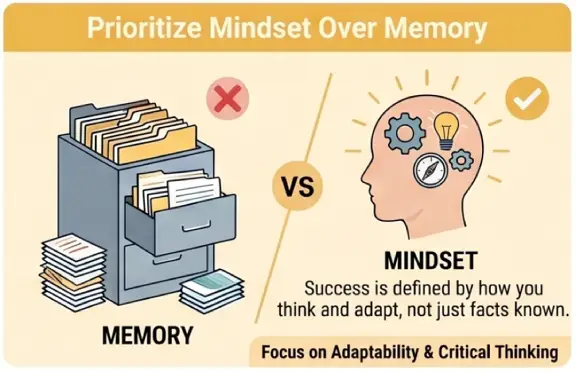
Information is no longer scarce—it is abundant. Careers are no longer linear—they are dynamic. And success is no longer defined by what you know, but by how you think, adapt, and respond.
A student who memorizes facts may perform well in an exam. But when faced with unfamiliar problems, shifting expectations, or new technologies, memorized knowledge alone offers little support. What becomes essential instead is the ability to learn continuously.
Futurist Alvin Toffler captured this transformation with remarkable clarity:
“The illiterate of the 21st century will not be those who cannot read and write, but those who cannot learn, unlearn, and relearn.”
This is not merely a philosophical idea—it is a practical necessity.
A Small Step Toward a Larger Shift
Recently, I took a small step that reflected this changing mindset. I arranged a weekend crash course in Python for my son, engaging a local youth who works as a software developer. It was not a formal program, nor a long-term commitment—just an introduction.
Before the session began, I spoke to the young tutor about why this mattered. I explained how the job market is becoming increasingly competitive, and how technology—particularly fields like coding and computer engineering—would continue to evolve alongside artificial intelligence. The aim was not to push my son into a specific career, but to expose him early to a skill that represents the direction in which the world is moving.
What struck me most was not how much he learned in that short session, but how naturally he engaged with it. There was no resistance, no sense of burden—only curiosity.
It reminded me that children are often ready for the future long before we prepare them for it.
What Does It Mean to Learn for the Future?
Learning for the future does not mean abandoning foundational knowledge. Reading, writing, mathematics, and core subjects remain essential. But they must be complemented by skills that allow students to navigate uncertainty.
Among these are:
· Analytical thinking and problem-solving
· Adaptability and resilience
· Digital literacy and technological awareness
· Communication and collaboration
· Self-awareness and independent learning
The Future of Jobs Report 2023 highlights many of these as critical competencies for the coming decades. Interestingly, most of these are not content-based skills. They are ways of thinking, ways of approaching problems, and ways of engaging with the world. They cannot be memorized. They must be developed.
From Instruction to Exploration
One of the key shifts required is moving from instruction to exploration.
In a traditional model, the teacher delivers knowledge, and the student receives it. In a future-oriented model, the teacher becomes a guide, and the student becomes an active participant in the learning process.
This means encouraging:
· Questions rather than just answers
· Exploration rather than strict adherence
· Understanding rather than memorization
· Application rather than repetition
It also means accepting that learning may not always follow a straight path. There will be detours, uncertainties, and even mistakes. But these are not signs of failure—they are signs of growth.
The Role of Parents and Educators
For parents and educators, this shift requires both openness and restraint.
Openness—to recognize that learning methods are changing, and that children may approach problems differently than we did.
Restraint—to allow children the space to explore, struggle, and discover on their own.
Guidance remains important, but control must give way to trust.
In my own experience, I have found that small interventions often make a bigger impact than constant supervision. Introducing an idea, providing an opportunity, or asking the right question can be far more effective than giving direct instructions. The Python session was one such intervention—not a command, but an invitation.
Balancing the Present with the Future
It is important, however, not to misunderstand this shift. Learning for the future does not mean neglecting the present. Students still need to perform well in their current academic environment. They must understand their subjects, complete their syllabus, and meet expectations. But the present should not become a limitation.
Exam preparation should not replace curiosity. Syllabus completion should not replace exploration. High scores may open doors, but they do not define the journey beyond them. The challenge is to strike a balance—where students fulfill present requirements while gradually building future capabilities.
A Quiet but Necessary Transformation
The transformation in education will not happen overnight. It will not be driven solely by policy changes or new technologies. It will happen gradually—in homes, in classrooms, in conversations, and in small decisions.
· A parent introducing a new skill.
· A teacher encouraging a different way of thinking.
· A student exploring beyond the syllabus.
These small shifts, when combined, create a larger change.
Looking Ahead
The future is not something we can predict with certainty. But it is something we can prepare for—with the right mindset. If we continue to teach only what we know, we risk preparing children for a world that no longer exists. But if we teach them how to learn, how to adapt, and how to think, we prepare them for a world that is still unfolding.
Education, at its core, is not about preserving the past. It is about enabling the future. And perhaps, the most important lesson we can offer today is not a piece of knowledge, but a way of approaching the unknown—with curiosity, confidence, and the willingness to learn again and again.
(Keithellakpam Manikanta Meetei is a seasoned journalist and a former educator. He writes under his pen name Keicha Chingthou Mangang instead of his actual name. You can contact him at chingthouheiya@gmail.com)