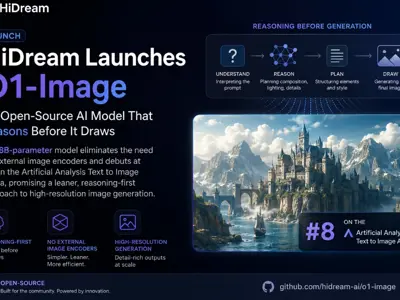
The 8B-parameter model eliminates the need for external image encoders and debuts at #8 on the Artificial Analysis Text to Image Arena, promising a leaner, reasoning-first approach to high-resolution image generation.

HiDream.ai has open-sourced its most ambitious image generation model to date. Released on May 8, 2026, HiDream-O1-Image — internally codenamed Peanut — is a natively unified generative model that breaks from the conventional diffusion pipeline by eliminating external Variational Autoencoders (VAEs) and separate text encoders, instead working directly in raw pixel space through an entirely new architecture.
The release has attracted immediate attention in the AI research community, with the model debuting at #8 on the Artificial Analysis Text to Image Arena — a leaderboard tracking open and proprietary image generation models — making it the highest-ranked open-weights model on the chart upon launch.
At the heart of HiDream-O1-Image is a Pixel-level Unified Transformer (UiT), a novel architecture that encodes raw pixels, text, and task-specific conditions in a single shared token space. Traditional diffusion models — including prominent systems like Stable Diffusion — typically rely on a VAE to compress images into a latent space before generation and decode them back into pixels afterwards. This compression step can introduce artefacts, lose fine-grained detail, or cause mismatches between what the model understands and what it ultimately renders.
By working natively in pixel space, HiDream-O1-Image removes one of the more technically demanding components of a modern image generation stack. The model supports text-to-image generation, instruction-based image editing, and subject-driven personalisation — all within a single unified framework — at resolutions up to 2,048 × 2,048 pixels.
Architecture: Pixel-level Unified Transformer (UiT)
Parameters: 8 Billion
Maximum Resolution: 2,048 × 2,048 pixels
Inference Steps (Full): 50 | Inference Steps (Dev): 28
Licence: MIT (open source, commercial use permitted)
Arena Ranking: #8, Artificial Analysis Text to Image Arena (May 2026)
Release Date: 8 May 2026
Perhaps the most distinctive feature of HiDream-O1-Image is what the developers call a Reasoning-Driven Prompt Agent. Shipped alongside the model as a standalone script (prompt_agent.py), the agent acts as an intelligent intermediary between a user's raw instruction and the image generation pipeline.
Rather than passing a short, ambiguous user prompt directly to the model, the agent explicitly reasons through the instruction — resolving implicit knowledge, mapping out scene layout, interpreting physical logic, and handling text-rendering requirements — before rewriting it into a rich, self-contained English prompt. The output is a structured JSON object containing three fields: the rewritten prompt, a record of the model's reasoning, and any resolved factual knowledge it drew upon.
This approach is particularly significant for complex generation tasks involving multilingual text rendering, multi-region layout, cultural specificity, or dense compositional requirements — scenarios where brief prompts routinely lead diffusion models astray. In a demonstration provided by the developers, the agent was given the Chinese-language instruction "Li Bai's Quiet Night Thoughts written on an ancient wall," and produced a detailed, culturally accurate visual prompt before any image was generated.
The agent supports two backends: a local inference mode using Google's Gemma-4-31B-IT model, and an API mode compatible with any OpenAI-specification endpoint, including OpenAI itself, Azure, vLLM, SGLang, and DeepSeek.
HiDream.ai has benchmarked O1-Image across five widely used evaluation suites: compositional generation, dense prompt alignment, human preference scoring, complex visual text generation, and long-text rendering. The company reports that despite having only 8 billion parameters — significantly fewer than many competitor models — HiDream-O1-Image matches or outperforms larger open-source Diffusion Transformers (DiTs) and select closed-source commercial models across these categories.
Text rendering — a historically weak point for image generation models — appears to be a particular focus. The model claims accurate, multi-region, multilingual text rendering and fine-grained layout control, areas that have frustrated developers building production applications on open-source generators.
The model's unified token space means it handles tasks beyond straightforward text-to-image generation. Subject-driven personalisation — where a model must preserve the visual identity of a person, character, or object across entirely new scenes — is supported natively, without requiring separate fine-tuning runs or LoRA adaptors that most competing open-source systems rely on.
Instruction-based image editing is also built into the same framework. Users can modify an existing image through natural language commands, maintaining continuity with the generation pipeline rather than routing edits through a separate model. The developers describe this as part of a broader trajectory begun with their earlier HiDream-I1 and HiDream-E1 models, positioning O1-Image as a more unified and architecturally consistent successor.
HiDream.ai first entered the open-source image generation space in April 2025 with HiDream-I1, a 17-billion-parameter Sparse Diffusion Transformer built on a dynamic Mixture-of-Experts (MoE) architecture. That model attracted significant community interest for achieving competitive quality at relatively low inference latency, and was formally described in an academic technical report published in May 2025.
The company subsequently released HiDream-E1 for instruction-based editing and HiDream-E1-1, an updated version, through mid-2025. HiDream-O1-Image represents a more fundamental architectural departure — not simply a larger or refined version of its predecessors, but a rebuild around the pixel-space UiT framework that also integrates reasoning as a first-class component of the generation workflow.
HiDream-O1-Image is released under the MIT Licence, making it freely available for personal, research, and commercial use. Both the undistilled full model and a distilled Dev variant — requiring fewer inference steps at the cost of some fidelity — are available on Hugging Face under the HiDream-ai organisation page. The accompanying Reasoning-Driven Prompt Agent and inference scripts are published on GitHub. Users deploying the local agent backend will require access to Google's Gemma-4-31B-IT weights, which carry a separate Gemma licence that must be accepted on Hugging Face.
The release arrives at a moment when the open-source image generation community has been navigating a transition from pure quality competition to a broader set of production requirements — including instruction fidelity, inference cost, text rendering, character consistency, and pipeline simplicity. HiDream-O1-Image's pixel-space approach and integrated reasoning layer represent a coherent architectural thesis about where that transition should lead.
HiDream-O1-Image (HiDream-ai/HiDream-O1-Image) is available on Hugging Face. Source code and the Reasoning-Driven Prompt Agent are published at github.com/HiDream-ai/HiDream-O1-Image under the MIT Licence.