For generations, the idea of studying has been tied to a particular image—silence, concentration, a room free from distraction, and a child bent over books with complete focus. But the learning environment is changing, and perhaps, it needs to.
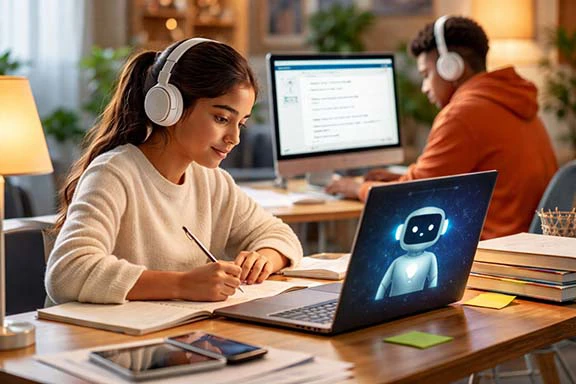
For generations, the idea of studying has been tied to a particular image—silence, concentration, a room free from distraction, and a child bent over books with complete focus. In Manipur, this remains the dominant cultural expectation. Even today, parents go to great lengths to recreate this ideal: some invest in home setups, while others take their children to hourly “study rooms” springing up across town—structured spaces offering a pocket of quiet in an increasingly chaotic world.
But the learning environment is changing, and perhaps, it needs to.
In a world where homes are often noisy, families large, and digital distractions endless, many students are beginning to adopt their own methods. These may look unconventional—studying with music on, switching between Google searches and AI tools, or solving problems on a screen rather than from a textbook—but they represent a shift born out of necessity. The traditional idea of study time may no longer be enough or realistic in every situation.
This shift isn’t just about convenience. It’s also about access, autonomy, and adaptation.
Digital tools like ChatGPT or AI-powered math solvers have quietly become learning companions for many students. Used wisely, they offer explanations, generate practice problems, and clarify doubts in a way that textbooks often can't. These tools don’t get tired, don’t judge, and are available around the clock. They are not meant to replace critical thinking but can reinforce it—if approached with intention.
I recently noticed this firsthand when I saw a study session that blended AI, music, and self-motivation. At first, it felt unfamiliar. But it soon became clear that the focus and effort were genuine. The student wasn’t searching for shortcuts but using technology to deepen understanding and practice independently.
Of course, not every method suits every learner. Some still prefer silence and paper, and that should be respected. But the real challenge lies in our response as parents and educators. Are we willing to observe before we judge? Can we adapt alongside our children, offering guidance rather than rigid rules?
It’s easy to view screens with suspicion, to assume noise means distraction, or to believe that learning can only happen in silence. But today’s learners are navigating a new world. And that world demands flexibility, creativity, and a different kind of focus.
This isn’t to dismiss traditional study methods—they’ve shaped generations of thinkers. But a hybrid model is emerging, one that blends structure with flexibility, books with devices, and logic with assistance. Recognizing this shift—and helping children use it responsibly—might be one of the most important roles we now play.
Rather than fearing these changes, perhaps we should explore them. Because if done thoughtfully, the modern study session, with all its music and machines, might just lead to deeper learning after all.