The 1,643 km porous border between India and Myanmar represents a critical non-traditional security threat vector and a force multiplier for regional destabilization.
By Keithellakpam Manikanta Meetei
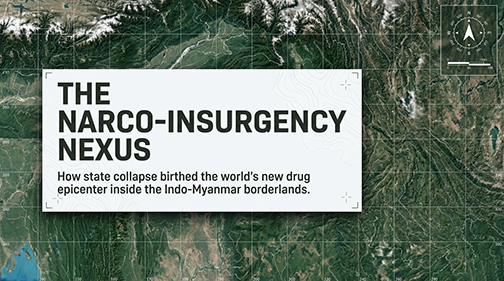
The 1,643 km porous border between India and Myanmar represents a critical non-traditional security threat vector and a force multiplier for regional destabilization. Historically defined as a "superimposed border," the colonial-era Pemberton Line bisected the traditional socio-economic homelands of the Chin-Kuki-Mizo ethnic groups across India, Myanmar, and Bangladesh. Following the 2021 Myanmar coup and the subsequent collapse of state authority, this frontier has transitioned into a kinetic epicenter where ethno-nationalist resistance and an institutionalized narcotics economy converge.
The historical continuity of the Kuki-Chin-Mizo tribes has facilitated fluid cross-border movement, yet the current "security void"—driven by the Myanmar military’s loss of territorial monopoly—has allowed fragmented Non-State Armed Actors (NSAAs) to entrench themselves. These groups have successfully exploited the administrative vacuum in "ungoverned spaces," transforming the region into a launchpad for both political insurgency and sophisticated illicit revenue streams. This regional geography provides the operational theater for a complex organizational architecture of militant groups.
The operational landscape of the borderlands is defined by a fragmented network of armed organizations that function as surrogate administrative authorities. These groups manage local security and rudimentary governance, sustaining their operational tempo through deep integration into the illicit economy.
Primary Chin-Kuki Armed Organizations and Operational Domains
|
Organization Name |
Key Leadership/Affiliations |
Geographic Strongholds |
Reported Tactical Alliances |
|
Kuki National Organisation (KNO) |
President P.S. Haokip |
Manipur (India), Kabaw Valley (Myanmar) |
Umbrella for a dozen factions; KNA is its principal wing |
|
Kuki National Army (KNA/KNA-B) |
Khaikam Touthang; David Hangsing |
Moreh, Tengnoupal (India); Chin State, Sagaing (Myanmar) |
KNA-Burma (KNA-B) allies with PDFs/KIA against the SAC junta |
|
Zomi Revolutionary Army (ZRA) |
Thanglianpau Guite |
Churachandpur (India), Chin State (Myanmar) |
ZRA-Eastern Command (EC) reportedly allies with the SAC junta |
|
Chin National Army (CNA) |
CNF Wing; Camp Victoria |
Chin State, Indo-Myanmar Border |
Active resistance against SAC; provides training to local PDFs |
|
Kuki-Chin National Front (KNF/KCNA) |
Nathan Bom |
Chittagong Hill Tracts (Bangladesh), Bandarban |
Financial-operational nexus with Jama’atul Ansar Fil Hindal Sharqiya |
|
United Socialist Revolutionary Army (USRA) |
Lalminthang Vaiphei |
Churachandpur and surrounding hills |
Operational focus on territorial control and ethnic protection |
|
United Kuki National Army (UKNA) |
Jampao Kuki |
Churachandpur, Bishnupur (Manipur) |
Involved in militant attacks and narcotics trafficking |
The strategic behavior of these groups is pragmatic and often contradictory. For instance, the ZRA’s "Eastern Command" has reportedly maintained a symbiotic relationship with the Myanmar military (SAC), acting as a proxy to target other resistance forces. Conversely, the KNF in Bangladesh has established an alliance with Islamic militants (Jama’atul Ansar Fil Hindal Sharqiya), providing shelter and arms training in exchange for direct financial payouts. Ultimately, the operational survival of these organizations is inextricably linked to the financial lifelines provided by the illicit economy.
In a major shift in global narcotics dynamics, 2025 data confirms that Myanmar has overtaken Afghanistan as the world's primary source of illicit opium. Following the Taliban’s 2023 ban, Myanmar's western borderlands have emerged as the new production epicenter, significantly altering the risk profile of the Indian frontier.
Total poppy cultivation area: 53,100 hectares (a ten-year peak).
Farmgate price surge: Dry opium prices increased from $160/kg in 2019 to $365/kg in 2025.
Potential dry opium production: Estimated at 1,010 metric tons.
This resurgence is characterized by a "Geographic Shift to the West." Cultivation density is surging in Chin State (+26%) and the Sagaing Region, bringing production into immediate proximity with the Tonzang-Moreh trafficking pipeline. This proximity facilitates shorter, more secure transit for heroin base into the Indian market. This expansion is fundamentally driven by the "Survival Crop" phenomenon, where economic collapse and state fragmentation force local farmers toward poppy as a resilient cash crop. This plant-based foundation has paved the way for the more dangerous proliferation of synthetic drug networks.
Synthetic drugs—specifically methamphetamine and yaba—represent an evolution in narco-trafficking due to their high profit margins and independence from land availability. These substances are increasingly synthesized in "industrial-scale" facilities, such as the major lab dismantled in Viet Nam in March 2025, signaling a shift toward mass-market production in the lower Mekong.
1. Manipur: Narcotics seizures valued at approximately Rs. 142 crore, including brown sugar processed in localized hill-based labs.
2. Mizoram: Security forces intercepted 34.15 kg of heroin and 34.18 kg of methamphetamine between April 2024 and January 2025.
3. Assam: A significant recovery in Cachar yielded 64,000 yaba tablets, confirming the volume passing through the Srikona corridor.
Transnational groups demonstrate high agility, exploiting maritime routes through Malaysia, Indonesia, and the Philippines. A critical driver is the expansion of cyber scam centers in border regions, which function as "shadow financial networks" to launder synthetic trade proceeds. Notably, the Three Brotherhood Alliance’s 2023–2024 offensive was permitted by China due to Beijing’s extreme frustration with the SAC junta’s refusal to dismantle these pro-junta scam centers. These transnational illicit flows have become deeply entangled with the localized ethnic conflict in Manipur.
In Manipur, the state government’s "War on Drugs" has become a central flashpoint for ethnic tension. The "Narco-Terrorist" label is frequently deployed to frame the conflict as an outcome of illegal immigration rather than an ethnic clash. The Kuki side alleges the Meetei of calling the whole community narco-terrorists while the Meetei CSOs are saying that the narco-terrorists tag is not for the whole community but for those armed groups engaged in illegall poppy cultivation and illicit narcotics trade. A critical analysis of drug-related arrest data shows involvement of different communities in the drug trade. However these data do not show the widespread poppy cultivation and the environmental destruction it causes in the once lush green forest of Manipur.
|
Ethnic/Religious Group |
Percentage of Total Arrests |
|
Muslims (Meitei Pangal) |
43.0% |
|
Kuki-Chin |
34.7% |
|
Meetei |
15.1% |
|
Others |
7.2% |
*Data based on 2,518 arrests as of early 2024.
The case of Lhukhosei Zou, former Chairman of the Chandel Autonomous District Council and a member of the BJP, who is from the Kuki community, epitomizes institutional complicity. Despite a 2018 raid recovering 4.59 kg of heroin and 280,200 yaba tablets, allegations by officer Thounaojam Brinda suggested high-level political pressure to stall the case. Zou’s subsequent 2020 acquittal led to a 2022 Supreme Court intervention questioning the state’s failure to appeal. While the state government maintains its focus on Kuki involvement, Kuki-Zo groups issued 2026 resolutions to halt poppy cultivation in Kangpokpi, claiming they are targeted for land eviction. However Naga and Meetei CSOs claim that the resolution is a smoke screen citing continued practice of illegal poppy cultivation, official data of security forces destroying poppy farms, and armed resistance to such anti-poppy drives. These conflicting narratives transition the regional crisis into a failure of border management and regional policy.
In response to demographic and narcotics threats, India has shifted toward a "rigid border" strategy, tightening the Free Movement Regime (FMR) and initiating fencing across the 1,643 km border. This is driven by "Demographic Anxiety" regarding the 95,600 documented Myanmar refugees and has necessitated biometric identification processes for foreign nationals. However, it would not be right to dismiss this demographic anxiety because the 2001 and 2011 census data showed massive unnatural decadal population growth in some hill areas of Manipur with growth rate reaching 50% to 100+% compared to 20% to 30% in the rest of the state.
This 2023 Manipur Crisis has resulted in the visible failure of the "Act East" Policy. The Moreh gateway, intended as a commercial hub, is now heavily militarized. Official trade dropped 48% in early 2024, and overall exports to Myanmar plummeted from $807 million in 2022-23 to $670.4 million in 2023-24. The long-term risk is the institutionalization of the region as a permanent production hub rather than a transit route.
The "Nexus" between conflict and the drug economy has created a self-reinforcing cycle where narcotics finance the military hardware of insurgency, and insurgency provides the ungoverned space required for drug production.
1. Escalation of Violence: Tensions surrounding the 2025 sham elections in Myanmar will serve as a trigger for intensified territorial battles.
2. Humanitarian Crisis: Displacement from aerial assaults will continue to drive populations across the border, exacerbating demographic friction.
3. Institutionalized Corruption: The symbiotic relationship between political elites and narco-insurgents ensures that drug proceeds will continue to fund political protection.
The borderlands remain locked in a deepening cycle of poverty and dependence. Illicit cultivation is currently the only viable survival strategy for populations caught between state collapse and localized ethnic warfare, ensuring the region remains a permanent hotspot for transnational crime.
---
(Keithellakpam Manikanta Meetei is a seasoned journalist and a former educator. He also writes under his pen name Keicha Chingthou Mangang instead of his actual name. You can contact him at chingthouheiya@gmail.com)