ASUSE 2025 data reveals Northeast India as a region of remarkable enterprise density but structural shallowness — well-banked but minimally formalised, commercially active but weakly integrated into national supply chains, resilient but trapped below a scaling ceiling.
The Ministry of Statistics and Programme Implementation (MoSPI) has released the detailed report and unit-level data of the Annual Survey of Unincorporated Sector Enterprises (ASUSE) 2025, following the earlier publication of key findings through a factsheet and press note on March 24, 2026. Covering the reference period from January to December 2025, the newly released data offers a rare and granular view of the unincorporated non-agricultural economy across Northeast India — a regional economic landscape often discussed in broad generalisations but far less frequently examined through detailed statistical evidence. What emerges is a picture far more complex than conventional assumptions suggest.
The Northeast is not economically stagnant. Across its eight states, nearly 19 lakh unincorporated enterprises operate in trade, manufacturing, and services — almost entirely run by households, self-employed individuals, and family units. Most operate year-round. Most maintain bank accounts. And yet, beneath this surface activity lies a structural story of informality, fragmentation, and weak integration into India's larger economic systems.
KEY FINDING: The Northeast is a region with high economic energy but low structural depth. It has entrepreneurs, but not scaling ecosystems.
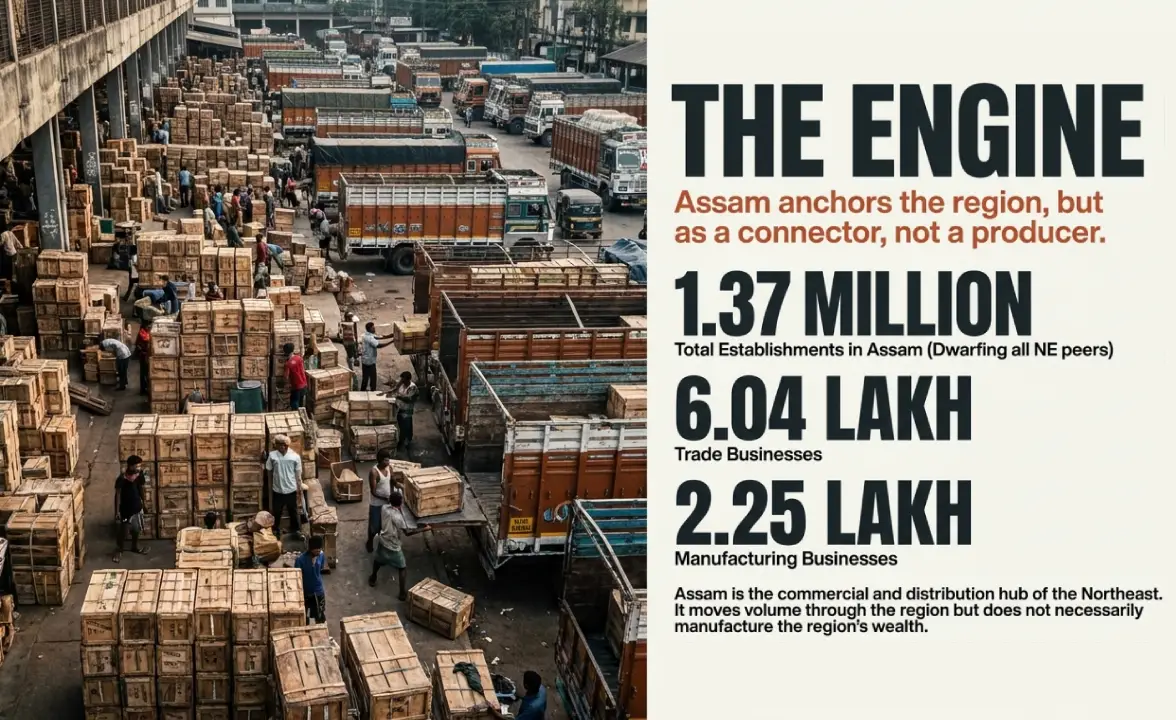
Assam is the undisputed economic anchor of the Northeast's unincorporated sector. With 13.71 lakh establishments, it dwarfs every other state in the region. Tripura and Meghalaya follow distantly at around 2.5 lakh each. At the other end, Mizoram has just 21,283 establishments — less than 2% of Assam's volume.
Table 1: Estimated Establishments by State — OAE vs HWE
|
State |
Total |
OAE (No Hired Workers) |
HWE (With Hired Workers) |
|
Assam |
13,71,161 |
11,99,647 |
1,71,514 |
|
Tripura |
2,55,757 |
2,29,832 |
25,924 |
|
Meghalaya |
2,53,403 |
2,01,779 |
51,624 |
|
Manipur |
1,88,848 |
1,73,680 |
15,168 |
|
Nagaland |
79,345 |
65,695 |
13,650 |
|
Arunachal Pradesh |
67,541 |
57,221 |
10,320 |
|
Sikkim |
41,839 |
36,612 |
5,227 |
|
Mizoram |
21,283 |
18,695 |
2,589 |
|
All-India Total |
7,92,46,545 |
6,86,60,898 |
1,05,85,647 |
Across every state, Own Account Establishments (OAEs) — run by the owner alone, with no hired workers — vastly outnumber Hired Worker Establishments (HWEs). In Assam, for example, OAEs make up 87.5% of all enterprises. This is the defining structural feature of the regional economy: most businesses are solo or family operations. They are livelihood units, not employment-generating firms.
Data point: At the national level, OAEs account for 86.6% of all unincorporated enterprises. The Northeast mirrors this national pattern, with several states showing even higher OAE dominance.
Nationally, the unincorporated sector is led by 'Other Services', followed by Trade and then Manufacturing. The Northeast tells a somewhat different story. Trade is the largest segment in Assam, Arunachal Pradesh, and Mizoram. 'Other Services' leads in Tripura, Meghalaya, and Sikkim. And then there is Manipur — a significant outlier.
Table 2: Sectoral Distribution — Manufacturing, Trade, Other Services
|
State |
Manufacturing |
Trade |
Other Services |
|
Assam |
2,25,994 |
6,04,844 |
5,40,322 |
|
Tripura |
33,150 |
93,848 |
1,28,759 |
|
Meghalaya |
39,073 |
91,135 |
1,23,195 |
|
Manipur |
86,877 |
40,298 |
61,673 |
|
Nagaland |
17,846 |
32,619 |
28,881 |
|
Arunachal Pradesh |
11,229 |
33,276 |
23,036 |
|
Sikkim |
1,642 |
15,794 |
24,403 |
|
Mizoram |
1,018 |
16,587 |
3,678 |
|
All-India |
2,14,51,288 |
2,42,15,514 |
3,35,78,102 |
Manipur's manufacturing segment — at 86,877 establishments — is its largest sector, surpassing both trade and services. This is unique in the region. It reflects a stronger household production culture: handloom, weaving, artisan goods, and small-scale food processing are deeply embedded in Manipur's informal economy. Manipur is, in effect, the Northeast's most production-oriented informal economy. That matters for policy, because it suggests a foundation that could be built on — if logistics, branding, and market access can be improved.
ANALYTICAL NOTE: Manipur's manufacturing dominance is a structural asset, not just a curiosity. With the right digital commerce and logistics linkages, it could become a scalable production economy. Without them, it remains a fragmented artisan sector.
The heavy trade orientation of Assam reinforces its role as the region's commercial hub — a distribution economy that connects goods to consumers, rather than a manufacturing powerhouse. Mizoram and Sikkim, with the smallest enterprise volumes, are both services-leaning economies, consistent with their smaller, more geographically concentrated populations.
One of the most striking findings in ASUSE 2025 is the Northeast's exceptional performance on financial inclusion — and the simultaneous near-absence of formal accounting. These two facts together define the region's deepest structural contradiction.
Table 3: Financial Inclusion and Auditing (per 1,000 establishments)
|
State |
Accounts in Financial Institutions |
Maintaining Audited Accounts |
|
Meghalaya |
993 |
9 |
|
Mizoram |
993 |
0 |
|
Sikkim |
988 |
14 |
|
Nagaland |
957 |
0 |
|
Assam |
946 |
2 |
|
Arunachal Pradesh |
940 |
3 |
|
Tripura |
912 |
1 |
|
Manipur |
551 |
1 |
|
All-India Average |
825 |
14 |
Six of the eight Northeastern states exceed 940 bank accounts per 1,000 enterprises — dramatically above the national average of 825. Meghalaya and Mizoram are effectively at saturation, with 993 per 1,000. This is remarkable. It means that almost every unincorporated enterprise in these states has a financial account. Decades of banking outreach, financial inclusion schemes, and Jan Dhan-style interventions have clearly paid off.
But audited accounts tell a completely different story. Only Sikkim (14 per 1,000) matches the national average. Nagaland and Mizoram report zero. Most states are between 1 and 9. What this means is that enterprises are banked — they receive payments, make transfers, and use digital systems — but they do not maintain formal financial records. There is no bookkeeping, no balance sheet, no tax-ready documentation. The business is invisible to the formal credit and compliance system, even if it has a bank account.
Manipur exception: At just 551 bank accounts per 1,000 enterprises, Manipur is the region's significant outlier in financial inclusion — well below the national average, and far behind its neighbours. This is unexplained by the raw data alone and warrants further investigation.
ANALYTICAL NOTE: High bank penetration without auditing means the region is financially connected but institutionally underdeveloped. Credit expansion, formalisation, and growth finance all depend on formal financial records. Without them, the banking infrastructure is underutilised.
Perhaps the most economically consequential finding in the dataset is the Northeast's extremely low engagement in contract manufacturing — the practice of producing goods for another firm as part of a larger supply chain.
Table 4: Contract Work Engagement (per 1,000 establishments)
|
State |
Contract Mfg Only |
Contract Services Only |
Not on Contract |
|
Assam |
37 |
9 |
955 |
|
Meghalaya |
29 |
0 |
971 |
|
Sikkim |
22 |
1 |
978 |
|
Nagaland |
20 |
0 |
980 |
|
Manipur |
15 |
5 |
980 |
|
Arunachal Pradesh |
7 |
5 |
988 |
|
Mizoram |
0 |
4 |
996 |
|
Tripura |
2 |
0 |
998 |
|
All-India Average |
87 |
3 |
911 |
The national average for contract manufacturing is 87 per 1,000 enterprises. Assam, the region's best performer, manages only 37. Tripura and Mizoram are near zero. This is not a marginal gap — it is a structural divide. The Northeast's enterprises are largely disconnected from India's subcontracting economy. They produce for local consumers. They do not participate as nodes in larger national production networks.
This has profound implications. It means the region does not benefit from the scale, technology transfer, and market access that come with being embedded in national value chains. It means that growth in the Northeast's informal sector is largely dependent on local demand — which limits how far it can expand. And it means that policy interventions designed around supply-chain integration would need to address deep infrastructure, logistics, and market-linkage deficits before contract manufacturing can become viable at scale.
One finding stands in sharp contrast to the structural weaknesses documented above: the overwhelming majority of Northeast enterprises operate on a perennial, year-round basis. Across all eight states, 968 to 999 enterprises per 1,000 are classified as perennial. Even in Nagaland — the most seasonal state in the region — 968 out of 1,000 enterprises operate year-round. The national average is 991 per 1,000.
This is significant. These enterprises exist in states with challenging terrain, periodic political instability, connectivity constraints, and limited market depth. And yet they persist, continuously, as primary livelihoods. This resilience is not incidental — it reflects the deeply embedded nature of informal enterprise in the social fabric of the region. These are not opportunistic or seasonal ventures. They are survival systems.
ANALYTICAL NOTE: Resilience without scaling is a ceiling, not an achievement. The Northeast's enterprise survival rate is impressive. But the absence of a pathway from micro-enterprise survival to medium-enterprise growth is the region's most serious structural problem.
One finding deserves special attention. Meghalaya reports 46 Non-Profit Institutions (NPIs) per 1,000 enterprises — nearly ten times the national average of 5 per 1,000. Nagaland reports 24 per 1,000 NPIs funded through 'other sources'. The rest of the Northeast registers virtually no NPI presence in the unincorporated sector.
This suggests that in Meghalaya and Nagaland, civil society and community-sector organisations play a meaningful role in the informal economy — grant-funded, donor-supported, and community-linked enterprises form a distinct institutional layer that does not exist in the same way elsewhere in the region. This is partly a reflection of the strong church and community organisation networks in these states, as well as their histories of civil society-driven development. It also suggests that any formalisation or scaling strategy in these states will need to engage civil society institutions as active economic actors, not just service providers.
Taken together, the ASUSE 2025 data presents a coherent and sobering portrait. The Northeast has enterprise culture. It has economic energy. It has financial infrastructure. It has resilient livelihoods. But it is missing the connective tissue that turns micro-enterprise activity into regional economic growth.
The region lacks industrial clusters. It lacks subcontracting integration. It lacks formal bookkeeping systems. It lacks logistics corridors that can link local production to national markets. And it lacks the medium-enterprise layer — between the micro-enterprise and the large corporate — that typically drives regional economic transformation.
The policy implication is clear. The Northeast does not need more enterprise creation. It already has entrepreneurs. What it needs is enterprise scaling — aggregation systems, market linkages, digital commerce pathways, accounting literacy, and above all, integration into India's broader industrial and supply-chain economy. Without that, a region of remarkable informal energy will remain trapped below its own potential.
CONCLUSION: The Northeast is banked but not formalised, active but not integrated, resilient but not scaling. The gap between where it is and where it could be is not a problem of entrepreneurial spirit. It is a problem of connective infrastructure — financial, digital, industrial, and logistical.