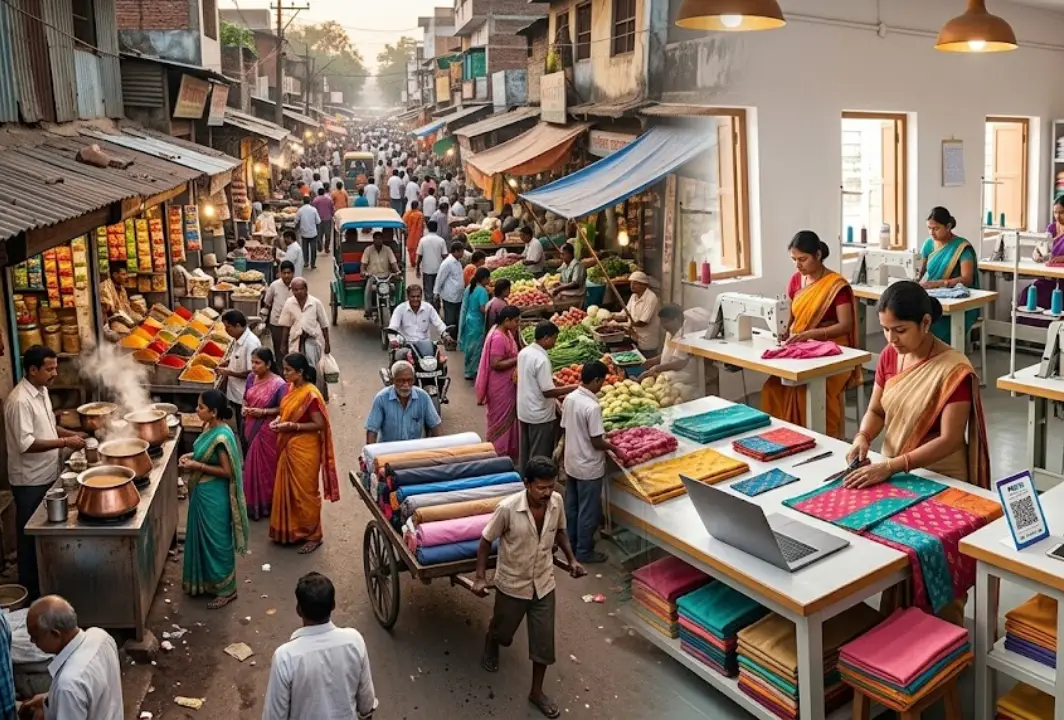
MoSPI's Annual Survey of Unincorporated Sector Enterprises 2025 reveals robust expansion across all key indicators — from establishment count and gross value added to internet use and formal credit access — pointing to a sector increasingly formalised, digitally integrated, and driven by women.
|
7.92 Cr Establishments |
12.81 Cr Workers |
+10.87% GVA Growth |
>60% Female Proprietors (Mfg.) |
India's vast unincorporated non-agricultural sector — the sprawling ecosystem of small enterprises in manufacturing, trade, and services that sits outside the formal corporate economy — has posted its strongest showing in recent years, according to the Annual Survey of Unincorporated Sector Enterprises (ASUSE) 2025, released in detailed form by the Ministry of Statistics and Programme Implementation (MoSPI) on 6 May 2026.
The survey, covering January to December 2025, recorded a total of 7.92 crore establishments across the country — up from 7.34 crore in ASUSE 2023-24, representing growth of 7.97%. The expansion was broad-based: the Other Services sector led with a 10.29% increase in establishments, followed by Manufacturing at 6.48% and Trade at 6.18%. This growth was not confined to one region. The highest concentrations of establishments were recorded in Uttar Pradesh, West Bengal, and Maharashtra, which together accounted for more than one-third of total workers across the sector.
The Gross Value Added (GVA), a primary measure of economic contribution, rose by 10.87% in current prices during the survey period. The Trade sector drove this growth at 16.77%, followed by Manufacturing at 8.52% and Other Services at 7.36% — underlining the sector's significant and multidimensional contribution to national GDP.
Employment in the sector expanded substantially. The unincorporated non-agricultural sector employed about 12.81 crore workers between January and December 2025 — an addition of more than 74.52 lakh jobs compared to the ASUSE 2023-24 period. This level of labour market absorption, generated outside the formal corporate sector, underscores the role these enterprises play as the primary employment safety net for a large portion of India's working population.
Women's participation in this workforce stood at approximately 29% of the total — a figure that, while still a minority share, is accompanied by a more striking headline: female proprietors headed over 60% of all establishments in the manufacturing sector. Overall, the percentage of female-headed proprietary establishments rose marginally from 26.17% in ASUSE 2023-24 to 26.93% in ASUSE 2025 — a slow but directionally consistent increase.
The data on women's role as employers is equally significant. Nearly 72% of female-led establishments that hired workers engaged at least one female hired worker, demonstrating a multiplier effect: women-led enterprises disproportionately generate employment for other women. Of the total female workers in the sector, nearly 22% were engaged in the manufacture of wearing apparel — the single largest category of female employment.
Three activity categories dominate the sector in terms of both establishment count and workforce. Other retail trade accounts for approximately 26% of all establishments and 27.55% of all workers in ASUSE 2025. The manufacture of wearing apparel accounts for around 12% of establishments and 8.67% of the workforce. Other community, social, and personal service activities account for about 12% of establishments and 9.51% of the workforce — a category that grew its workforce share between the two survey periods, reflecting rising demand for personal and social services.
Table 1: Share of Establishments and Workers — Top 3 Activity Categories (ASUSE 2023-24 vs. ASUSE 2025)
|
Activity Category |
Estab. 23-24 (%) |
Estab. 2025 (%) |
Workers 23-24 (%) |
Workers 2025 (%) |
|
Other Retail Trade |
27.07 |
26.49 |
27.46 |
27.55 |
|
Manufacture of Wearing Apparel |
12.17 |
11.68 |
9.22 |
8.67 |
|
Other Community, Social & Personal Services |
10.90 |
11.60 |
8.93 |
9.51 |
One of the most striking findings of ASUSE 2025 is the dramatic increase in internet adoption for entrepreneurial purposes. Overall usage rose from 26.68% to 39.37% — an increase of nearly thirteen percentage points in a single year. The rural-to-urban gap in digital adoption, while persistent, narrowed considerably: rural internet use for business purposes climbed from 17.94% to 31.06%, while urban usage increased from 37.01% to 48.94%.
Among activity categories, the trade sector crossed a significant threshold — more than 50% of trading establishments used internet for entrepreneurial purposes during January to December 2025. This milestone signals a structural shift in how small-scale commerce operates in India, with digital tools increasingly embedded in daily business operations rather than confined to larger or urban enterprises.
Capital deepening in the sector also registered progress. Average fixed assets per establishment rose from Rs 3,24,075 in ASUSE 2023-24 to Rs 3,42,242 in ASUSE 2025 — an increase of approximately Rs 18,000 per establishment, indicating improved physical capacity and longer-term investment commitment.
Access to formal credit improved significantly. More than 80% of outstanding loans were sourced through institutional channels — including commercial banks and government schemes — up from lower levels in previous surveys. This shift away from informal lending toward structured financial institutions reduces the cost of capital for small enterprises and integrates them more deeply into the formal banking ecosystem. Registration rates, though still modest, inched upward from 37.20% to 37.50%, indicating a slow but steady trend toward formalisation.
ASUSE 2025 collected data from 6,70,289 establishments — 2,94,144 in rural areas and 3,76,145 in urban areas — across 24,153 first-stage units spanning the whole of India, excluding difficult-to-access villages in the Andaman and Nicobar Islands. Data was collected through Computer Assisted Personal Interviewing (CAPI) on tablets, mostly through oral enquiry on a monthly reference period. The survey's sampling design was revised this cycle to enable quarterly estimates in addition to annual results, with the sample size increased by approximately 1.5 times to support this capability. The design also allows participating states to generate annual estimates at the district level — a significant enhancement for granular policymaking.
The survey covers unincorporated non-agricultural enterprises in the proprietorship, partnership, cooperative, and society/trust categories in manufacturing, trade, and other services (excluding construction). The detailed report and unit-level data are available on the MoSPI website at mospi.gov.in.