India’s core sector growth slowed to 1.7% in April 2026 as declines in coal, crude oil and natural gas output offset gains in steel, cement and electricity.
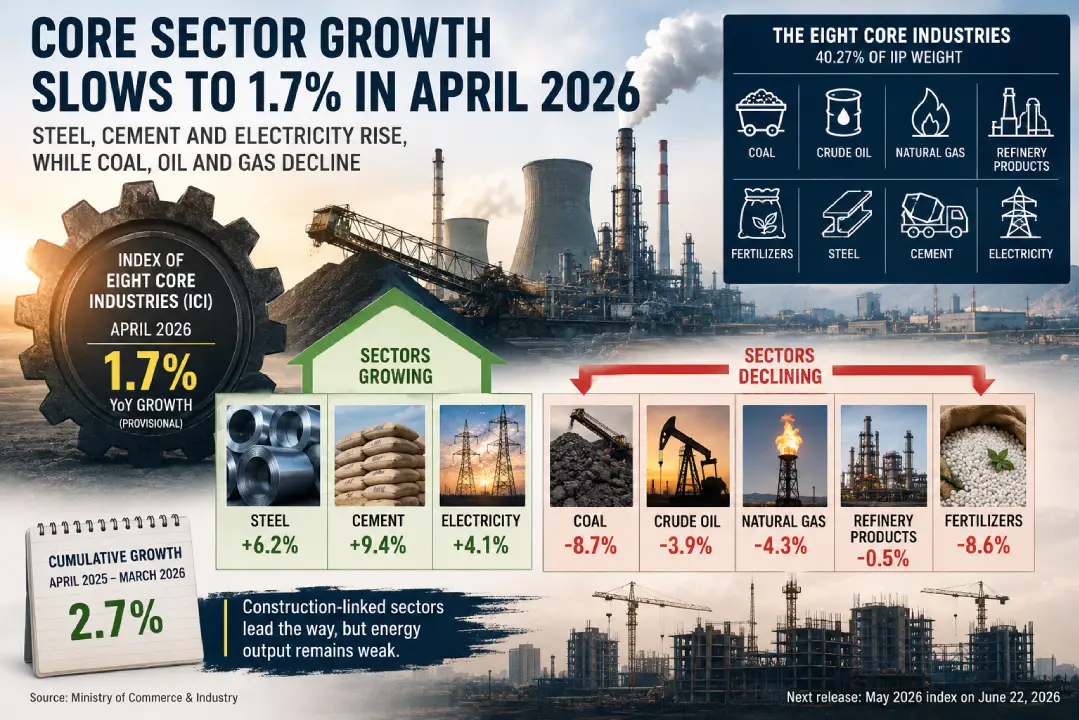
New Delhi, May 20: India’s eight core industries registered a modest 1.7 per cent growth in April 2026, reflecting continued weakness in energy-related sectors even as steel, cement and electricity production remained strong. Data released by the Ministry of Commerce and Industry on Tuesday showed that five of the eight core sectors recorded negative growth during the month. Coal, crude oil, natural gas, refinery products and fertilizers all contracted compared to April last year, while steel, cement and electricity posted positive growth.
The Index of Eight Core Industries (ICI), which measures the performance of sectors accounting for 40.27 per cent of the weight of the Index of Industrial Production (IIP), had recorded a 1.2 per cent growth in March 2026. The cumulative growth for the full 2025-26 financial year stood at 2.7 per cent. The latest figures point to a mixed industrial trend, where construction-linked sectors continue to support output growth, but traditional energy segments remain under pressure.
Steel production grew by 6.2 per cent year-on-year in April, while cement output increased by 9.4 per cent — the highest among all eight sectors. The strong performance of both sectors indicates sustained activity in infrastructure, housing and construction projects despite broader concerns over industrial momentum. Electricity generation also rose by 4.1 per cent during the month, suggesting stable power demand across industrial and domestic consumption categories.
Among the eight sectors, steel remained one of the strongest long-term performers as well. Official data showed cumulative steel growth at 9.5 per cent during 2025-26, while cement recorded cumulative annual growth of 8.7 per cent. The continued resilience of these sectors has helped offset weakness in fuel and extraction industries over the past year.
Coal production declined sharply by 8.7 per cent in April compared to the same month last year, marking one of the steepest sectoral contractions in the latest data set. Crude oil output fell by 3.9 per cent, while natural gas production declined by 4.3 per cent. Petroleum refinery products also slipped by 0.5 per cent during the month. The fertilizer sector contracted by 8.6 per cent.
The sustained decline in crude oil and natural gas output reflects a longer-term structural trend visible across the annual core sector data. Since the 2011-12 base year, crude oil and natural gas indices have shown a gradual downward trajectory despite fluctuations in demand and pricing conditions.
Analysts often view declining domestic fossil fuel production as a concern because it increases import dependence, particularly at a time of global energy market volatility. Coal, despite remaining one of India’s most critical energy sources, also showed uneven monthly trends throughout 2025-26. After witnessing periods of strong production earlier in the financial year, April’s decline pulled the sector into negative territory on a year-on-year basis.
The latest core sector data suggests India’s industrial growth remains uneven across sectors rather than broad-based. Construction-linked industries such as steel and cement continue benefiting from public infrastructure spending and urban development activity. However, weaker performance in mining and fuel sectors points to supply-side challenges and softer industrial demand in some segments.
The refinery sector’s near-flat performance is particularly significant because petroleum products carry the highest weight — 28.04 per cent — within the core industries index. Even small changes in refinery output therefore have a disproportionate effect on overall industrial growth.
Similarly, electricity, steel and coal together account for a large share of the index, making their monthly performance critical indicators of wider economic activity. Economists and industry observers often track the eight core industries closely because the index serves as an early indicator of industrial production trends before the release of the broader IIP data.
The annual index data released alongside the April figures also reflects changing industrial patterns over the past decade. Steel and cement sectors have shown sustained expansion since the base year of 2011-12, while electricity generation has also steadily increased. In contrast, crude oil and natural gas production indices remain below earlier levels, indicating stagnant or declining domestic extraction capacity. The data also reflects the lingering impact of the pandemic period. In 2020-21, the overall core sector index had contracted by 6.4 per cent before rebounding strongly in the following two financial years.
Although overall industrial activity has recovered since then, growth has moderated gradually over the last two years. The overall ICI growth slowed from 7.8 per cent in 2022-23 to 7.6 per cent in 2023-24, further easing to 4.5 per cent in 2024-25 and 2.7 per cent in 2025-26.
The moderation suggests that while infrastructure-driven sectors remain relatively stable, broader industrial expansion may be losing momentum amid weaker commodity and energy sector performance. The government said data for April 2026 remains provisional, while March 2026 figures have been finalised. The next release of the Index of Eight Core Industries for May 2026 is scheduled for June 22.