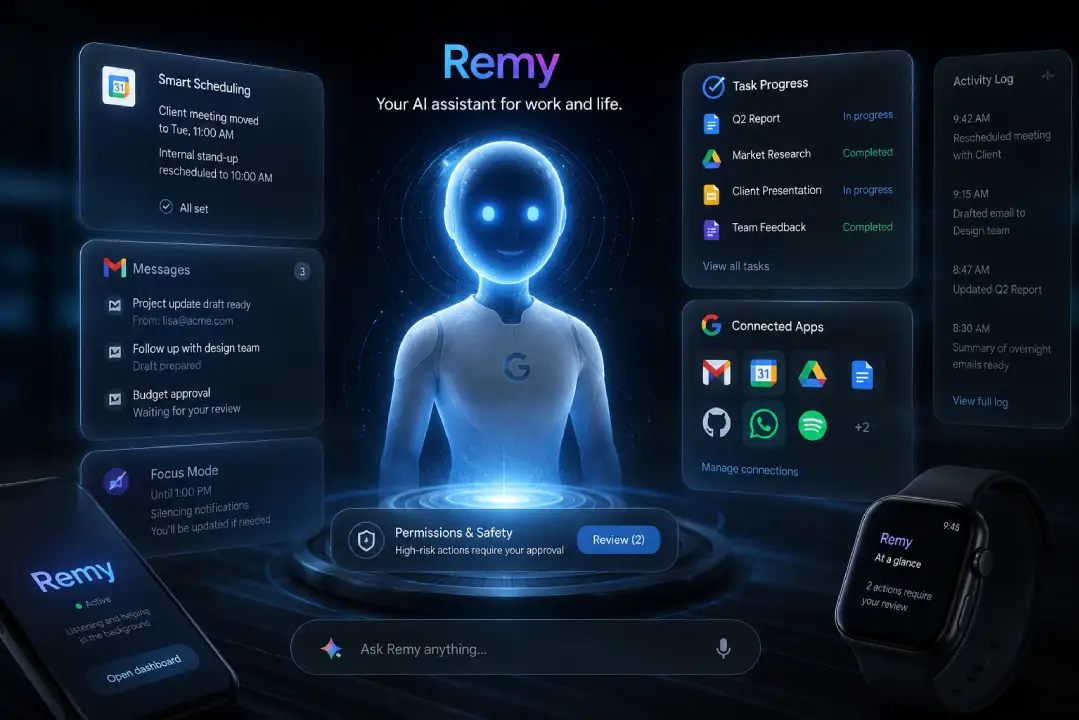
Google is reportedly developing “Remy,” a persistent AI assistant integrated with Gemini and Android. The project raises major questions about AI automation, privacy, and cybersecurity.
Google is reportedly testing a highly advanced artificial intelligence agent codenamed “Remy,” according to claims based on decompiled application strings and unverified internal materials referenced by Business Insider.
The reported system is described as a persistent digital assistant capable of operating across work, communication, and productivity environments with a higher degree of automation than current AI chatbot platforms. Unlike conventional assistants that respond primarily to direct prompts, Remy is said to maintain contextual awareness across applications and automate selected workflows in the background.
According to the report, the agent may integrate deeply with Google’s Gemini ecosystem and Android operating system layer, allowing it to interact with services such as Gmail, Calendar, Docs, Drive, Keep, and Photos. The system is also reportedly being tested with selected third-party platforms including GitHub, Spotify, and WhatsApp.
The reported capabilities include scheduling meetings, organizing tasks, drafting replies, managing reminders, and coordinating multi-step workflows across connected services. Some unconfirmed claims further suggest the assistant could eventually support limited transaction handling or communications with external parties under user-defined permissions.
However, Google has not officially confirmed the existence of Project Remy or publicly disclosed a release timeline.
Persistent Context and Workflow Automation
According to the Business Insider report, the system may rely on long-term behavioral modelling techniques to personalize automation and adapt to user preferences over time.
One scenario described in the unverified materials involves the assistant identifying a scheduling conflict between an internal meeting and an external client request, then preparing alternative meeting arrangements based on existing calendar availability and communication history.
While such automation is technically feasible within structured environments, experts note that fully autonomous decision-making across real-world scenarios remains difficult due to reliability, accountability, and edge-case handling challenges.
The report also claims the system may be capable of interacting with websites lacking modern APIs by visually identifying interface elements such as buttons and form fields — an approach similar to experimental “computer-use” systems already demonstrated by several AI companies.
Hardware and Infrastructure Challenges
Running continuously active AI assistants at large scale presents major computational and financial demands.
The report references an alleged custom Google chip referred to internally as “TPU8i,” though no public documentation currently confirms the existence of such hardware. The unverified materials claim the architecture is designed to reduce inference latency and improve efficiency for persistent background AI tasks.
The article further references “subquadratic context architecture,” described as a method for managing extremely large memory windows more efficiently. While long-context AI systems are an active area of research across the industry, experts caution that maintaining large-scale persistent memory remains technically complex and computationally expensive.
Google’s publicly released Gemini models already demonstrate increasingly large context capabilities, though it remains unclear whether the reported Remy system is directly connected to those architectures.
Security and Privacy Concerns
The concentration of personal communications, files, browsing activity, and application access within a single AI agent raises significant cybersecurity and privacy concerns.
One of the most widely discussed risks in the AI research community is “indirect prompt injection,” in which hidden instructions embedded within emails, documents, websites, or metadata could influence an AI system’s behavior without the user’s awareness.
Security researchers have already demonstrated forms of these attacks in current-generation AI tools, particularly in systems capable of interacting with external applications or retrieving information autonomously.
According to the report, Google’s DeepMind division may be developing internal safeguards intended to filter or sanitize potentially malicious inputs before they reach the agent’s reasoning systems. However, cybersecurity experts broadly view AI agent security as an evolving challenge rather than a solved problem.
The report also states that higher-risk actions would likely require explicit user approval and verification before execution, particularly for financial or irreversible operations.
Intensifying Competition in AI Agents
Google is not alone in pursuing more autonomous AI systems.
Major technology companies including OpenAI, Anthropic, Microsoft, and Apple are all investing heavily in agentic AI models capable of executing multi-step workflows, interacting with software interfaces, and maintaining longer-term contextual memory.
At the same time, open-source alternatives are advancing rapidly, with some developers focusing on local-device AI systems designed to reduce dependence on centralized cloud infrastructure and improve user privacy.
Industry analysts increasingly view AI agents as a major next phase of consumer and enterprise computing, though the commercial models, regulatory frameworks, and long-term societal impacts remain uncertain.
Potential Impact on the Web Ecosystem
Analysts have also raised concerns that increasingly capable AI assistants could reduce direct engagement with websites by retrieving and summarizing information on behalf of users.
Such a transition could weaken traffic-dependent advertising models that support much of the open web ecosystem, including publishers, blogs, and search-driven businesses. The shift may also accelerate ongoing debates around content licensing, attribution, and platform dependency in the AI era.
At the same time, technology firms continue expanding investment in AI infrastructure as enterprises seek productivity gains through automation and integrated digital workflows.
No Official Confirmation Yet
Google has not officially confirmed the existence of “Project Remy,” and many of the claims circulating online remain unverified.
However, the broader direction described in the reports aligns with the technology industry’s accelerating push toward more capable AI systems that can operate across applications with reduced human supervision.
Whether such systems eventually become mainstream will likely depend not only on technical capability, but also on how effectively companies address security, transparency, reliability, and user-control concerns in increasingly autonomous digital environments.