A hantavirus cluster aboard a South Atlantic cruise ship has killed three and sickened seven, prompting a coordinated WHO-led international response. The vessel, carrying 147 people of 23 nationalities, is currently moored off Cabo Verde.
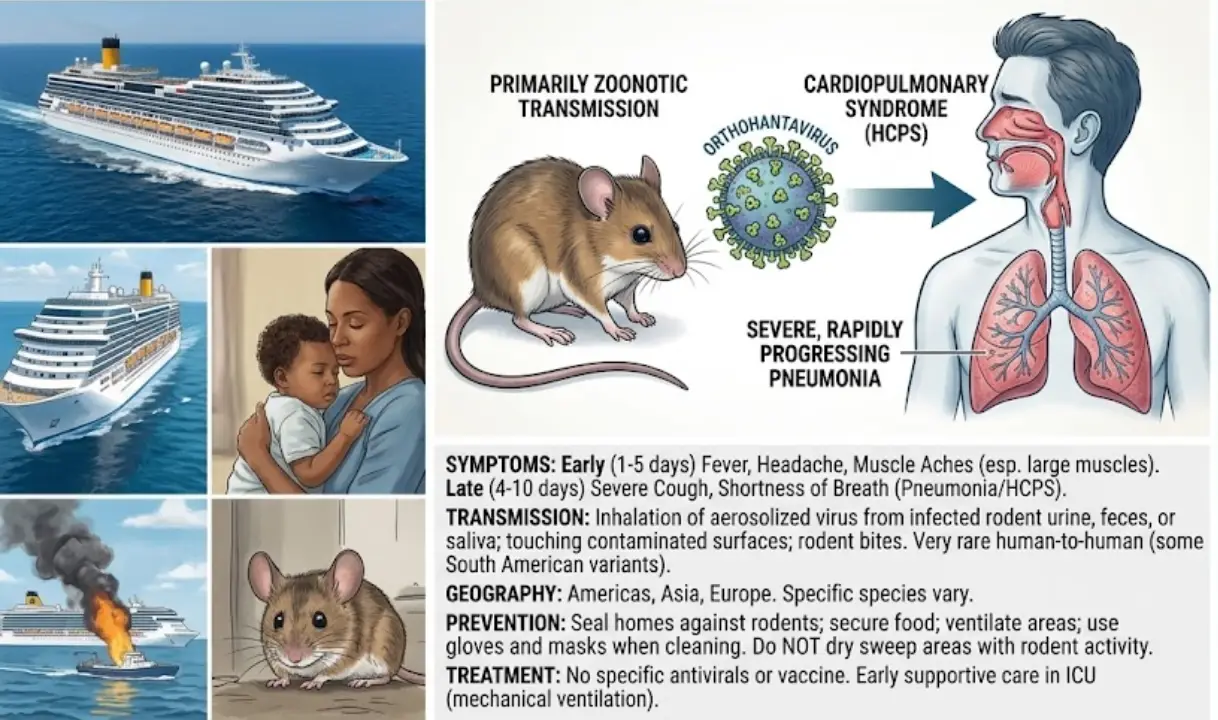
On 2 May 2026, the World Health Organization received formal notification from the United Kingdom's National IHR Focal Point of a cluster of severe acute respiratory illness aboard a Dutch-flagged cruise ship. The vessel had departed Ushuaia, Argentina, on 1 April 2026, traversing a remote itinerary across the South Atlantic that included mainland Antarctica, South Georgia, Nightingale Island, Tristan da Cunha, Saint Helena, and Ascension Island. Carrying a total of 147 individuals — 88 passengers and 59 crew members from 23 nationalities — the ship had navigated some of the most ecologically isolated regions on Earth before mooring off the coast of Cabo Verde.
As of 4 May 2026, seven cases have been recorded — two laboratory-confirmed hantavirus infections and five suspected cases — including three deaths, one critically ill patient currently hospitalised in an Intensive Care Unit (ICU), and three individuals on board reporting mild symptoms. Illness onset occurred between 6 and 28 April 2026, characterised by fever, gastrointestinal symptoms, and rapid progression to pneumonia, acute respiratory distress syndrome, and shock.
#Hantavirus cluster linked to cruise ship travel:
— World Health Organization (WHO) (@WHO) May 5, 2026
Since 1 April when the boat set sail, of the 147 passengers and crew, 7 people have become ill, among whom 3 have died, 1 is critically ill and 3 are reporting mild symptoms.
Based on the current information, including how… pic.twitter.com/KDKwmrNeBt
The first case involved an adult male who developed fever, headache, and mild diarrhoea on 6 April while on board. His condition deteriorated rapidly; by 11 April, he had developed respiratory distress and died the same day. No microbiological testing was performed, and his body was removed to Saint Helena on 24 April. A close contact — an adult female identified as Case 2 — went ashore at Saint Helena on the same date presenting with gastrointestinal symptoms. She deteriorated further during a flight to Johannesburg, South Africa on 25 April, and died upon arrival at the emergency department on 26 April. She was subsequently confirmed by PCR to have had hantavirus infection on 4 May. Contact tracing for passengers on that flight has been initiated.
Case 3, an adult male, presented to the ship's doctor on 24 April with febrile illness, shortness of breath, and signs of pneumonia. His condition worsened two days later, prompting medical evacuation to South Africa on 27 April, where he remains in an ICU. Laboratory testing confirmed hantavirus via PCR on 2 May 2026, with serology, sequencing, and metagenomics ongoing. A fourth adult female died on 2 May after experiencing symptom onset on 28 April, presenting with fever and general malaise. Three additional suspected cases with high fever and/or gastrointestinal symptoms remain on board, where medical teams in Cabo Verde are evaluating them and collecting specimens for testing.
WHO has activated three-level coordination and is supporting national authorities across five States Parties: Cabo Verde, the Netherlands, Spain, South Africa, and the United Kingdom. Epidemiological investigations are underway to identify the source of exposure, and Argentina's National IHR Focal Point has shared passenger and crew lists with relevant countries in accordance with nationality. Laboratory testing and confirmation have been conducted at South Africa's National Institute for Communicable Diseases (NICD), while additional samples are being sent, with WHO support, to the Institut Pasteur de Dakar in Senegal. In line with the working arrangement between the WHO Emergency Medical Team Secretariat and the EU Emergency Response Coordination Centre, formal discussions have been launched to support the clinical management and medical evacuation of symptomatic passengers.
Passengers on board have been advised to practice maximal physical distancing and remain in their cabins where possible. Logistical support, including sample collection materials, has been provided to the vessel. The extent of passenger contact with local wildlife during the voyage — or prior to boarding in Ushuaia — remains undetermined, a gap that investigators are actively working to close.
Hantavirus cardiopulmonary syndrome (HCPS) is a severe zoonotic respiratory disease transmitted primarily through contact with the urine, faeces, or saliva of infected rodents, or by touching contaminated surfaces. In the Americas, Orthohantavirus andesense is responsible for most South American cases, while limited human-to-human transmission of the Andes virus has been documented in previous outbreaks in community and healthcare settings. The case fatality rate in the Americas can reach up to 50%, and there are currently no specific antiviral treatments or approved vaccines.
WHO currently assesses the risk to the global population from this event as low and will continue to monitor the epidemiological situation and update the risk assessment as more information becomes available. WHO advises against the application of any travel or trade restrictions based on current information. The organisation recommends that passengers and crew practice frequent hand hygiene, remain vigilant for hantavirus symptoms, and undertake active symptom monitoring for 45 days following potential exposure. Crew members must ensure adequate environmental cleaning — avoiding dry sweeping — and proper ventilation throughout the vessel. Anyone experiencing respiratory symptoms is advised to wear a medical mask, self-isolate, and inform on-board medical professionals.
For healthcare environments, standard precautions combined with droplet precautions during close contact are considered sufficient for managing suspected or confirmed cases. Routine airborne precautions are not typically required, except during aerosol-generating procedures. Suspected cases should be promptly transferred to an emergency department or ICU for close monitoring and supportive management, as early intervention is critical given the rapid progression of HCPS.