A student who only memorises answers may succeed in examinations temporarily. A student who learns how to ask questions develops the ability to continue learning throughout life.
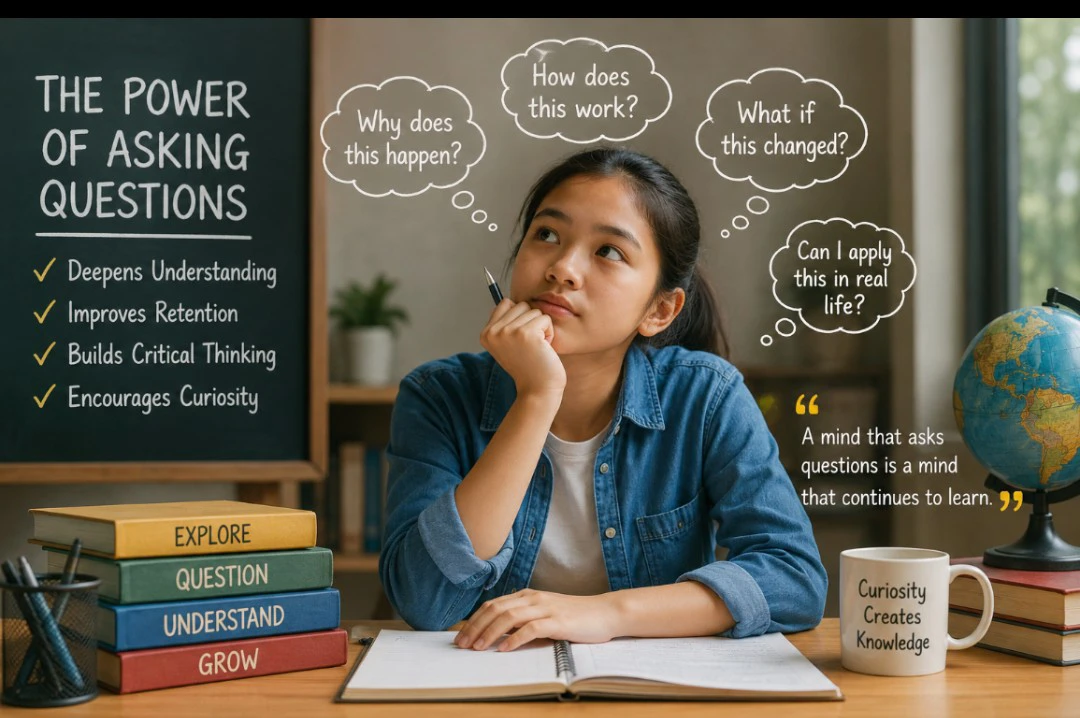
In many classrooms, learning still moves mostly in one direction. The teacher explains, students listen, notes are copied, and important answers are memorised before examinations. The system appears efficient on the surface because chapters are completed, tests are conducted, and marks are produced. Yet beneath this routine, a deeper problem quietly remains. Many students who perform reasonably well in examinations still struggle to explain the same topic in their own words a few weeks later.
This gap between memorisation and understanding is something I gradually began noticing during my teaching years. Students could reproduce textbook definitions almost perfectly, but when asked a slightly different or practical question, many became uncertain. At first, I assumed the issue was insufficient revision. Later, I realised the problem often lay elsewhere. Students were being trained mainly to answer questions, not to ask them.
That distinction may appear small, but it changes the entire nature of learning.
When students form questions from a lesson themselves, the mind becomes active in a completely different way. The child must identify important ideas, understand relationships between concepts, and think carefully about what the lesson is actually trying to say. The brain stops functioning like a storage device and begins functioning like a thinking system. Learning becomes participation rather than passive reception.
I remember introducing this method occasionally while teaching English grammar and computer subjects. Instead of ending a class by asking students to memorise answers, I would sometimes ask them to prepare five questions from the lesson on their own. Initially, many students struggled even to begin. Some copied questions directly from guidebooks because they had rarely been encouraged to think independently about the structure of a lesson.
But over time, noticeable changes emerged inside the classroom.
Students started listening more carefully during explanations because they knew they would later need to frame meaningful questions. Some who were usually quiet during class discussions slowly became more involved. A few average-performing students unexpectedly demonstrated strong conceptual understanding once they were encouraged to think critically about the material instead of memorising it mechanically. Even peer discussions improved because students became curious about how others interpreted the same lesson.
What changed was not merely performance. Attention itself changed.
Modern educational research strongly supports this approach. Cognitive psychologist Daniel Willingham has repeatedly argued that memory is deeply connected to thinking. Students remember what they actively process, analyse, and mentally work with. Simply rereading material repeatedly may create familiarity, but familiarity is not the same as understanding.
Research on “retrieval practice” and the “generation effect” in educational psychology also points toward the same conclusion. Students tend to retain information more effectively when they generate ideas, explanations, or questions themselves rather than merely reviewing ready-made material. The process of mentally retrieving and organising information strengthens long-term memory far more effectively than passive exposure.
Questioning naturally activates this process.
To frame a meaningful question, students must revisit the lesson mentally. They begin identifying confusion, recognising patterns, and evaluating what matters most within the chapter. In many cases, students discover gaps in understanding only when they attempt to ask questions independently. A child may feel confident while reading a chapter quietly but suddenly realise uncertainty while trying to create thoughtful questions from it.
That moment of confusion is not failure. In many ways, it is the beginning of genuine learning.
Unfortunately, many educational environments still unintentionally discourage questioning. In highly examination-oriented systems, silence is often mistaken for discipline. Students who frequently ask questions may sometimes be viewed as disruptive, slow, or unnecessarily argumentative. Over time, many children become hesitant to express curiosity openly because they fear embarrassment or criticism.
This becomes particularly visible in places where academic competition dominates educational culture. In Manipur today, conversations around education are increasingly shaped by marks, rankings, entrance examinations, and tuition schedules. Parents understandably worry about their children’s future opportunities, and students often move through exhausting routines involving school, coaching centres, homework, and revision sessions with very little mental space in between.
Within such systems, efficiency becomes the primary goal. Students are trained to identify “important questions,” memorise likely answers, and optimise examination performance. While this strategy may produce short-term results, it can also weaken independent thinking habits over time.
A student who only learns how to reproduce prepared answers may struggle when confronted with unfamiliar situations requiring analysis or adaptation.
This matters even more today because the future workplace increasingly rewards thinking skills rather than information recall alone. The World Economic Forum has repeatedly identified critical thinking, problem-solving, adaptability, and analytical reasoning among the most important future-ready skills. Artificial intelligence systems can already retrieve information instantly. What remains uniquely valuable is the human ability to question, interpret, connect ideas, and evaluate meaning.
Education therefore cannot remain limited to memorisation.
Students must gradually learn how to think independently, and questioning is one of the most natural pathways toward that independence.
I have observed this even while guiding my own son’s studies. Sometimes after completing a chapter, instead of immediately asking whether he had memorised everything, I encouraged him to ask questions about the lesson itself. Not only factual questions, but practical and reflective ones as well. Why does this happen? What would change if a certain condition were different? Can this concept apply in daily life? Which part still feels confusing?
Interestingly, these conversations often revealed understanding gaps more clearly than ordinary revision sessions. A student can sometimes memorise content without fully understanding it, but meaningful questioning exposes weak areas naturally and honestly.
This process also develops confidence gradually. Students stop viewing knowledge as something distant that belongs only to textbooks or teachers. They begin interacting with ideas personally. Learning becomes less about fear and more about exploration.
Some children especially benefit from this approach because they are naturally reflective learners. They may not excel immediately in rote-learning environments, but they understand deeply once they are allowed to discuss, question, and analyse concepts at their own pace. Traditional systems do not always recognise these learners early enough because memorisation is easier to measure than curiosity.
One particularly interesting change I observed during peer-questioning exercises was the improvement in classroom attention. When students knew they would later ask classmates questions from the lesson, they listened differently. They became mentally alert throughout the class because they were actively preparing themselves to engage with the material afterward. The lesson transformed from something to survive into something to interact with.
There is also an important emotional dimension to questioning.
Children remain curious when they feel their thoughts are respected. A classroom or home environment where every question is dismissed quickly can gradually make learning feel mechanical and emotionally distant. On the other hand, even small encouragement such as listening patiently or appreciating thoughtful curiosity can strengthen a child’s intellectual confidence significantly.
Parents do not need expensive systems or complicated educational tools to encourage this habit. Small practices can make meaningful differences. Children can be encouraged to frame three questions after finishing a chapter. Families can occasionally discuss current events together at dinner tables. Students can maintain small notebooks containing interesting questions, doubts, or observations. Teachers can allow brief peer-questioning activities during revision sessions instead of relying entirely on one-way instruction.
These habits slowly cultivate independent learners.
And independent learning may become one of the most important educational abilities of the coming decades. Knowledge itself is now available everywhere through search engines, videos, and AI systems. But the ability to ask meaningful questions, identify confusion, examine claims carefully, and think critically remains deeply human.
A student who only memorises answers may succeed in examinations temporarily. A student who learns how to ask questions develops the ability to continue learning throughout life.
Perhaps that is the deeper purpose of education itself. Not merely producing students capable of reproducing information under pressure, but nurturing minds capable of curiosity, reflection, understanding, and independent thought. Real learning often begins not when a child gives the right answer immediately, but when the child becomes thoughtful enough to ask better questions.
(Keithellakpam Manikanta Meetei is a seasoned journalist and a former educator. He also writes under his pen name Keicha Chingthou Mangang instead of his actual name. You can contact him at chingthouheiya@gmail.com)