An analytical look at how students in Manipur are blending traditional study methods with digital tools to reshape learning in a changing educational landscape.
By Keithellakpam Manikanta Meetei
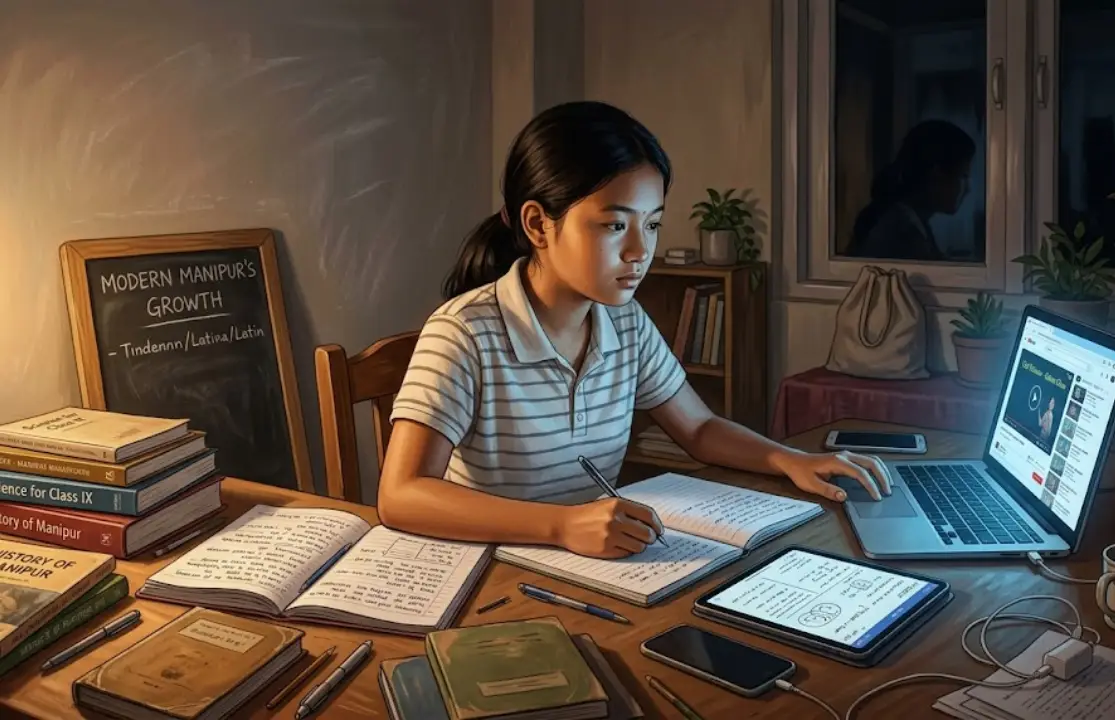
For generations, the image of studying in Manipur has remained largely unchanged: a quiet room, neatly arranged textbooks, handwritten notes, and long hours spent in silence. It is an image that still dominates the educational mindset of many parents, who continue to associate effective learning with stillness, discipline, and distance from distraction. Study rooms and self-study spaces have even emerged as modest business models in the state, offering students a controlled environment away from the noise and unpredictability of daily life. In many ways, these spaces reflect a genuine and pressing need in a society where peaceful conditions for study are not always easy to find.
But beneath this familiar surface, learning itself is beginning to change — quietly, gradually, and without announcement.
The modern study session no longer looks the same for every student. Some learn best through videos, others through discussion or structured notes. An increasing number are combining digital tools, online explanations, and self-tailored methods to understand concepts at their own pace. What once seemed unconventional is becoming, for many young learners, simply normal. This shift is not merely about technology replacing books or screens displacing classrooms. It reflects something more fundamental: a movement away from standardised learning toward something far more personal.
The real issue is no longer access to information — it is learning how to navigate it meaningfully.
Today's students are growing up in a world overflowing with information. Unlike previous generations, who were largely dependent on textbooks, libraries, and teachers, today's learners can access explanations, tutorials, simulations, discussions, and digital assistance almost instantly. This abundance brings genuine opportunity, but also real challenge. The question before educators and students alike is no longer whether information is available — it almost always is — but how to engage with it critically and purposefully.
As someone who began his professional journey as a teacher before moving into journalism, I observe these changes with a mix of curiosity and care. During my years in the classroom, silence was often treated as a precondition for concentration. A disciplined class was, almost by default, a quiet one. Yet over time, I noticed that students did not all learn in the same way. Some grasped material through repetition, others through lively discussion, and still others through questioning and active experimentation. No single method worked for everyone.
That reality has only grown more visible today.
A student studying while listening to soft music, switching between a textbook and a digital explanation, or exploring ideas across multiple platforms may appear distracted to an older generation watching from the outside. But many of these students are not escaping learning — they are reshaping it according to their own cognitive rhythms and environments. Appearance, in this case, can be genuinely misleading.
This evolution carries particular weight in a place like Manipur, where students often navigate social instability, crowded households, irregular routines, and mounting academic pressure simultaneously. Under such conditions, insisting that every learner conform to a single rigid model is not simply demanding — it may no longer be realistic. Here, adaptability itself becomes part of education.
Somewhere between chalk dust and touchscreens, a new culture of learning is quietly taking shape.
None of this suggests that discipline has become irrelevant, or that every new trend deserves uncritical adoption. Technology, like any tool, can either strengthen learning or undermine attention, depending entirely on how it is used. The challenge before parents, teachers, and students is not whether to accept change blindly or reject it wholesale. It is how to integrate useful change thoughtfully — keeping what works, questioning what does not, and remaining honest about the difference.
Educational psychologist Carol Dweck's research on the growth mindset is instructive here. Her work argues that learning flourishes when students are encouraged to see ability not as fixed, but as something that develops through effort, experimentation, and persistence. That insight aligns closely with how many contemporary educators now speak about learning: not as the mere delivery of content, but as the cultivation of habits — curiosity, adaptability, critical thinking, and the willingness to keep learning long after formal education ends.
The future will demand far more than memorisation. It will require learners who can think independently, adapt to unfamiliar problems, evaluate information wisely, and sustain the motivation to grow throughout their lives. In that sense, education is quietly redefining its own purpose.
The blackboard has not disappeared. The textbook still matters. Teachers remain irreplaceable. But around these enduring foundations, a new learning ecosystem is taking shape — one that blends traditional rigour with digital tools, flexibility, and personal exploration. The two are not in opposition. They are, increasingly, in conversation.
For many parents and educators, this transformation may feel unsettling. Every generation tends to trust the methods it was shaped by. Yet history offers a useful reminder: education has always evolved alongside the society it serves. The forms change. The deeper purpose — helping young minds grow into capable, thoughtful human beings — does not.
The challenge now is neither to resist change out of fear, nor to embrace every trend without discernment, but to ask honestly what truly helps students learn better in the world they are actually living in.
---
(Keithellakpam Manikanta Meetei is a seasoned journalist and a former educator. He also writes under his pen name Keicha Chingthou Mangang instead of his actual name. You can contact him at chingthouheiya@gmail.com)