Critical minerals beneath Manipur’s complex geology may place Northeast India at the centre of the global clean energy and technology economy.
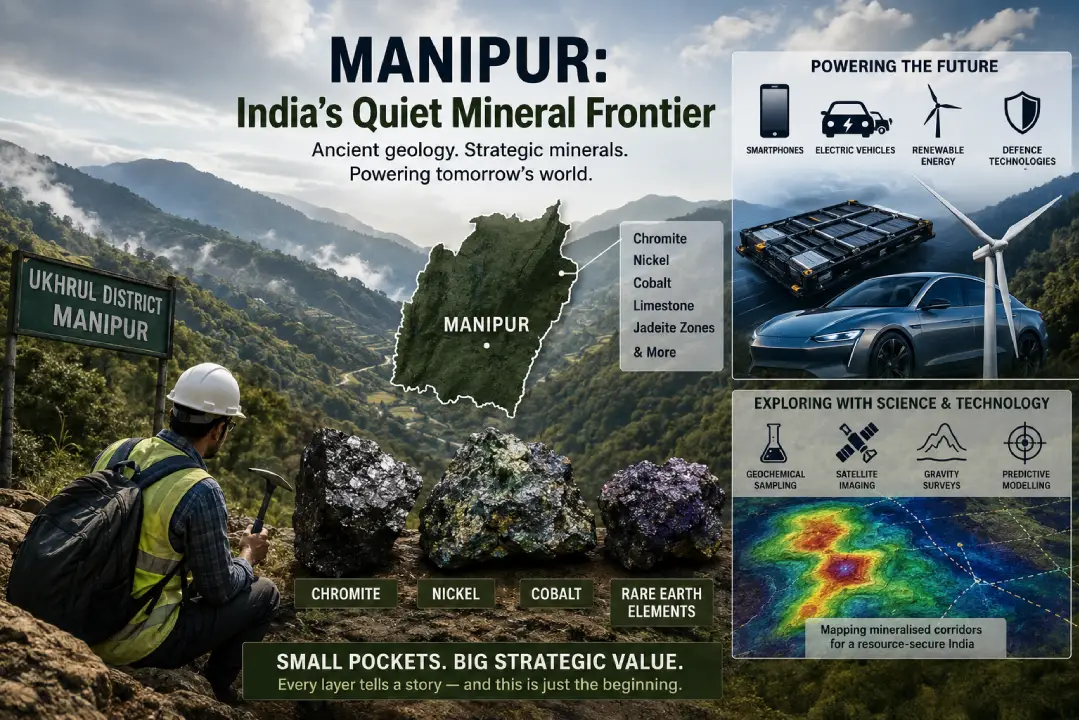
IMPHAL, May 20: For decades, Northeast India was discussed largely through the language of conflict, remoteness and underdevelopment. Today, a different narrative is quietly emerging beneath its forests and mountain ranges — one tied not to geopolitics alone, but to the future of global technology itself.
The growing international race for critical minerals has pushed regions like Manipur into sharper focus. According to the Geological Survey of India’s recent Handbook on Geological Potential of Northeast India, the state may hold geological formations capable of hosting strategic minerals such as nickel, cobalt, chromite and rare earth elements — materials that now sit at the heart of electric vehicles, smartphones, renewable energy systems and defence technologies.
The significance of this shift cannot be overstated. The 21st century economy is increasingly dependent on minerals once considered obscure outside geological circles. Lithium powers rechargeable batteries. Cobalt stabilises battery chemistry. Rare earth elements are crucial for magnets used in wind turbines, electronics and military equipment. Nations across the world are scrambling to secure reliable supply chains as dependence on limited mining regions creates economic and strategic vulnerabilities.
In that changing map, Manipur’s terrain is no longer peripheral.
What makes the region particularly important is its geology. Manipur lies within the Indo-Burma Fold Belt, a tectonically active zone formed through the collision of the Indian and Burmese plates millions of years ago. Unlike the older Shillong Plateau nearby, Manipur’s geological formations are relatively younger and more chaotic, shaped by violent tectonic movements that folded, fractured and uplifted deep-earth rocks onto the surface.
Among the most important formations identified by geologists are ophiolite complexes — fragments of ancient oceanic crust and upper mantle that were thrust upward during tectonic collisions. These formations are not merely scientific curiosities. They are known globally as host rocks for strategic minerals, especially chromite, nickel and cobalt.
In districts such as Ukhrul, locations including Shirui, Harbui and Lunghar have already shown chromite occurrences within ultramafic rock formations. These dense mantle-derived rocks, later altered through weathering and chemical processes, may also contain concentrated lateritic soil deposits enriched with nickel, cobalt and rare earth elements.

The science behind this is striking. Over millions of years, heavy tropical rainfall chemically weathered the ultramafic rocks, washing away lighter minerals while leaving behind residual concentrations of heavier metals in rust-coloured lateritic soils. In effect, nature itself performed a long-term concentration process that modern mining companies now seek to identify and evaluate.
This geological possibility explains why exploration priorities are changing. Traditional mineral resources in Manipur, such as small pockets of lignite or scattered limestone deposits, are increasingly less significant in a world moving away from fossil fuels. The strategic value now lies in minerals essential for energy transition technologies.
Beneath Manipur’s hills lies a geological story still unfolding.
— Ministry of Mines (@MinesMinIndia) May 13, 2026
From chromite, nickel and cobalt occurrences to limestone belts, jadeite zones, and other strategically important minerals, the state holds significant untapped mineral potential waiting to be explored responsibly… pic.twitter.com/4qXWdWf8Ji
Ministry Signals Growing Strategic Interest
The Geological Survey of India’s handbook is not emerging in isolation. In recent months, the Ministry of Mines itself has begun publicly framing Manipur as an important frontier in India’s evolving critical minerals strategy.
In a Facebook post published on May 13, 2026, the Ministry of Mines described Manipur as “India’s Quiet Mineral Frontier,” pointing to the state’s “significant untapped mineral potential” and highlighting occurrences of chromite, nickel, cobalt, limestone belts, jadeite zones and other strategically important minerals.
The ministry stated that as India moves toward “resource security and future-ready mineral development,” Manipur is “gradually emerging as an important frontier in the country’s mineral landscape.”
One of the graphics shared in the post described Manipur’s mineral geography as “geologically diverse, strategically significant, and still underexplored,” adding that “every layer tells a story — and this is just the beginning.”
The messaging reflects a broader shift in how Northeast India is being positioned within national resource planning. For years, mineral exploration in the region remained relatively limited due to difficult terrain, ecological sensitivity, weak infrastructure and political instability. But the accelerating global demand for critical minerals appears to be reshaping that approach.
The Ministry’s emphasis on “small pockets, big strategic value” also aligns closely with the Geological Survey of India’s findings regarding Manipur’s fragmented ultramafic formations and lateritic mineral zones. Unlike massive continuous ore belts found in traditional mining regions, many of Manipur’s mineral occurrences are scattered and structurally complex. Yet in the era of battery technologies and strategic resource competition, even smaller deposits of cobalt, nickel or rare earth elements can carry disproportionate economic significance.
The Rise of Data-Driven Exploration
But locating such deposits in Manipur is not straightforward. The region’s dense forests, steep terrain and fragmented geology make conventional exploration methods slow and expensive. This is where the government’s newer exploration frameworks become important. The Critical Mineral Assessment Programme (CMA) and the Regional Mineral Targeting (RMT) initiative represent a shift from traditional field-based prospecting toward data-driven predictive exploration.
Instead of relying only on visible rock outcrops, geologists now combine geochemical sampling, satellite imaging, structural fault mapping, gravity surveys and remote sensing technologies to identify “mineralised corridors” beneath inaccessible terrain.
Even vegetation patterns are being studied. Heavy metal concentrations in soil can alter the way plant cover reflects light, allowing satellites to detect subtle anomalies. Gravity surveys can identify dense ultramafic rock bodies hidden beneath the surface because such formations exert slightly stronger gravitational signatures than surrounding sedimentary rocks.
The result is a predictive geological model — one that significantly reduces the financial risks of exploration in complex terrains like Manipur.
This matters not only for India’s resource security but also for Northeast India’s future economic trajectory. If commercially viable deposits are eventually confirmed, the region could become part of a strategic global supply chain linked to electric mobility, clean energy and advanced manufacturing.
Yet the opportunities come with equally serious questions.
Critical mineral extraction is rarely free from environmental and social consequences. Mining in ecologically sensitive and politically fragile regions carries risks of deforestation, displacement, water contamination and intensified land conflicts. Manipur’s already complex socio-political realities mean that any future mineral development will require far greater transparency, consultation and environmental safeguards than India’s extractive sectors have historically demonstrated.
The global demand for critical minerals may be accelerating, but local communities will inevitably ask who benefits, who bears the costs and whether development will genuinely improve livelihoods on the ground.
That debate has only just begun.
Still, one reality is becoming increasingly difficult to ignore: the global clean-energy transition is not being built only in laboratories, factories or financial centres. Part of its foundation may already lie hidden beneath the rain-soaked hills of Northeast India.