The Swasth Bharat Portal, launched by Union Health Minister J.P. Nadda, integrates India's siloed health programme systems into a single API-driven platform, promising 20–40% reductions in data entry, HR duplication, and infrastructure costs.
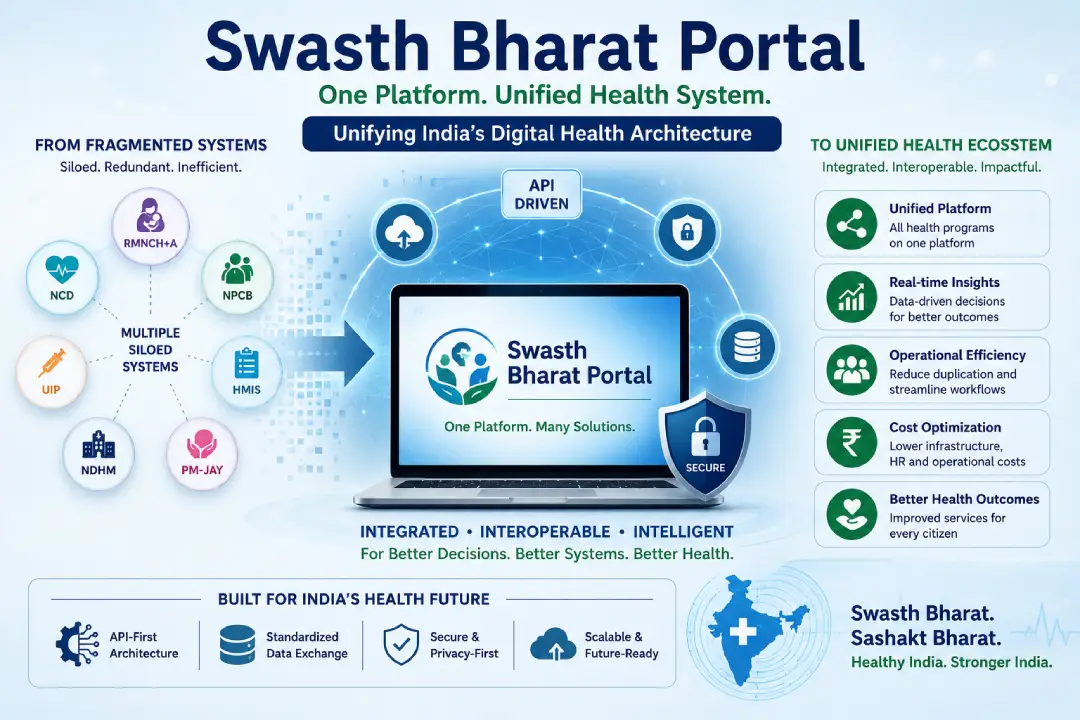
India's public health system has long grappled with a structural challenge that technology inadvertently deepened: the proliferation of independent digital applications across national health programmes, each operating in isolation, duplicating data, fragmenting workflows, and burdening frontline workers with multiple logins and redundant reporting tasks. The launch of the Swasth Bharat Portal marks a decisive effort to resolve this, bringing India's digital health infrastructure into a new era of integration, efficiency, and interoperability.
The portal was unveiled by Union Minister for Health and Family Welfare, Jagat Prakash Nadda, during the 10th National Summit on Innovation and Inclusivity: Best Practices Shaping India's Health Future. It represents a landmark milestone in the Ministry of Health and Family Welfare's (MoHFW) broader agenda of transforming India's digital public health architecture from a collection of siloed systems into a cohesive, data-driven ecosystem.
#HealthForAll
— Ministry of Health (@MoHFW_INDIA) May 6, 2026
Swasth Bharat Portal Unveiled: Unifying Fragmented Health Systems to Power India’s Digital Health Transformation
Swasth Bharat Portal as a One-Stop Aggregator Platform to Integrate Programme Systems via APIs, Enabling Interoperability and Reducing Administrative… pic.twitter.com/fnhfKKlKXl
Over the past decade, the MoHFW developed multiple digital applications under various national health programmes to support service delivery, monitoring, and reporting. While this drive towards digitisation enabled data capture at scale and brought measurable improvements in programme management, it also produced an increasingly complex technology landscape characterised by fragmentation.
Each programme operated its own independent platform, requiring separate logins, separate data entry, separate hosting infrastructure, and separate development and maintenance teams. Frontline health workers — including Accredited Social Health Activists (ASHAs), Auxiliary Nurse Midwives (ANMs), Community Health Officers (CHOs), and Medical Officers (MOs) — were required to navigate multiple applications in the course of their daily duties, consuming time that could otherwise be directed towards patient care. Datasets remained siloed, preventing cross-programme analysis, evidence-based planning at the local level, and efficient resource utilisation. The cumulative cost of maintaining this fragmented architecture — in terms of human resources, IT infrastructure, and administrative overhead — was substantial.
The Swasth Bharat Portal has been architected as an aggregator platform rather than a replacement system. It integrates existing programme applications through an Application Programming Interface (API)-based federated architecture, creating a unified digital layer that sits above the individual systems without dismantling them. This design approach preserves existing programme-specific workflows while enabling interoperability and convergence at the data and user-access levels.
For frontline workers, the most immediate benefit is the elimination of multiple logins. The portal provides a single interface through which health personnel can access all programme systems, enter data once, and fulfil reporting obligations across programmes simultaneously. This not only reduces administrative burden but also standardises data capture, improving the quality and consistency of health information flowing upward through the system.
The portal is fully compliant with the Ayushman Bharat Digital Mission (ABDM) and supports integration with ABHA — the Ayushman Bharat Health Account — enabling secure and seamless exchange of patient health records across institutions and programmes. It is further designed to integrate with national registries, including the Healthcare Professionals Registry (HPR) and the Health Facility Registry (HFR), laying the groundwork for a comprehensive and interoperable national digital health ecosystem.
The Swasth Bharat Portal is projected to deliver substantial efficiency gains across multiple dimensions of public health administration. By consolidating independent hosting, storage, and compute resources into a unified platform, the portal is expected to reduce IT infrastructure load by approximately 20 to 30 per cent. The consolidation eliminates the need to maintain separate server environments, licences, and technical support structures for each programme.
In terms of data management, the portal is expected to cut data entry effort by 20 to 40 per cent. Beneficiary information that was previously entered repeatedly across multiple systems will now be recorded once on the unified platform and made available across programmes through API linkages. Similarly, the consolidation of development and maintenance responsibilities into a single unified system is expected to reduce HR duplication by 20 to 40 per cent, freeing technical personnel to focus on innovation and system improvement rather than parallel maintenance.
Beyond quantifiable savings, the portal is designed to accelerate decision-making speed at all levels of the health system. By providing integrated data visualisation tools and enabling local-level data access for monitoring and evidence-based planning, it empowers health administrators and programme managers to identify trends, gaps, and opportunities in near real-time rather than relying on time-lagged aggregated reports.
Projected Efficiency Gains at a Glance
|
Infrastructure Load |
~20–30% reduction |
|
Data Entry Effort |
~20–40% reduction |
|
HR Duplication |
~20–40% reduction |
|
Decision-Making Speed |
Increased — through integrated data visualisation |
|
ABDM Compliance |
Yes — supports ABHA integration |
|
Registry Integration |
Healthcare Professionals Registry (HPR) and Health Facility Registry (HFR) |
The launch of the Swasth Bharat Portal is more than a technology upgrade — it is a governance reform. By eliminating the structural inefficiencies embedded in India's fragmented health IT landscape, the portal enables the MoHFW to extract greater value from the investments already made in individual programme systems, while simultaneously reducing the ongoing cost of maintaining them in parallel.
For India's vast frontline health workforce, the change is tangible: fewer applications to navigate, less time spent on administrative tasks, and more time available for direct service delivery. For programme managers and policymakers, the portal offers a unified, real-time view of health data across programmes — a capability that has long been identified as essential for responsive, evidence-based public health governance. The Swasth Bharat Portal thus sets a new standard for how digital public infrastructure can be designed to serve not just administrative efficiency, but the broader goal of equitable, data-driven healthcare delivery across India.