Vercel Labs has introduced Zero, an experimental systems programming language designed for AI agents to read, repair and ship native software.
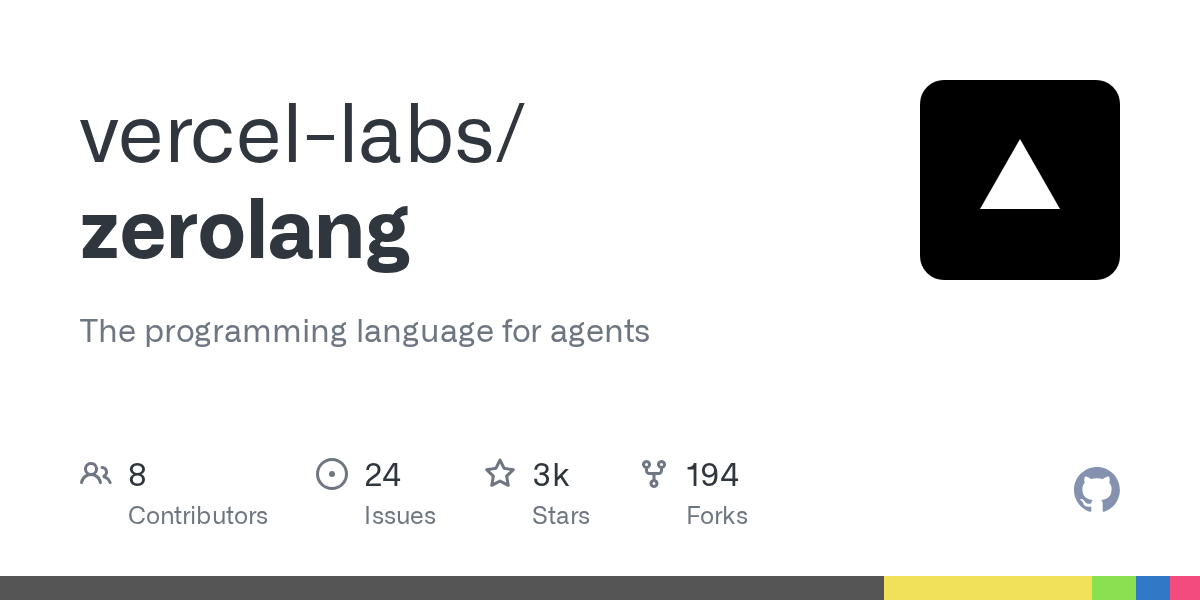
Imphal, May 20: Cloud platform company Vercel has introduced an experimental programming language called “Zero”, positioning it as a systems language designed specifically for AI agents rather than conventional human-centric software development workflows.
The announcement was made by Vercel Labs earlier this month as the broader technology industry increasingly shifts toward autonomous AI coding systems and “agentic” software development. The company said Zero was created to help AI systems read, inspect, repair and compile programs more reliably without depending heavily on human interpretation.
According to the official project description shared by Vercel Labs, the language was designed from the ground up to make machine interaction with code more structured and predictable. The compiler outputs diagnostics in JSON format, allowing AI agents to process errors, understand repair instructions and apply fixes programmatically.
Chris Tate, who introduced the project publicly on behalf of Vercel Labs, said the goal was to create “a systems language that was faster, smaller, and easier for agents to use and repair.” He also highlighted features such as “explicit capabilities”, “JSON diagnostics”, and “typed safe fixes” as central design principles behind the language.
The company described Zero as “the programming language for agents,” reflecting the growing interest across the software industry in AI systems capable of autonomously generating and modifying code.
Focus on machine-readable programming workflows
Unlike many existing programming languages that were primarily designed around human developers, Zero attempts to structure software behaviour in ways that are easier for AI systems to interpret.
Vercel Labs said the language removes several layers of ambiguity that often complicate AI-generated programming. The language reportedly avoids hidden allocators, implicit asynchronous operations and mandatory garbage collection mechanisms. External system access such as file operations or network communication must also be explicitly declared through capability-based function signatures.
Another key aspect of the project is the compiler architecture. Instead of producing only text-based error messages intended for human developers, the Zero compiler emits structured machine-readable diagnostics. These include stable error identifiers and metadata intended for automated repair systems.
Reports describing the launch said the language can also generate small native binaries while maintaining predictable memory behaviour and explicit error flows.
Technology observers view the project as part of a broader industry movement toward AI-assisted software engineering. Over the past year, major technology firms and AI startups have increasingly invested in coding agents capable of independently writing, debugging and deploying software.
Released as an experimental project
Vercel Labs has clarified that Zero remains an experimental project and is still under active development.
The company released the language under the Apache 2.0 open-source licence and made the compiler, documentation and sample projects publicly available for testing and feedback.
Technical reports linked to the launch noted that the current release should not yet be considered production-stable. Vercel Labs said the project is still evolving and that the publicly released compiler and standard library are intended mainly for experimentation and community feedback.
The launch also comes at a time when Vercel is expanding its broader AI infrastructure strategy. The company, widely known for developing Next.js and cloud deployment tools for frontend applications, has increasingly focused on AI-native cloud infrastructure, AI coding systems and autonomous software agents.
In recent months, Vercel has introduced multiple AI-focused services including AI Cloud infrastructure, AI Gateway integrations and automated backend deployment systems.
Company executives have repeatedly argued that software development is moving toward what they describe as an “agentic internet”, where autonomous AI systems handle larger portions of application development and operational workflows.
Growing competition in AI coding tools
The emergence of Zero also reflects intensifying competition in the AI coding ecosystem.
Technology companies including OpenAI, Google, Anthropic and several startups are rapidly developing AI-assisted coding systems capable of generating software from natural language prompts. Tools such as Cursor, GitHub Copilot, Claude Code and Vercel’s own v0 platform have accelerated adoption of AI-supported development workflows.
Industry analysts say current AI coding systems still face reliability challenges, especially when handling debugging, infrastructure management and large-scale code maintenance. Structured programming environments such as Zero could potentially improve machine interpretability and reduce ambiguity in automated software repair.
However, experts also caution that agent-driven software development remains an evolving field with unresolved questions around reliability, security and accountability.
The issue gained additional attention recently after Vercel disclosed a security incident involving unauthorised access to some internal systems linked to a third-party AI tool integration. The company said it had engaged incident response experts and informed law enforcement authorities while investigating the breach.
Despite those concerns, investment and experimentation around AI-native software infrastructure continue to accelerate globally.
Vercel has not yet announced a commercial roadmap for Zero, though reports citing the company indicated that future stable releases are expected after additional testing and ecosystem development.
For now, the project is being presented primarily as a research and experimentation initiative aimed at exploring how programming languages may evolve in an era increasingly shaped by autonomous AI agents.