Manipur occupies a mere 0.7% of India’s total landmass. With a population of just 28.56 lakh, this small northeastern state—nestled in the transitional zone of Indian and Malayan biodiversity—might appear to be a geographical underdog.
Manipur occupies a mere 0.7% of India’s total landmass. With a population of just 28.56 lakh, this small northeastern state—nestled in the transitional zone of Indian and Malayan biodiversity—might appear to be a geographical underdog. Yet, on the international sporting stage, Manipur is a colossus. From the indomitable Mary Kom to a consistent dominance in national leaderboards, the region punches significantly above its weight. To the Manipuri consciousness, the boundary between the sacred and the competitive is porous; sports are not merely a pastime but a profound cultural manifestation of identity and survival.
How did such a small territory become a global powerhouse? The answer lies in a deep-seated history where ancient manuscripts, royal patronage, and a warrior ethos have converged to create an unparalleled sporting lineage.
1. Polo Isn’t Just for Elites—It’s an Ancient Manipuri Legacy
While global audiences often associate polo with the Western aristocracy, its true heart beats in the valley of Manipur. The indigenous game, Sagol Kangjei, is no modern import. According to the Cheitharol Kumpaba (the Royal Chronicle of Manipur) and ancient manuscripts written in the Meetei Mayek script, such as Kangjeirol (the Lore of Polo), the game originated during the reign of King Kangba in the fourth millennium B.C.
Far from being an elitist pursuit, Sagol Kangjei was a grassroots passion rooted in the people's cosmology and their sacred relationship with the Manipuri pony. Historical records, including the Leithak Leikharol, describe the game as a manifestation of faith and belief. It flourished through the centuries, particularly under King Khagemba (1597–1652), who formalized many of the indigenous traditions that survived the colonial transition.
"Every boy who could master a pony played Sagol Kangjei, and every boy who could not play on foot." — Sir James Johnstone, My Experiences in Manipur and the Naga Hills (1971)
2. Indigenous Games Were Actually Stealth Warfare Training
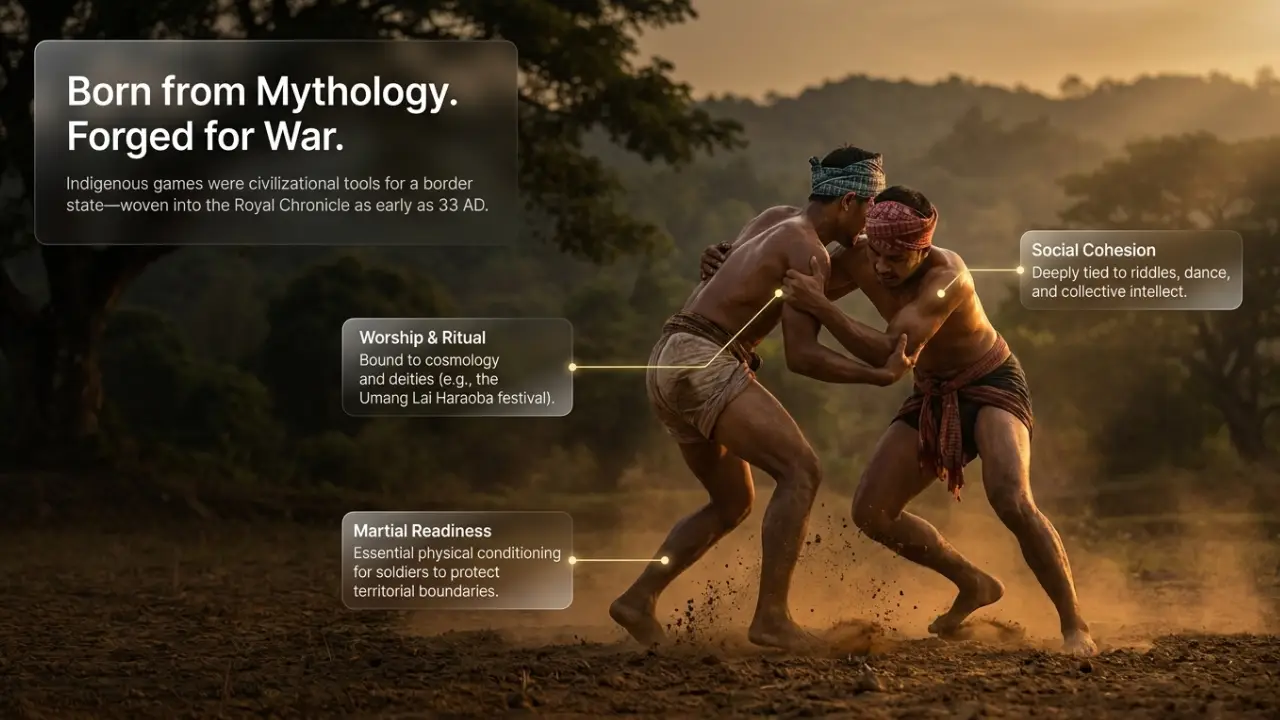
In Manipur, the evolution of sports is inseparable from the history of nation-making. For a small state frequently tasked with defending its boundaries against foreign invaders, physical prowess was a prerequisite for survival. Indigenous games like Mukna (wrestling), Thang-Ta (martial arts), and Arambai Hunba (dart throwing from horseback) were meticulously designed to ensure soldiers remained in a state of perpetual combat readiness.
However, a cultural historian would note that these games were never purely physical. As documented in ancient texts like Chainarol, there is a profound story, riddle, and philosophy behind every game. Intellectual and social development was woven into play; for instance, games exclusively for girls were designed to teach essential life skills—such as the preparation of healthy food and the etiquette of service—disguised as recreation. From the ritualistic boat races of Hiyang Tanaba to the "coconut rugby" of Yubi Lakpi and the traditional game of Kang, these activities served as tools for social cohesion and civilizational development.
3. The King Who Was a "Player-Manager"
The successful bridge between ancient traditions and modern Western sports—such as hockey, cricket, and football—was built through "Royal Patronage." Maharaja Churachand Singh, who ruled in the early 20th century, was far more than a figurehead; he was a dedicated athlete who essentially acted as the state’s premier "player-manager."
A proficient hockey and cricket player himself, the Maharaja was instrumental in establishing the Hapta Kangjeibung grounds. He formed the "Maharaj Team" to compete against British Sepoys in 1905 and personally financed the state’s participation in the 1940 All-Assam Olympic Games. By actively participating in these new disciplines, the royalty ensured that modern sports were not viewed as colonial impositions, but as a natural extension of the Manipuri warrior tradition.
4. The 1999 "Miracle in Imphal"
Manipur’s arrival as a national sporting hegemon reached its zenith during the 5th National Games in 1999. To understand the significance of this "Miracle in Imphal," one must look to the state’s political history. Before attaining full statehood in 1972, Manipuri athletes were often forced to compete under the banner of Assam due to a lack of independent national affiliation. For instance, hockey legend Soram Lokeshwar Singh had to play for the Assam team in the 1968 National Championship.
Winning the overall championship in 1999 was a symbolic declaration of independence and excellence. The contingent was led by iconic flag bearers who embodied this lineage: Kkhetrimayum Tingongleima Chanu, the world-class goalkeeper of the silver-medal-winning hockey team at the 1970 Asian Games, and Ngangom Dingko Singh, the celebrated Asian Games boxing gold medalist. Their presence linked the struggles of the post-colonial era to the triumphs of the modern state.
5. A Government That Treats Athletes Like Civil Servants
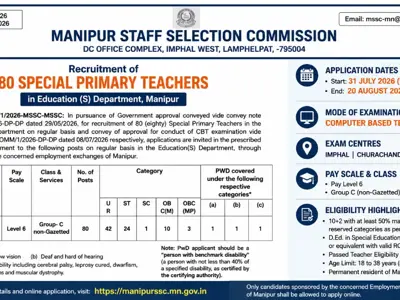
The final secret to Manipur’s sustained success is the institutionalization of sports as a high-stakes professional career. Following the 1972 transition to statehood, the government moved to turn cultural passion into economic security. Today, Manipur offers some of the most robust incentives in India to its athletes:
This institutional support has cultivated an extraordinary roster of 20 Arjuna Awardees across diverse disciplines, including weightlifting icon Nameirakpam Kunjarani Devi, football legend Oinam Bembem Devi, boxing champion Laishram Sarita Devi, and archery star Laishram Bombayla Devi. By treating the stadium as a training ground for the civil service, Manipur ensures that its talent is nurtured from the grassroots to the global podium.
Conclusion: Beyond the Medal Tally
The rise of Manipur is not a mere accident of geography or biology. It is the result of a centuries-old tapestry where history, religion, and politics are inextricably intertwined with the spirit of competition. From the ancient philosophies recorded in the Meetei Mayek manuscripts to the modern-day "Joint Director" positions, the state has built a society where every citizen is, in some sense, born a player.
This leaves us with a compelling question: Is the Manipuri model of total cultural and institutional immersion in sports a replicable strategy for other nations, or is it a unique, lightning-in-a-bottle result of a history where sport was the only way to ensure the survival of the state?
Reference:
Sanasam Yaiphaba Singh, Yumlembam Khogen, Rajendra Kshetri. (2025). Intertwining Of Sports With A Region's Cultural, Religious And Political History: The Case Of Manipur. Journal of Applied Bioanalysis, 11(S4), 794-800. https://doi.org/10.53555/jab.v11si4.1050