A student who depends on motivation has to make a decision every day. Should I study now or later? Which subject should I pick? How long should I sit? Each of these questions takes mental effort. When the mind is already tired, it chooses the easiest option, which is to postpone.
There is a scene that plays out in many homes.
A child sits with an open book. The clock moves forward, but the page does not. After a while, the familiar line appears: “I don’t feel like studying today.”
We tend to accept this as normal. We even try to solve it by searching for motivation. Parents advise, teachers encourage, sometimes we even scold. All of it revolves around one assumption that has quietly shaped our thinking: a child must feel motivated before they can act. But if we observe carefully, this assumption does not hold for long.
Motivation is unreliable. It changes with mood, energy, sleep, and small events of the day. A student may feel inspired today and completely withdrawn tomorrow. When learning depends on such a fluctuating force, consistency becomes difficult.
Over time, this inconsistency is often misunderstood. We call it laziness. In reality, it is something else. It is the absence of structure.
A student who depends on motivation has to make a decision every day. Should I study now or later? Which subject should I pick? How long should I sit? Each of these questions takes mental effort. When the mind is already tired, it chooses the easiest option, which is to postpone.
This is where the idea of systems becomes important.
A system is simply a fixed way of doing things. It removes the need to decide repeatedly. Instead of asking every day, the answer is already built into the routine.
For example, saying “I will study when I feel like it” sounds flexible, but it creates uncertainty. Saying “I will study from 6 to 7 in the evening” is a system. It is simple, but it reduces confusion.
In my own experience as a parent, I have noticed that children do not resist effort as much as we think. They resist unclear expectations. When study time shifts every day, when there is no predictable pattern, they hesitate. Not because they do not want to learn, but because they do not know where to begin.
With my son, I did not try to increase pressure. I tried to reduce ambiguity.
We fixed a time. Not a long one, just a consistent one. We did not focus on how much he studied on a particular day. We focused on whether he showed up at the same time every day. At first, there was resistance. That is natural. But after a few days, something changed.
The negotiation reduced. This is the quiet strength of a system. It does not force action. It makes action easier. There are a few simple systems that any student can follow without feeling overwhelmed.
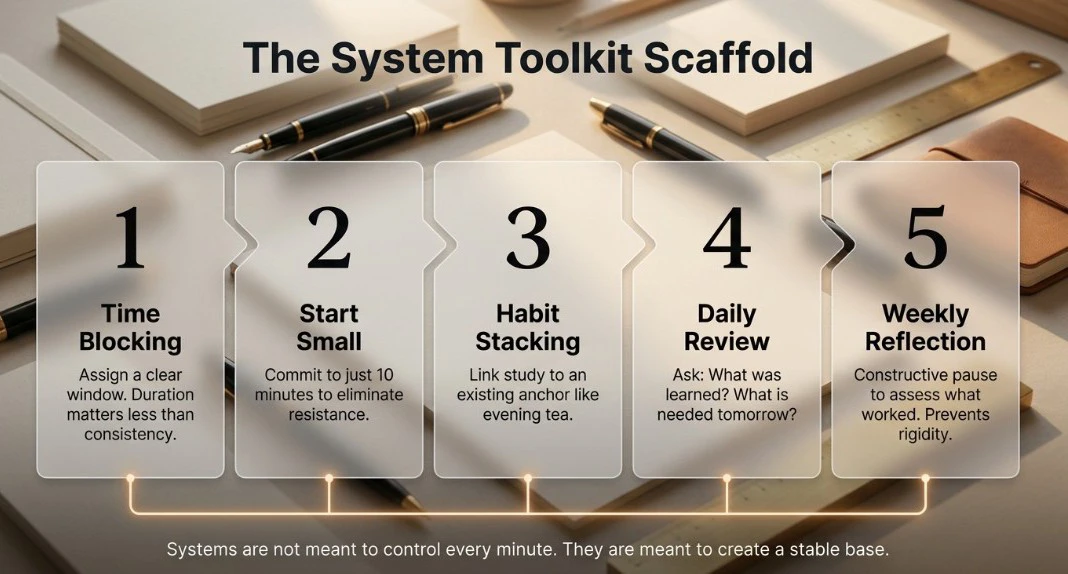
The first is time blocking. Instead of leaving study time undefined, assign a clear window. It could be one hour in the evening. The exact duration is less important than the consistency. Over time, the mind begins to associate that time with focus.
The second is starting small. Many students struggle because they think they have to sit for long hours. That thought itself creates resistance. A better approach is to begin with a very small commitment. Even ten minutes is enough. Once the child begins, continuation becomes easier.
Another useful approach is linking study with an existing habit. For instance, studying after evening tea or after dinner. When a new habit is attached to something familiar, it feels less forced.
A short daily review also helps. At the end of the day, asking what was learned and what needs to be done tomorrow builds clarity. It keeps the process active in the child’s mind.
Once a week, it is helpful to pause and reflect. Not in a critical way, but in a constructive one. What worked this week? What did not? This small practice prevents the system from becoming rigid.
What is important here is not perfection. Systems are not meant to control every minute. They are meant to create a stable base.
There is often a concern that such structure may make a child’s life mechanical. In practice, I have found the opposite. When the routine is clear, the child becomes more relaxed. There is less mental clutter. They know what is expected, and that clarity gives them space to engage better.
Our current education environment puts a lot of focus on results. Marks, ranks, outcomes. But these are not directly in our control. What we can control is the process that leads to them.
A child who studies only when motivated may have bursts of effort, but they will struggle to sustain it. A child who follows a simple system may not appear extraordinary at first, but over time, their progress becomes steady.
That steady progress builds confidence. Not the kind that comes from a single good result, but the kind that comes from knowing, “I can do this again tomorrow.” That is a deeper form of learning.
If there is one shift we need to make, it is this. Instead of asking how to motivate children, we should ask how to simplify their daily process. Instead of pushing them to try harder, we should help them build a rhythm they can rely on.
Motivation may help a child start. But it is the system that helps them continue.
(Keicha Chingthou Mangang is a seasoned journalist and a former educator. He writes under his pen name Keicha Chingthou Mangang instead of his actual name. You can contact him at chingthouheiya@gmail.com)