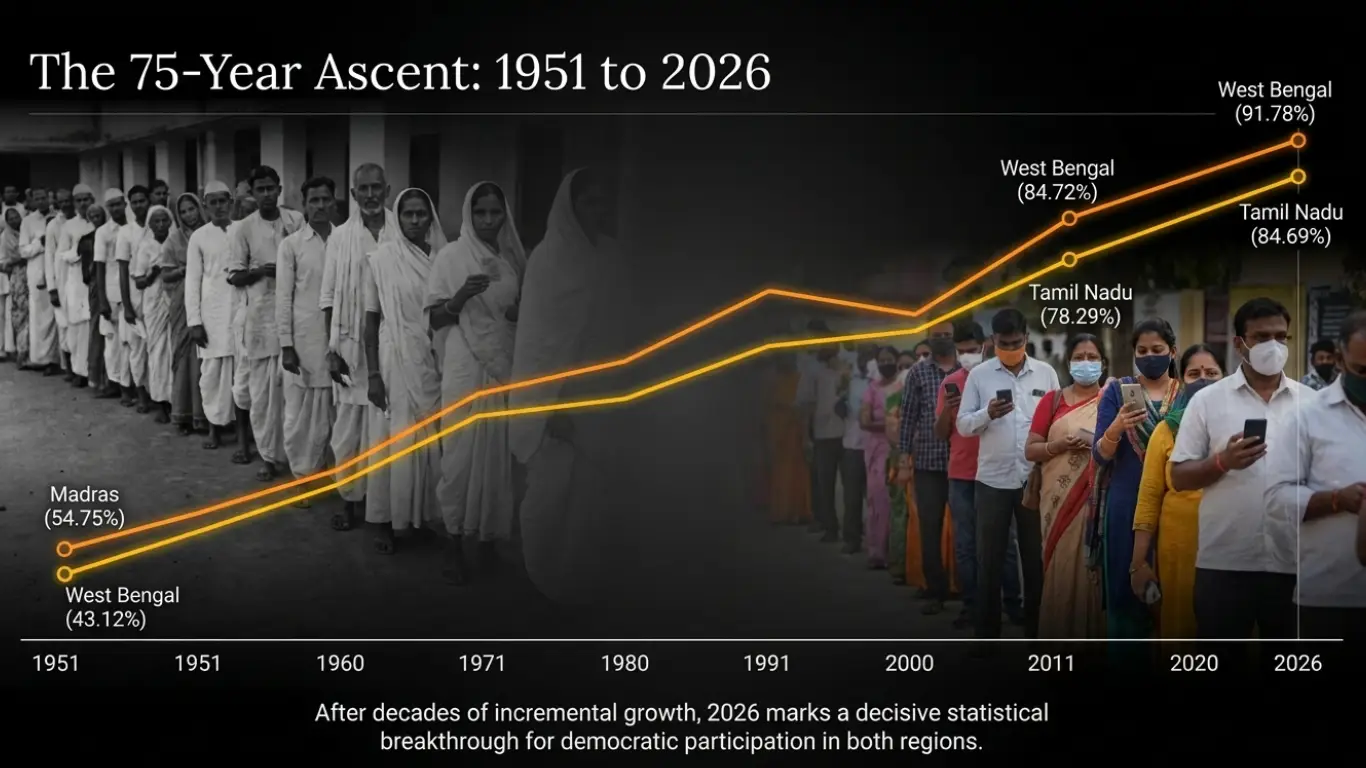
Tamil Nadu recorded 84.69% and West Bengal (Phase I) recorded 91.78% voter turnout on April 23, 2026 — the highest-ever poll participation since Independence in both states, surpassing their previous records set in 2011. Bye-elections were also held in Gujarat and Maharashtra.
NEW DELHI – Polling for the General Elections to the Legislative Assemblies of Tamil Nadu and West Bengal (Phase I), along with bye-elections in three Assembly Constituencies across Gujarat and Maharashtra, commenced at 7:00 a.m. on April 23, 2026. By the close of polling, both Tamil Nadu and West Bengal had shattered their own historical records for voter participation — a milestone that the Election Commission of India described as the highest-ever poll participation in both states since Independence.
Tamil Nadu recorded an overall voter turnout of 84.69%, surpassing its previous all-time high of 78.29% registered during the 2011 General Election to the Legislative Assembly. In West Bengal, Phase I of the General Election saw an extraordinary turnout of 91.78%, eclipsing the state's previous record of 84.72%, also set during the 2011 General Election to the Legislative Assembly. In terms of gender-wise participation, female voters led the way in both states — Tamil Nadu recorded female turnout of 85.76% against male turnout of 83.57%, while West Bengal saw female turnout of 92.69% against male turnout of 90.92%.
The Election Commission of India noted that these figures are provisional and based on data uploaded by Presiding Officers into the ECINET system. At the time of reporting, data from 6,411 polling stations in Tamil Nadu and 6,345 polling stations in West Bengal was yet to be updated. Final figures, which will include service voters and postal ballots, will be shared through Index Cards on ECINET.
Poll Participation Details — April 23, 2026
|
State/UT |
Male (%) |
Female (%) |
3rd Gender (%) |
Total (%) |
|
Tamil Nadu (General Election) |
83.57 |
85.76 |
60.49 |
84.69 |
|
West Bengal – Phase I (General Election) |
90.92 |
92.69 |
56.79 |
91.78 |
|
Gujarat – Umreth-111 (Bye-election) |
61.52 |
56.34 |
50.00 |
59.03 |
|
Maharashtra – Baramati-201 (Bye-election) |
61.61 |
53.29 |
4.48 |
57.48 |
|
Maharashtra – Rahuri-223 (Bye-election) |
58.59 |
51.80 |
0.00 |
55.31 |
*Figures are provisional and exclude Service Voters & Postal Ballots.
The electoral exercise on April 23 was conducted across 386 Assembly Constituencies in the two states — 234 in Tamil Nadu and 152 in West Bengal (Phase I) — covering a combined electorate of approximately 9.33 crore voters. A total of 1,19,440 polling stations were set up to accommodate voters across both states, staffed by nearly 5.97 lakh polling personnel. Across the two states, 5,501 candidates contested the elections, with 5,75,550 polling agents deployed at polling stations.
Tamil Nadu's 234 Assembly Constituencies were served by 75,064 polling stations, with an electorate of 5.73 crore — comprising 2.80 crore male voters, 2.93 crore female voters, and 7,728 voters of the third gender. West Bengal's 152 Phase I constituencies had 44,376 polling stations catering to an electorate of 3.60 crore, made up of 1.84 crore male voters, 1.76 crore female voters, and 465 voters of the third gender.
Election Logistics — Tamil Nadu and West Bengal (Phase I)
|
State |
ACs |
Total Electorate (Crores) |
Polling Stations |
Polling Staff |
Candidates |
Polling Agents |
|
Tamil Nadu |
234 |
5.73 |
75,064 |
3,75,320 |
4,023 |
4,21,328 |
|
West Bengal (Phase I) |
152 |
3.60 |
44,376 |
2,21,880 |
1,478 |
1,54,222 |
|
TOTAL |
386 |
9.33 |
1,19,440 |
5,97,200 |
5,501 |
5,75,550 |
Chief Election Commissioner Shri Gyanesh Kumar, along with Election Commissioners Dr. S.S. Sandhu and Dr. Vivek Joshi, maintained close and continuous oversight of the polling process through live webcasting, which was ensured at 100% of polling stations in both Tamil Nadu and West Bengal. This round-the-clock monitoring from the Election Commission's end ensured prompt response to any on-ground irregularities.
In a further step toward efficient data management, Presiding Officers were directed to update polling percentage figures on ECINET at the close of poll before leaving their respective polling stations, in line with the Election Commission's latest instructions. This resulted in minimal delays in the updation and availability of polling trend data.
Several new voter-friendly initiatives were introduced for these elections to improve the voting experience and ease of participation. Colour photographs of candidates were made easily identifiable on Electronic Voting Machine (EVM) ballot papers, helping voters make informed choices at the booth. A Mobile Deposit Facility (MDF) was put in place, and newly designed Voter Information Slips (VIS) were issued for improved readability. The number of electors per polling station was capped at 1,200 to reduce overcrowding and waiting times.
Polling stations were equipped with wheelchairs and volunteers specifically to assist voters with disabilities (PwD). Additionally, transport facilities were arranged to help PwD voters reach their respective polling stations, ensuring that accessibility barriers did not prevent eligible voters from exercising their franchise.
District-wise and Assembly Constituency-wise approximate voter turnout figures from both states are available on the ECINET App for public access and reference.
In addition to the two state general elections, bye-elections were held on the same day in three Assembly Constituencies across two states. In Gujarat, bye-elections were conducted in the Umreth-111 constituency, which recorded a voter turnout of 59.03% — with male turnout at 61.52% and female turnout at 56.34%. In Maharashtra, bye-elections were held in two constituencies: Baramati-201, which recorded 57.48% turnout, and Rahuri-223, which recorded 55.31% turnout.