India launches DPI@2047 roadmap targeting a $30 trillion economy by leveraging digital infrastructure, AI, and inclusive growth. The plan builds on Aadhaar and UPI success, shifting focus from welfare delivery to productivity-led wealth creation.
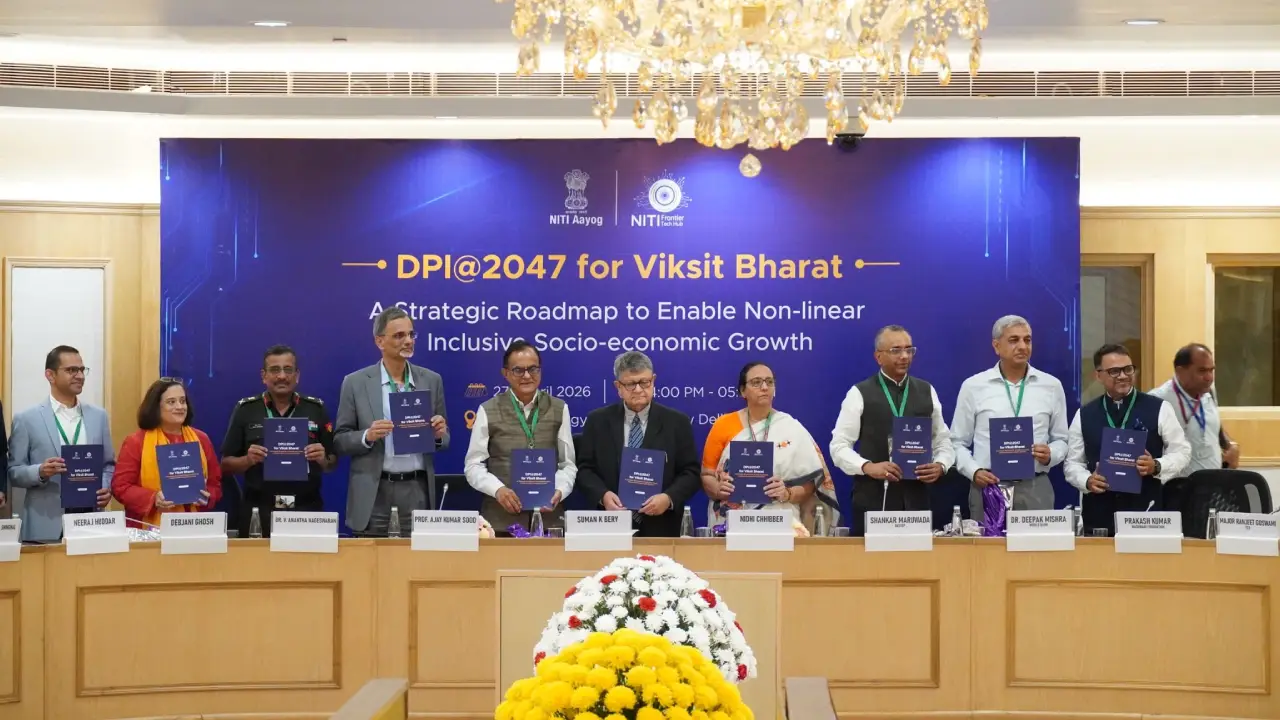
NEW DELHI – In a landmark step toward achieving the vision of Viksit Bharat by 2047, India has unveiled an ambitious strategic framework titled “DPI@2047”, positioning Digital Public Infrastructure (DPI) at the core of its economic transformation. Developed by the NITI Frontier Tech Hub, the roadmap aims to propel India into a $30 trillion economy with a projected per capita income of $18,000.
The strategy marks a decisive shift from traditional economic growth models to a technology-driven paradigm focused on exponential scalability, productivity gains, and inclusive wealth creation. By leveraging interoperable digital systems, artificial intelligence, and decentralized innovation, the government seeks to redefine how economic value is created and distributed across the country.
“DPI@2047 represents a generational leap—from enabling access to unlocking opportunity, productivity, and prosperity at scale,” the roadmap emphasizes.
From Inclusion to Expansion: The DPI 1.0 Legacy
The foundation of this transformative roadmap lies in India’s remarkable achievements over the past decade and a half, now termed DPI 1.0. Historically, India faced deep structural challenges—low banking penetration, inefficient welfare delivery, and limited access to formal financial systems.
The rollout of Aadhaar, the world’s largest biometric identity system, enabled over 1.39 billion residents to gain a verifiable digital identity. This significantly reduced leakages in welfare schemes, saving an estimated ?3.48 lakh crore in public funds.
NITI Aayog Frontier Tech Hub launched “DPI@2047: A Strategic Roadmap for Viksit Bharat,” outlining India’s pathway to a USD 750–850 billion technology services sector by 2035, driven by the expanding role of Digital Public Infrastructure.
— NITI Aayog (@NITIAayog) April 27, 2026
India’s Digital Public Infrastructure,… pic.twitter.com/poy21sji8G
Coupled with the Jan Dhan-Aadhaar-Mobile (JAM) Trinity, India achieved near-universal financial inclusion in record time. Bank account penetration surged to 80 percent within just eight years—a process experts estimated would have otherwise taken nearly five decades.
The launch of Unified Payments Interface (UPI) further revolutionized the digital economy. Within six years, India became a global leader in real-time digital payments, bringing millions of small businesses and street vendors into the formal financial ecosystem.
KEY ACHIEVEMENTS OF DPI 1.0:
o 1.39 billion digital identities via Aadhaar
o 80% bank account penetration in 8 years
o ?3.48 lakh crore saved through reduced leakages
o Global leadership in digital payments via UPI
By 2022, DPI contributed approximately 0.9 percent to India’s GDP, with projections estimating a rise to 4.2 percent by 2030—demonstrating the powerful, non-linear growth potential of digital ecosystems.
DPI 2.0: Building a Capable and Productive Society
The newly unveiled roadmap introduces a phased evolution—DPI 2.0 (2025–2035) and DPI 3.0 (2035–2047). The immediate phase focuses on dismantling systemic barriers that hinder economic participation, especially among lower and middle-income groups.
DPI 2.0 is structured around three key pillars:
1. Mass Inclusion at Scale
India’s vast MSME sector, comprising over 6.3 crore enterprises, stands to benefit from AI-driven market access tools and open digital commerce networks. These systems will simplify compliance and expand access to global markets.
Similarly, the roadmap proposes interoperable job-matching platforms for blue- and grey-collar workers, enabling seamless connections between employers and local talent pools through verified digital profiles.
Agriculture, a critical livelihood sector, will see transformation through AI-powered advisory systems, agricultural registries, and real-time data services delivered in regional languages.
“By empowering farmers, workers, and MSMEs with intelligent digital tools, DPI 2.0 aims to unlock grassroots productivity,” the report states.
2. Foundations of Human Capability
Recognizing the importance of human capital, the roadmap prioritizes education and healthcare as central pillars of growth.
AI-enabled learning platforms will support personalized education, bridging gaps for rural and underserved communities. Teachers and students will gain access to multilingual resources, improving learning outcomes.
In healthcare, strengthening the Ayushman Bharat Digital Mission will enable integrated digital health records, AI diagnostics, and preventive care systems, reducing financial vulnerability and improving access.
3. Systemic Enablers for Growth
The roadmap envisions a transformation in how credit, energy, and welfare systems operate.
Through digital asset tokenization and the Account Aggregator framework, individuals and businesses will gain access to formal credit based on verifiable digital data rather than physical collateral.
In energy, decentralized peer-to-peer markets will allow households with renewable energy sources, such as rooftop solar panels, to sell surplus power digitally—creating new income streams.
Additionally, welfare delivery will become proactive, with systems automatically matching citizens to eligible schemes, ensuring no benefits remain unclaimed.
KEY FOCUS AREAS OF DPI 2.0:
o AI-driven MSME growth and job matching
o Smart agriculture and farmer support systems
o Digital education and universal healthcare
o Tokenized credit and decentralized energy markets
Execution Blueprint: Driving Change at Scale
To translate vision into reality, the roadmap outlines four critical execution imperatives:
Decentralized District-Led Implementation
Recognizing India’s diversity, the plan emphasizes district-level programs tailored to local needs. This approach ensures demand-driven innovation and localized impact.
Scaling Technology Entrepreneurship
India aims to nurture a massive ecosystem of innovators, targeting one million startups by 2035. This distributed innovation network will serve as the backbone for DPI solutions.
Integrating Artificial Intelligence
AI is positioned as the central driver of productivity. From predictive analytics to conversational interfaces in local languages, AI will power decision-making at every level.
Strategic “Unlocks” Across Systems
The roadmap identifies key structural barriers—data silos, high trust costs, and language divides—and proposes solutions such as:
o Open, machine-readable data systems
o Democratized access to AI tools
o Real-time knowledge delivery platforms
o Interoperable digital transaction networks
The Road Ahead: Immediate Action and Global Vision
The government has called for immediate implementation through a decentralized, state-led model. The first phase (2026–2027) will focus on agriculture and MSMEs, with six “Champion States” piloting scalable solutions.
KEY POINT:
o Target: $30 trillion economy by 2047
o DPI shifts focus from welfare to wealth creation
o AI and open networks central to strategy
o District-led implementation model
o First rollout in agriculture and MSMEs
A dedicated institutional framework, supported by global partnerships, will oversee execution. By 2027, India also plans to establish a global DPI body to share its digital governance models internationally.
Conclusion: A Paradigm Shift in Economic Growth
The DPI@2047 roadmap signals a fundamental shift in India’s development strategy—from linear growth models to exponential, technology-driven expansion. By integrating digital infrastructure, artificial intelligence, and inclusive policy design, India is positioning itself as a global leader in the next wave of economic transformation.
If executed effectively, this vision has the potential to not only achieve a $30 trillion economy but also ensure that growth is broad-based, equitable, and sustainable—impacting the lives of over a billion citizens.
“DPI is no longer just infrastructure—it is the engine of India’s future prosperity,” the roadmap concludes.