The 2026 Assam Assembly election delivered a historic three-fourths NDA supermajority, the BJP's solo tally rising to 82 seats, as record-breaking female turnout, Tea Tribe consolidation, and strategic alliance realignment combined to eviscerate a fractured Congress-led opposition.
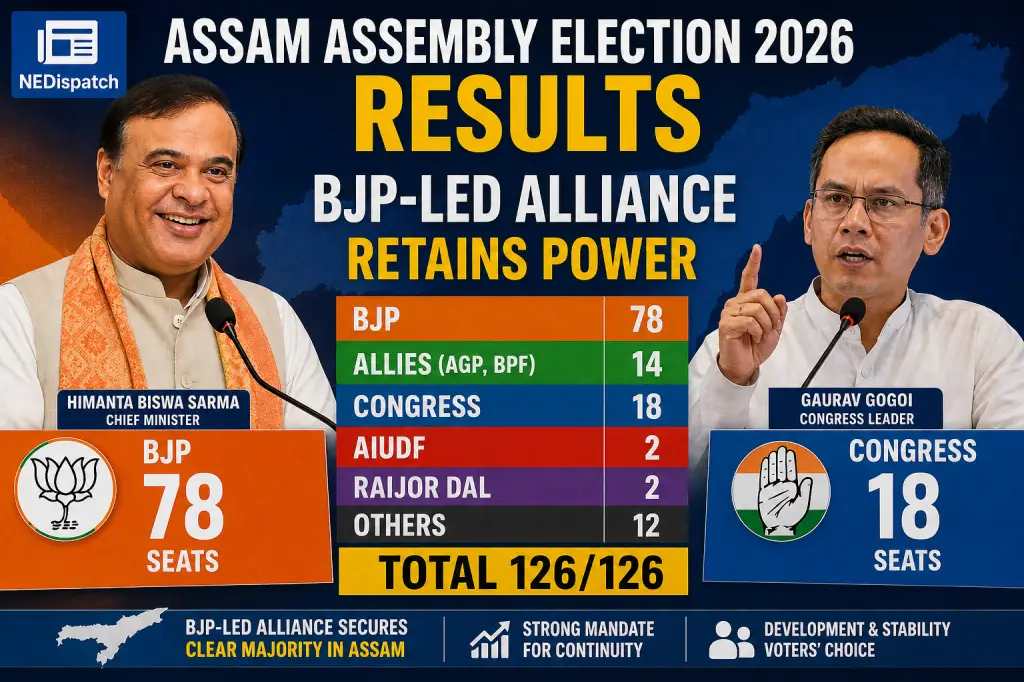
The 2026 Assam Assembly election will be remembered not merely as an NDA victory, but as a structural re-ordering of the state's entire political landscape. When the final tallies emerged, the Bharatiya Janata Party-led National Democratic Alliance had won 102 of 126 assembly seats — a three-fourths supermajority that grants the ruling coalition the legislative muscle to amend the state constitution, override dissent, and implement transformative policy without a single concession to the opposition. More than a mandate, this is a legislative absolute.
The numbers alone tell a story of historic proportions. The BJP, standing independent of its allies, secured 82 seats — up from 60 in 2021 — enough by itself to command a two-thirds majority. Voter turnout reached 85.91%, the highest participation rate in Assam's democratic history. Most significantly, female voter turnout hit 86.5%, a record-breaking figure that analysts broadly credit as the decisive engine behind the NDA's overwhelming numbers. In a state where electoral contests have historically been defined by ethnic sub-identities and regional fragmentation, the 2026 result signals a striking consolidation around a single axis of governance.
The contrast with 2021 underlines just how profound this shift has been. The Congress-led Mahajot went from 50 seats to a mere 19, a collapse that represents not just an electoral defeat, but what strategic analysts have described as 'legislative irrelevance.' The architecture of opposition multi-party alliances — long considered the only viable counter to BJP dominance — has been effectively dismantled.
|
Alliance / Party |
2021 Seats |
2026 Seats |
Change |
|
NDA (BJP + AGP + BPF) |
75 |
102 |
+27 |
|
BJP (Standalone) |
60 |
82 |
+22 |
|
Opposition (INC-led) |
50 |
19 |
−31 |
|
AIUDF |
16 |
2 |
−14 |
ALSO READ: Assam Assembly Results Complete List: BJP-Led Alliance Dominates Across Majority Constituencies
No individual figure defined the 2026 election more completely than Chief Minister Himanta Biswa Sarma. Contesting from his traditional Jalukbari fortress, Sarma secured his sixth consecutive term with a margin exceeding 80,000 votes against Congress challenger Bidisha Neog — a margin so decisive that it rendered the contest effectively uncompetitive. By leading the alliance to its third straight majority, Sarma has described the outcome as a 'hat-trick with a century,' referencing both the alliance's 102-seat tally and his administration's public commitment to merit-based governance.
Sarma's campaign was anchored on a 'positive agenda' that deliberately sidestepped divisive identity rhetoric in favour of developmental deliverables. His framing of the BJP as the guarantor of youth employment, rural welfare, and Assamese cultural pride proved more durable than the opposition's attempts at coalition arithmetic. Union Minister Sarbananda Sonowal, commenting on the scale of the NDA victory, called it a validation of 'development-oriented governance' — a narrative that Sarma had carefully constructed over five years.
The strategic genius of Sarma's operation extended beyond his own constituency. The decision to re-induct the Bodoland Peoples' Front (BPF) into the NDA fold — replacing the UPPL following BPF's dominant showing in the October BTC polls — was a masterstroke. With BPF securing 10 seats and the Asom Gana Parishad (AGP) adding another 10, the alliance's regional coverage was near-total. Charan Boro's win in Mazbat, with a margin of 55,546 votes, exemplified how the re-entry of a former rival can transform western Assam from a contested zone into a reliable NDA stronghold.
The decimation of the Congress-led front represents one of the most complete collapses of an opposition bloc in Assam's post-independence history. The 'Mahajot' model — premised on the idea that a grand coalition of disparate parties could overcome BJP dominance through sheer arithmetic — has been repudiated by voters who appear to have decisively prioritised programmatic governance over fragmented resistance.
The fall of the opposition's most prominent state-level anchors was stark. Debabrata Saikia, the Leader of the Opposition, failed to hold his Nazira seat against BJP's Mayur Borgohain. Lurinjyoti Gogoi, president of the Assam Jatiya Parishad (AJP), was defeated in Khowang, signalling the limits of narrow regionalist sentiment as an electoral platform. Even Akhil Gogoi, the Raijor Dal chief who eventually retained Sibsagar, emerged from the contest with a severely diminished political footprint after trailing significantly in early rounds.
Perhaps the most symbolically resonant contest of the cycle was in Jorhat, where State Congress Chief Gaurav Gogoi made his assembly debut. The son of former Chief Minister Tarun Gogoi, Gaurav framed his candidacy through an 'Arjun vs. Bhishma' metaphor — positioning himself as the focused young challenger against BJP incumbent Hitendra Nath Goswami's veteran experience. The metaphor did not survive contact with the electorate; Gogoi lost by 23,182 votes, demonstrating that legacy and national recognition are insufficient substitutes for the machine-level incumbency that the BJP's local veterans command.
The Pradyut Bordoloi phenomenon illustrated the Congress's organisational collapse from yet another angle. A Congressman for over five decades, Bordoloi defected to the BJP less than a month before polling day. His subsequent victory in the prestigious Dispur constituency, by a margin of 49,667 votes, demonstrated the BJP's gravitational pull and the Congress's inability to retain even its most experienced leaders.
The structural story behind the NDA's supermajority lies in the precise socio-political engineering that moved the needle across multiple historically resistant voting blocs simultaneously.
A record-breaking female turnout of 86.5% — outpacing even the overall historic turnout — is widely regarded as the primary demographic engine of the NDA's three-fourths majority. This figure reflects the successful conversion of welfare delivery, social justice programmes, and direct benefit transfer schemes into a durable gender-based electoral coalition. Women voters, analysts note, prioritised stability and tangible welfare outcomes over the identity-driven appeals of the opposition.
The BJP has now effectively displaced the Congress in Upper Assam's decisive tea garden communities — a development that would have been inconceivable a decade ago. Key victories by Rupesh Gowala in Doomdooma, Dhiraj Gowala in Titabor, and Rameshwar Teli in Duliajan illustrate the depth of the BJP's penetration into these historically Congress-aligned belts. Gowala, the former Tea Tribe Welfare Minister, and Teli, a veteran parliamentarian, leveraged deep community roots to deliver constituencies that once formed the foundation of Congress's Upper Assam fortress.
Badruddin Ajmal's party, the All India United Democratic Front (AIUDF), was reduced from 16 seats to just 2 — Binnakandi and Dalgaon — despite Ajmal himself winning his constituency. The result confirms that individual popularity no longer guarantees party-level relevance in Assam's new political geometry. Voters appear to have moved decisively toward a binary choice between governance and fragmentation, with no appetite for the 'kingmaker' role Ajmal sought to play.
The 2026 result leaves three structural realities that will define Assam's political economy for years to come.
First, the NDA's 102-seat tally delivers a legislative absolute. The alliance can implement large-scale infrastructure and policy reforms with zero friction in the assembly. The 'double-engine' model — where state and central governments operate in seamless developmental alignment — is now at peak efficiency, unencumbered by the need for compromise legislation or coalition management.
Second, the Congress and AIUDF face an existential crisis that transcends a single electoral cycle. The death of the Mahajot model means the opposition must rebuild its ideology, leadership bench, and grassroots organisational structure from a near-zero base. Without high-profile anchors capable of securing their own seats — a problem dramatised by Gaurav Gogoi's Jorhat defeat — the opposition has lost its structural integrity.
Third, Himanta Biswa Sarma has cemented his position as the most dominant political figure in modern Assam history. His ability to bridge ethnic, linguistic, and sub-regional divides to create a singular electoral identity represents a political achievement that few state-level leaders in India have matched. The 2026 verdict confirms that he has moved well beyond the role of coalition manager and into the terrain of a genuinely hegemonic regional leader.
For observers of Indian democracy, Assam 2026 offers a case study in how a combination of incumbent welfare delivery, strategic alliance engineering, demographic targeting, and the systematic co-option of opposition talent can transform a competitive multi-party state into a singular-axis political order — and how quickly that transformation can become self-reinforcing.