An in-depth analysis of the May 7, 2026 Kamjong attacks in Manipur, examining hybrid border insurgency, cross-border militancy, proxy warfare, intelligence failures, and the strategic implications for India’s Indo-Myanmar frontier and Act East Policy.
This analysis is based on publicly available reports, local accounts, security-linked inputs, and competing claims that remain independently unverifiable in several respects.
The Assault on the Frontier: Chronology and Humanitarian Fallout
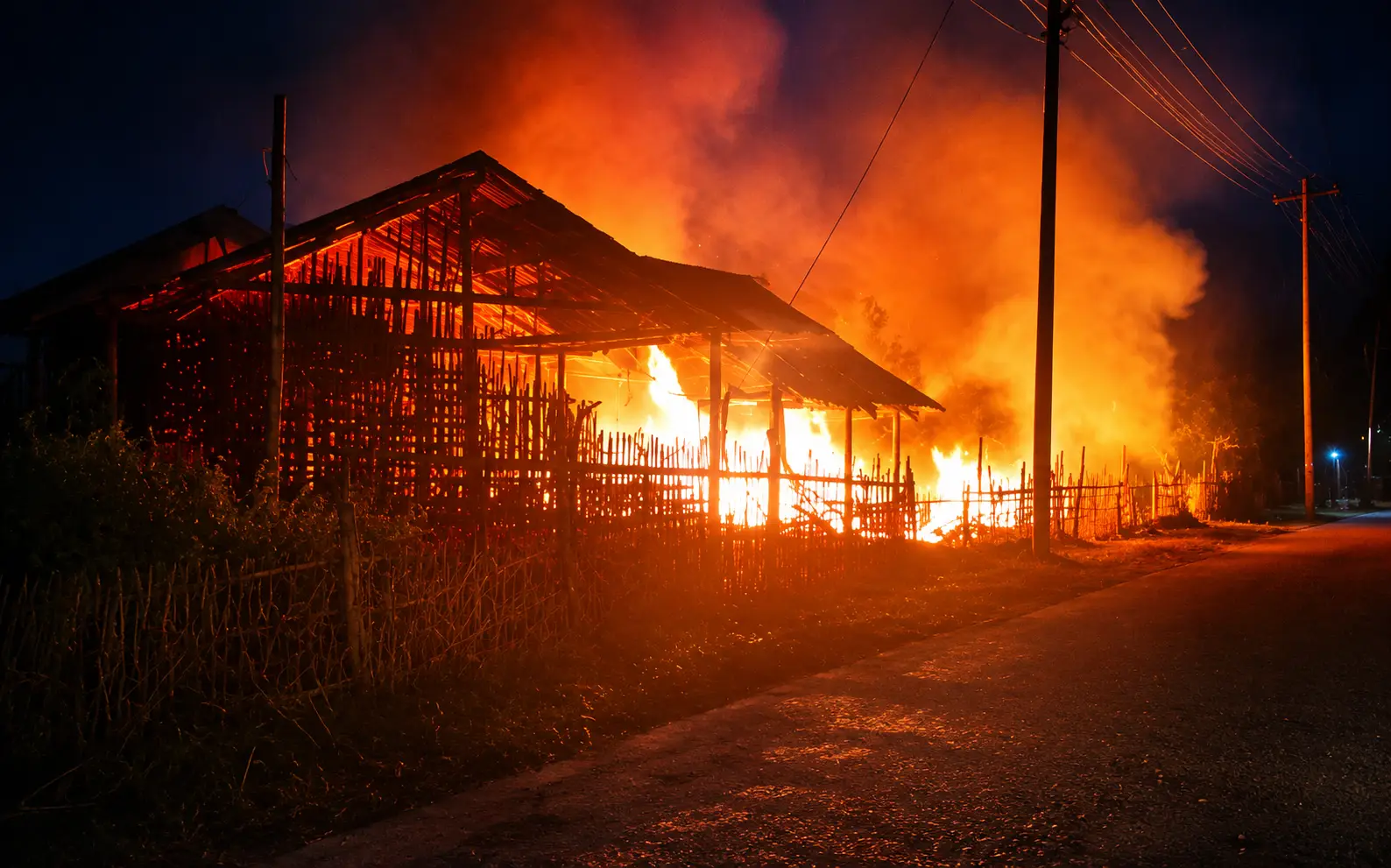
On the morning of May 7, 2026, a significant escalation in the volatile security situation along Manipur’s eastern frontier unfolded with a series of coordinated pre-dawn attacks on several Tangkhul Naga villages in the Kamjong district. The assaults targeted the border settlements of Namlee, Wanglee, and Choro, located in close proximity to the international boundary with Myanmar, specifically near the Kasom Khullen sector.
According to local accounts and police inputs, the attacks commenced between approximately 3:30 a.m. and 4:00 a.m., exploiting the vulnerability of sleeping populations in these geographically isolated communities. The assailants were described as heavily armed men who entered the villages, opened fire, set homes ablaze, and looted property before retreating into the nearby forests.
The speed and precision of the operation point toward a well-coordinated mobile force rather than an unorganized mob, effectively trapping civilians and forcing them to flee into the dense forest cover for safety under the cover of darkness.
A fresh attack was reported from border areas of Kamjong district near Myanmar in the early hours of May 7. According to sources, suspected KNA-B militants allegedly launched drone-based attacks around 2 am targeting Namlee Market and Choro village. Several houses were reportedly… pic.twitter.com/ZnjYNi2ih3
— India Today NE (@IndiaTodayNE) May 7, 2026
The humanitarian consequences of the assault were severe and immediate. In Namlee, multiple structures, including the residence of the village headman, were reportedly destroyed in the fires. The village of Wanglee witnessed numerous houses reduced to ashes, while accounts from Choro suggested that nearly the entire settlement was obliterated, with only a church structure remaining standing.
Beyond the physical destruction, the attacks resulted in civilian casualties and widespread fear. One elderly woman, identified as Khin Htwe Yei, sustained injuries while attempting to escape through the forested terrain during the assault.
???? Amid heavy firing and explosions near the #India-#Myanmar Border in Kamjong district, #Manipur on 07 May 2026, #AssamRifles acted swiftly to rescue civilians and restore stability.
— PRO Defence, Manipur, Nagaland & South Arunachal (@prodefkohima) May 8, 2026
?? 15 villagers, including women and children, were safely evacuated and provided humanitarian… pic.twitter.com/JmMHyQckkY
The most alarming aspect of the aftermath has been the large number of people reported missing. Local residents and security sources have stated that at least 21 individuals from the Wanglee Market area remain unaccounted for. Among those missing are Tangkhul Naga civilians, but also several Myanmar nationals who had sought shelter in the Indian border area.
The fear among some local officials is that these individuals may have been abducted, although no independent confirmation of this has been established. One prominent case is that of Zingran Ningshen, whose house-cum-shop was allegedly set on fire; his fate remains unknown. The attacks triggered mass displacement, with hundreds of villagers forced to abandon their homes and seek refuge in safer areas, creating a significant humanitarian crisis for local relief organizations.
BreakingNews: At least three Tangkhul Naga villages along the Indo–Myanmar border in #Manipur’s #Kamjong district came under attack by suspected Kuki National Army-Burma (KNA-B) militants on Thursday early morning. One civilian has been reportedly injured, though no fatalities… pic.twitter.com/DoYzZ40cWS
— Ukhrul Times (@ukhrultimes) May 7, 2026
The destruction extended beyond residential structures to personal property and livelihood assets. Villagers alleged that the attackers looted vehicles, motorbikes, cash, and mobile phones before withdrawing. This systematic plunder compounded the trauma of the attack, wiping out not just homes but also the economic means of survival for many families. The total number of displaced persons was estimated to be around 270, including members of the Vaiphei community and Myanmar nationals seeking safety.
These displaced individuals now face critical shortages of food, shelter, and medical aid, placing a heavy burden on local civil society groups and community organizations that have initiated emergency relief efforts. The destruction of shops, such as the one belonging to Zingran Ningshen, further illustrates the comprehensive nature of the looting and its devastating long-term impact on the local economy. For the survivors in Namlee, Wanglee, and Choro, the reality is one of profound loss—burned homes, missing relatives, and an uncertain future—all underscored by a deepening collapse of confidence in the state's ability to provide protection in these vulnerable frontier settlements. The incident represents not merely a security crisis but a complete breakdown of social and economic stability for the affected communities.
#BreakingNews: At least three Tangkhul Naga villages along the Indo–Myanmar border in #Manipur’s #Kamjong district came under attack by suspected Kuki National Army-Burma (KNA-B) militants on Thursday early morning. One civilian has been reportedly injured, though no fatalities… pic.twitter.com/DZ0xHvJwSo
— Ukhrul Times (@ukhrultimes) May 7, 2026
|
Village |
Damage & Weapons Used |
Human Impact |
AR/Security Proximity |
Security Response |
|
Choro (Z. Choro) |
15+ homes, church, market razed; drones, rocket launchers, Latthi guns, small arms |
Residents rounded up and tortured; pastor & 4 others abducted then released after looting of phones and cash |
200–400 m from 11 AR post, Aloyo village |
Militants entered after AR patrol on May 6; AR entered only after militants withdrew |
|
Namlee |
1 house fully burnt; 2–3 severely damaged; state police outpost unmanned |
One woman shot in the thigh while fleeing; total displacement of residents |
Eastern frontier; unmanned state police outpost |
DO letter warning sent April 24; no reinforcement deployed |
|
Wanglee |
3 houses completely destroyed by fire; rocket launchers and Latthi guns |
Zingran Ningsen (35) and 5–6 Burmese nationals abducted; mass displacement |
Kasom Khullen sub-division; border-adjacent |
Missing persons unaccounted; diplomatic stakes raised by foreign national abductions |
|
Ashang Khullen (KAKA) |
Severe structural damage; bombs and heavy gunfire |
Entire families — including elderly and children — fled to jungle without food or medicine |
3 km from AR post (Bundung/Mountain post); clear line of sight |
AR post observed burning via binoculars; zero retaliation or movement |
Attribution Conundrum: Competing Narratives of Cross-Border Aggression and Internal Retaliation
The May 7 attacks on Kamjong district have become mired in a complex web of conflicting narratives regarding responsibility, creating a "fog of war" that complicates any definitive attribution of blame. The available information reveals three primary, mutually exclusive claims that paint starkly different pictures of the incident, ranging from external cross-border invasion to internal ethnic retaliation. Each narrative carries significant political and strategic weight, and none can be independently verified with the provided sources.
The first major narrative frames the violence as an act of "external aggression" by militant groups based in Myanmar. Several political leaders and indigenous rights organizations have adopted this framing, urging the Government of India to recognize the "external dimensions" of the conflict.
Phungyar MLA L. Keishing publicly alleged that militants associated with the Kuki National Army-Burma (KNA-B) and Myanmar's People’s Defence Force (PDF) crossed into Indian territory to launch the assault.
KAMJONG DISTRICT Phungyar A/c MLA Mr Leishiyo Keishing has now categorically stated that the attack on Namlee, Wanglee villages, including Z Choro today early morning, was carried out by KNA (Burma) and PDF elements. If that is the case, then this is nothing less than an act of… pic.twitter.com/dUF89rX9gE
— Khuraijam Athouba (@Paari_Athouba) May 7, 2026
Similarly, the Coalition of Indigenes’ Rights Campaign (CIRCA) condemned the incident as a "coordinated cross-border terrorist attack" and raised concerns about a pattern of targeted violence against indigenous communities. CIRCA Secretary General Leishangthem Lamyanba Meitei argued that such repeated incidents reflect a deliberate attempt to destabilize vulnerable settlements near the international boundary
Echoing this sentiment, the United Naga Council (UNC) called for stronger border enforcement measures and firm action against foreign-based aggressors operating near the border. This narrative is strategically potent as it recasts the issue from a domestic law-and-order problem into a matter of national border security and counter-insurgency, potentially justifying a more robust military response from the central government.
United Naga Council(UNC) condemns CROSS-BORDER AGGRESSION
— SpeakNaga_X (@SpeakNaga_X) May 8, 2026
Tahamzam(Senapati) | 8th May 2026
“The UNC unequivocally condemns the egregious failure and deliberate inaction of Central Security Forces deployed along the International Indo-Myanmar Border.”
“That about hundreds… pic.twitter.com/JqvGqxEsJd
In direct opposition stands the narrative of internal retaliation, advanced by the Village Volunteers Eastern Zone (VVEF), a Kuki-Zo armed formation. This group issued statements claiming responsibility for the strikes, characterizing them as retaliatory operations linked to the alleged burning of Lancha Kuki village in Kamjong district on May 2, 2026. The VVEF accused the National Socialist Council of Nagalim-Isak Muivah (NSCN-IM), specifically its "Eastern Flank," of involvement in the earlier aggression against Kuki settlements. To further complicate the regional power struggle, the VVEF also alleged that the NSCN-IM received support from approximately 30 cadres belonging to the NSCN-K (AY) faction and indicated there were signs that the Myanmar-based Shanni Nationalities Army (SNA) was assisting anti-Kuki operations in the region.
#MANIPUR: However, a detailed ground verification by Ukhrul Times contradicts the VVEF's claims. The three Tangkhul Naga villages—Namlee, Wanglee Market, and Choro—was repelled by the #NSCN-IM rather than a faction as the VVEF suggested. The #NSCNIM which has carders from the… pic.twitter.com/mrQxNKSpcj
— Ukhrul Times (@ukhrultimes) May 8, 2026
This account places the Kamjong attacks squarely within the context of the ongoing intra-regional ethnic conflict in Manipur, viewing the violence as part of a broader, escalating cycle of retaliation between various armed factions.
This attribution conundrum is further deepened by direct contradictions and denials. The Kuki National Army-Burma (KNA-B) itself issued an unverified public statement categorically denying any involvement in the Kamjong violence. The organization described the allegations linking it to the attacks as "false and malicious" and accused certain sections of the media of spreading misinformation that inflames tensions. This denial directly contradicts the claims made by MLA Leishoyo Keishing and CIRCA
This is my humble appeal to every community: do not drag KNA-B into this under any circumstances. It will provoke them, and once provoked, the situation will be out of control. Kindly understand the gravity of the situation.@PMOIndia @HMOIndia @adgpi @official_dgar @Spearcorps… pic.twitter.com/7Nri70vaO1
— The Proud Indian (@DynastyDoungel) May 9, 2026
Even more significantly, ground reports from local residents, cited by Ukhrul Times, present a third version of events that contradicts portions of the VVEF's own narrative. These accounts allege that the attack was launched from multiple directions from the Myanmar side by Kuki armed groups, but that they were ultimately resisted and repelled by NSCN-IM cadres.
This directly refutes the VVEF's claim that the NSCN-IM was the aggressor. Furthermore, some villagers reportedly claimed the attackers spoke the Kuki language and retreated back toward Myanmar after encountering armed resistance.
EXPOSED!
— raj rk (@rajrk26247) May 8, 2026
Attempt to save blood brothers KNA (B) Terrorists' attack on Indian sovereignty by #Kuki in #Manipur with forged letterhead without authorized signature and same SCRIPTED propaganda publicized and peddled by #Kuki sleepers' cells in #Manipur FAILED!
Fake vs Original! pic.twitter.com/iFRqlArkvk
The table below summarizes these competing and contradictory claims.
|
Claimant/Organization
|
Alleged Perpetrators
|
Justification/Context
|
|
Phungyar MLA Leishiyo Keishing, UNC, CIRCA |
Kuki National Army-Burma (KNA-B) & Myanmar's People’s Defence Force (PDF) |
Coordinated cross-border "terrorist attack" as part of a destabilization campaign against indigenous communities. |
|
Village Volunteers Eastern Zone (VVEF) |
Not specified (claims self-responsibility) |
Retaliatory strike for the alleged burning of Lancha Kuki village on May 2, 2026, attributed to NSCN-IM. |
|
KNA-B |
Denied involvement |
Allegations are "false and malicious" and intended to inflame tensions. |
|
Local Residents (Ukhrul Times report) |
Kuki armed groups (attacking from Myanmar side) |
Attackers were repelled by NSCN-IM cadres. Attackers spoke Kuki language and fled back to Myanmar. |
The synthesis of these accounts suggests a highly fragmented and fluid conflict environment where operational realities blur national boundaries and alliances shift rapidly. No single narrative can be deemed definitively credible. The most plausible conclusion is that the truth is hybrid, reflecting the complex interplay of local grievances, transnational militancy, and strategic maneuvering. The incident strongly indicates a proxy warfare dynamic, with the VVEF's allegations implicating multiple factions, including Myanmar-based ones like the SNA, suggesting a deeply interconnected ecosystem of armed groups.
The distinction between "Indian-based" and "Myanmar-based" actors becomes operationally meaningless in a porous border zone where movements are fluid and tactical. All parties appear to be weaponizing these narratives for their own purposes: indigenous rights groups are using the "cross-border aggression" claim to pressure the Indian government for stronger security, the VVEF is framing its actions as necessary retaliation to justify its position, and the KNA-B's denial may be aimed at preventing escalation and maintaining plausible deniability.
???? #AssamRifles secured the safe release of a local woman abducted from Kamjong district, #Manipur.
— PRO Defence, Manipur, Nagaland & South Arunachal (@prodefkohima) May 9, 2026
?? Amid heightened tensions along the Indo-Myanmar border, troops swiftly restored stability, rescued the distressed population, evacuated vulnerable families and ensured all the… pic.twitter.com/7R9aijxvFG
Assam Rifles Statement Alters Attribution Narrative
A significant development in the evolving Kamjong narrative emerged through the Assam Rifles press release issued on May 9 regarding the rescue of abducted Tangkhul woman Olina Ningshen. Beyond its humanitarian framing, the statement carries important operational and analytical implications because it represents one of the clearest official attributions made so far in connection with the May 7 violence.
In the release, Assam Rifles explicitly stated that the woman had been “abducted by KNA(B) and Village Volunteers Eastern Zone (VVEZ) from Namlee.” The wording is notable because security agencies in conflict zones often rely on generalized terminology such as “armed miscreants,” “suspected militants,” or “unknown cadres” unless they possess at least some degree of operational or intelligence confidence regarding attribution. The decision to specifically identify KNA(B) and VVEZ therefore substantially strengthens the argument that security agencies believe those groups were operationally linked to at least part of the incident.
The statement is particularly significant because it appears to contradict earlier denials attributed to KNA-B, which had reportedly rejected allegations of involvement in the Kamjong attacks. While the Assam Rifles release does not explicitly assign responsibility for the entirety of the coordinated arson and violence across Namlee, Wanglee, and Choro, it nevertheless constitutes an official acknowledgement connecting KNA(B)-associated actors to the abduction component arising from the same incident environment.
At the same time, the press release also reflects the layered complexity of counterinsurgency operations along the Indo-Myanmar frontier. The statement noted that the woman’s release occurred “under the watch of Assam Rifles, Intelligence and other agencies,” and that the process involved “minute level” coordination. Analytically, this suggests the existence of communication, mediation, or influence channels enabling security agencies to facilitate controlled civilian recovery operations even in highly volatile border conditions.
The release also reveals an important contradiction in the broader information landscape surrounding the Kamjong violence. While local organizations, political leaders, armed groups, and independent ground accounts continue to present sharply divergent narratives regarding who initiated the attacks and why, the Assam Rifles statement moves beyond ambiguity in at least one respect: it formally places KNA(B) and VVEZ within the operational chain of events linked to the Namlee incident.
From a strategic perspective, this matters because the conflict narrative in Kamjong increasingly appears to be shifting away from a purely localized communal confrontation toward a more complex framework involving cross-border armed mobility, hybrid militant alignments, and overlapping insurgent theatres stretching across the Indo-Myanmar frontier.
HEADQUARTERS INSPECTOR GENERAL ASSAM RIFLES (SOUTH)
PRESS RELEASE: 09 MAY 2026
ABDUCTED WOMEN SAFELY RESCUED BY ASSSAM RIFLES IN KAMJONG, MANIPUR
09 May 26, Kamjong District.
Due to concerted efforts by the Assam Rifles, the Tangkhul women, Olina Ningshen was released today. The women was abducted by KNA (B) and Village Volunteers Eastern Zone (VVEZ) from Namlee. The release took place south of Z Choro village close to the incident area under the watch of Assam Rifles, Intelligence and other agencies.
The husband of the woman, Village Headman and CSOs were also taken to Humine Thana, short of Phaikoh and close to the handover location, once own forces had secured the release. After release, the family and CSOs were taken to the unit headquarters at Chassad for formal handing over and documentation. The family, village headman and CSOs thereafter moved to their village, Khangpat Khn. In the entire process all details were coordinated at minute levels including the medical checkup and psychological assistance. Also village headman and local villagers were also appropriately treated and addressed by the force.
Assam Rifles is the oldest Armed Police Forces of India and has some of the most distinguished honours and awards to its credit. In the early hours of 07 May, there was unrest reported near Z Choro and opposite Namlee along the India Myanmar Border. The volatile situation was brought under control by the troopers of the Assam Rifles with immediate response despite challenging conditions.
Acting proactively during the incident the Assam Rifles deployed multiple rescue teams. Ten houses affected by the violence were secured and civilians were evacuated to the nearest safe location. Fifteen distressed villagers, including women and children, were rescued and provided humanitarian assistance at Aloyo Assam Rifles camp. A woman was provided with immediate first aid and medical evacuation support.
Assam Rifles conducted prompt sanitisation operations concurrently to prevent any further escalation and to restore stability. One armed cadre of KNA B, Lal Thag John, 38yrs was also apprehended along with a weapon, magazine and ammunition during search operations from Churachandpur and later handed over to local police authorities.
Even as tensions and emotions remain high, Assam Rifles continues to patrol across other sensitive areas of Kamjong to ensure peace and security for local residents. The force has shown unparalleled resilience as incident once again highlights the unwavering commitment of Assam Rifles towards protecting our citizens and maintaining peace in North East India.
Security Posture Under Scrutiny: Intelligence Failures and Controversial Responses
The Kamjong attacks of May 7, 2026 exposed profound vulnerabilities and systemic failures in India's security apparatus along the 398-kilometer-long, largely unfenced Indo-Myanmar border. The incident has reignited a fierce debate over the preparedness of security agencies, particularly concerning intelligence gathering, surveillance capabilities, and the conduct of troops in sensitive frontier zones. The Chief Minister of Manipur, Yumnam Khemchand Singh, reviewed the security situation with senior officials from the Border Security Force following the attacks and publicly condemned the violence as "unacceptable," directing security agencies to take "strict action" against the perpetrators and restore normalcy. However, this official response has failed to assuage the deep mistrust felt by local residents in the affected areas.
Manipur Chief Minister Yumnam Khemchand Singh reviewed the law and order situation with senior BSF officials following violence in border villages of Kamjong district along the Indo-Myanmar border.
— Northeast Now (@NENowNews) May 8, 2026
According to reports, armed militants attacked Namlee, Wanglee and Choro villages… pic.twitter.com/pwIbsnerEW
The most glaring failure highlighted by the incident was the apparent lack of intelligence regarding the impending assault. The fact that heavily armed assailants could penetrate a vulnerable border zone so close to regular security patrols without detection raises serious questions about the effectiveness of India's surveillance and early warning systems. The geography of the region, characterized by rugged, forested terrain, inherently favors mobile insurgent operations and makes continuous monitoring exceedingly difficult.
Nonetheless, the scale and coordination of the May 7 attacks suggest a lapse that goes beyond mere geographical challenge. Particular suspicion has fallen on the chronology of events involving the Assam Rifles, the primary security force in the area. Allegations surfaced that security personnel had visited the targeted villages of Namlee, Wanglee, and Choro shortly before the attack, yet were conspicuously absent during the hours of violence.
An opinion piece published in The Morung Express argued that this sequence of events requires a thorough investigation to determine if the failure was due to operational lapses, intelligence shortcomings, or broader systemic problems within the security establishment.
While no evidence has been made public to substantiate allegations of deliberate complicity by security personnel, the perception of negligence has severely damaged the relationship of trust between the local population and the security forces.
The Assam Rifles' subsequent response to the attacks has also become a subject of controversy. Official accounts state that rescue teams successfully evacuated 15 distressed villagers—primarily women and children—to the Aloyo camp and provided medical assistance to injured civilians, including a Myanmarese woman. Additionally, troops secured undamaged structures and apprehended one armed cadre allegedly carrying an AK-47 rifle during follow-up operations, whom security sources said as cadre of NSCN-IM but local residents call him village guard defending the villages from the attackers. Despite these actions, the initial absence of security forces during the assault has fuelled local suspicion and anger.
This frustration is amplified by broader, unverified allegations that have circulated throughout the region. A paper published in the Indian Journal of Legal Review referenced claims of "proxy warfare," suggesting that certain militant formations operating in the border sectors might have benefited from selective collaboration or tactical accommodation by security forces at various points during the wider conflict.
Such allegations, whether true or not, contribute to a climate of deep-seated distrust among local populations already traumatized by years of ethnic violence and displacement. They raise troubling questions about the motives and conduct of security personnel, making civilians wary of both external attackers and the very forces meant to protect them.
A crucial precursor to the May 7 violence that underscores the region's militarization occurred on April 11, 2026, when Assam Rifles personnel recovered a massive cache of weapons near Border Pillar 115. The seized materials included AK-47 rifles, RPG rounds, mortar bombs, Chinese grenades, M-16 ammunition, and Burmese-origin ammunition.
This discovery served as a stark warning of the high level of armament available to non-state actors in the borderlands. The presence of sophisticated ordnance like rocket-propelled grenade rounds and mortar munitions heightened fears that localized disputes could rapidly escalate into more conventional-style armed confrontations, far exceeding the capabilities of traditional village-level conflicts.
The recovery confirmed the existence of substantial, organized arms trafficking networks operating across the porous border, transforming the region into a powder keg where any spark could ignite a much larger conflict.
This context is vital for understanding the severity of the May 7 attacks and the state's failure to prevent them. The combination of a fragile security posture, intelligence gaps, and a heavily armed environment populated by fluid and unpredictable actors created the perfect conditions for the Kamjong attacks to occur with devastating effect.
Strategic Implications: Threats to Border Integrity and India's Act East Policy
The security crisis in Kamjong district extends far beyond the immediate devastation of the Tangkhul Naga villages; it carries significant strategic implications that threaten India's long-term objectives and regional stability. The incident serves as a stark reminder of the dangers posed by ungoverned spaces along the Indo-Myanmar border and signals a dangerous evolution in the nature of conflict in the region, moving towards a hybrid model that blends local ethnic strife with transnational militancy. This transformation poses a direct challenge to India's Act East Policy and its core initiatives aimed at enhancing connectivity and geopolitical influence in Southeast Asia.
The instability along the 398-kilometer Manipur-Myanmar frontier directly undermines the foundational goals of India's Act East Policy, which seeks to strengthen diplomatic, economic, and cultural ties with nations in the Asia-Pacific region.
A key component of this policy is improving relations and fostering economic integration, particularly with Southeast Asian countries. Initiatives like the Kaladan Multi-modal Transit Transport Project, designed to provide an alternative trade route to landlocked Northeast India and Southeast Asia, rely on stable and secure land corridors passing through regions like Manipur.
Persistent violence, a perception of lawlessness, and the presence of active militant groups operating across the border create a hostile environment that jeopardizes these ambitious connectivity projects. Foreign investors and trading partners are unlikely to engage with infrastructure that traverses zones of chronic instability, thereby damaging India's credibility and economic prospects in the region.
The Kamjong attacks, therefore, are not an isolated local incident but a tangible threat to the success of a cornerstone of India's contemporary foreign policy.
Furthermore, the nature of the conflict appears to be evolving into what can be termed a "hybrid border insurgency." This type of conflict is characterized by the convergence of local ethnic grievances, transnational militancy originating from Myanmar's internal crisis, fluid and shifting armed alliances, and the availability of sophisticated weaponry.
The Kamjong incident exemplifies this fusion: the VVEF's claim of retaliation against the NSCN-IM is rooted in intra-regional ethnic tensions, while simultaneously implicating Myanmar-based factions like the SNA and referencing the massive arms cache recovered in April, which speaks to transnational supply chains.
The porous border acts as a sanctuary and a conduit, allowing armed groups to move freely, regroup, and resupply, making it exceedingly difficult for Indian security forces to gain a decisive advantage. This hybrid model complicates traditional responses, which are often tailored either to internal police actions or formal cross-border warfare. It necessitates a more nuanced, multi-pronged strategy that addresses both the root causes of local conflict and the transnational dimensions of militancy.
The incident also highlights the deepening role of proxy warfare dynamics in the region. The overlapping presence of numerous armed organizations with shifting allegiances creates an environment ripe for indirect conflict.
The allegations of tactical accommodation by security forces, even if unproven, reflect a broader concern that the lines between different armed actors are blurred, and that rivalries are being exploited for strategic advantage
Civilians in border villages like Namlee, Wanglee, and Choro are caught in the middle, victimized by the competing ambitions of these non-state actors. Their marginalization and the collapse of state authority in these areas create fertile ground for continued recruitment into armed groups, perpetuating a vicious cycle of violence that benefits no one but the armed factions themselves. Ultimately, the Kamjong attacks underscore that the security of India's northeastern periphery is inextricably linked to the stability of its southern neighbor. Unresolved grievances within Manipur continue to fuel retaliatory violence, while the chaos within post-coup Myanmar provides a constant source of new arms, fighters, and strategic calculations that spill over the border.
Addressing the crisis in Kamjong is thus not just a matter of restoring order in a remote corner of Manipur, but a critical step in safeguarding India's strategic interests and regional leadership ambitions.
Synthesis of Findings: A Hybrid Conflict at the Edge of Sovereignty
The coordinated attacks on the Tangkhul Naga villages of Namlee, Wanglee, and Choro in Manipur’s Kamjong district on May 7, 2026, may represent a major turning point in the evolving security landscape of India’s northeastern frontier. Emerging assessments suggest the violence cannot be viewed solely through the conventional framework of localized ethnic retaliation or simple cross-border aggression. Instead, the incident increasingly reflects the characteristics of a hybrid frontier conflict where local grievances, transnational militancy, shifting armed alliances, and strategic territorial maneuvering converge within a fragile and contested border environment.
The attacks were swift, heavily coordinated, and devastating in their humanitarian impact. Villages located along remote stretches of the Indo-Myanmar border were targeted in pre-dawn assaults that reportedly resulted in deaths, injuries, mass displacement, and the disappearance of at least 21 individuals. The affected settlements are sparsely populated and geographically isolated, separated by dense forests, steep ridgelines, and difficult terrain that inherently favour mobile insurgent operations. Such conditions make sustained surveillance difficult and leave civilian settlements vulnerable to sudden armed incursions.
Security observers note that the geography of the Kamjong frontier has long enabled fluid militant movement across the Indo-Myanmar border. Beyond the mountain ridges lies Myanmar’s unstable region, where multiple armed formations are believed to operate amid weak control by Myanmar’s military Junta and continuing instability inside Myanmar. Sources familiar with situation in the region say distinctions between India-based and Myanmar-based armed structures are often operationally blurred in these remote frontier zones due to cross-border ethnic linkages, kinship ties, and long-established movement networks.
The ability of heavily armed attackers to penetrate villages located close to security deployment zones has also exposed serious intelligence and surveillance vulnerabilities. Although security forces later conducted rescue and evacuation operations, the broader response has been overshadowed by growing local distrust and perceptions of operational failure. Questions have intensified over how such coordinated incursions could occur in sensitive border sectors despite an existing security presence.
The earlier recovery of a large cache of sophisticated weapons and ammunition near the border in April 2026 further underscored the scale of militarization in the region. Security analysts believe the availability of advanced weaponry has significantly altered the nature of conflict in the frontier areas, transforming localized disputes into potentially larger and more organized armed confrontations.
The question of attribution remains contested, but the narrative environment has shifted significantly following the May 9 Assam Rifles statement identifying KNA(B) and VVEZ in relation to the abduction of Olina Ningshen. While the statement does not conclusively establish responsibility for every dimension of the attacks, it marks one of the clearest official acknowledgements linking specific armed actors to the operational chain of events surrounding the Namlee incident.
This development materially alters the broader analytical landscape. Earlier claims and counterclaims were largely shaped by political actors, civil society organizations, armed group statements, and local testimonies. The introduction of an official security force attribution elevates the conflict narrative beyond competing allegations and strengthens assessments that at least part of the violence involved organized armed structures operating within a wider cross-border militant ecosystem.
The contradictory narratives have created a highly fragmented security picture where the distinction between “foreign” and “domestic” actors increasingly appears functionally meaningless. The attackers’ ability to rapidly enter and withdraw across porous frontier terrain reflects a broader proxy-style conflict environment in which alliances are fluid, operational objectives are layered, and multiple armed formations operate simultaneously within overlapping territorial spheres.
Security analysts note that in frontier insurgency environments, armed incursions are not always limited to immediate tactical objectives. Such operations can also serve to test resistance levels, establish temporary movement corridors, or reshape influence across adjoining conflict zones.
If such assessments are accurate, the Kamjong violence could indicate a deeper transformation underway along the Indo-Myanmar frontier — one in which localized ethnic conflict is increasingly merging with transnational insurgent dynamics originating from Myanmar’s prolonged internal crisis. The result is an evolving hybrid border insurgency characterized by cross-border sanctuary networks, rapid militant mobility, fluid armed alignments, and expanding operational spillover into India’s frontier districts.
Strategically, the implications extend well beyond Kamjong. Persistent instability along the Manipur-Myanmar border poses risks not only to local civilian security but also to India’s wider regional objectives under the Act East Policy. Continued violence, insecurity, and perceptions of weak territorial control threaten critical connectivity ambitions and reinforce concerns over the growing entrenchment of a cross-border insurgent ecosystem reshaping the security architecture of Manipur’s eastern frontier.
For policymakers, the key takeaway is the urgent need to move beyond simplistic categorizations of the conflict. An effective strategy must address the dual challenges of the intra-regional ethnic conflict and the transnational insurgent ecosystem simultaneously. This requires a fundamental overhaul of intelligence-gathering capabilities along the entire border, a concerted effort to rebuild trust with vulnerable civilian populations through transparent investigations and community engagement, and more robust regional diplomacy with all stakeholders in Myanmar to disrupt the flow of arms and address the root causes of spillover instability. Without such a comprehensive approach, the borderlands of Manipur will remain a tinderbox, and incidents like the one in Kamjong will persist, blurring the line between internal crisis and expanding frontier conflict.