The people of Kamjong and the wider Northeast are left to wonder why the "Sindoor spirit"—the commitment to protecting every inch of Indian soil with "ruthless" resolve—seems to dissipate when the threat comes from the Chin Hills instead of the Khyber Pakhtunkhwa.
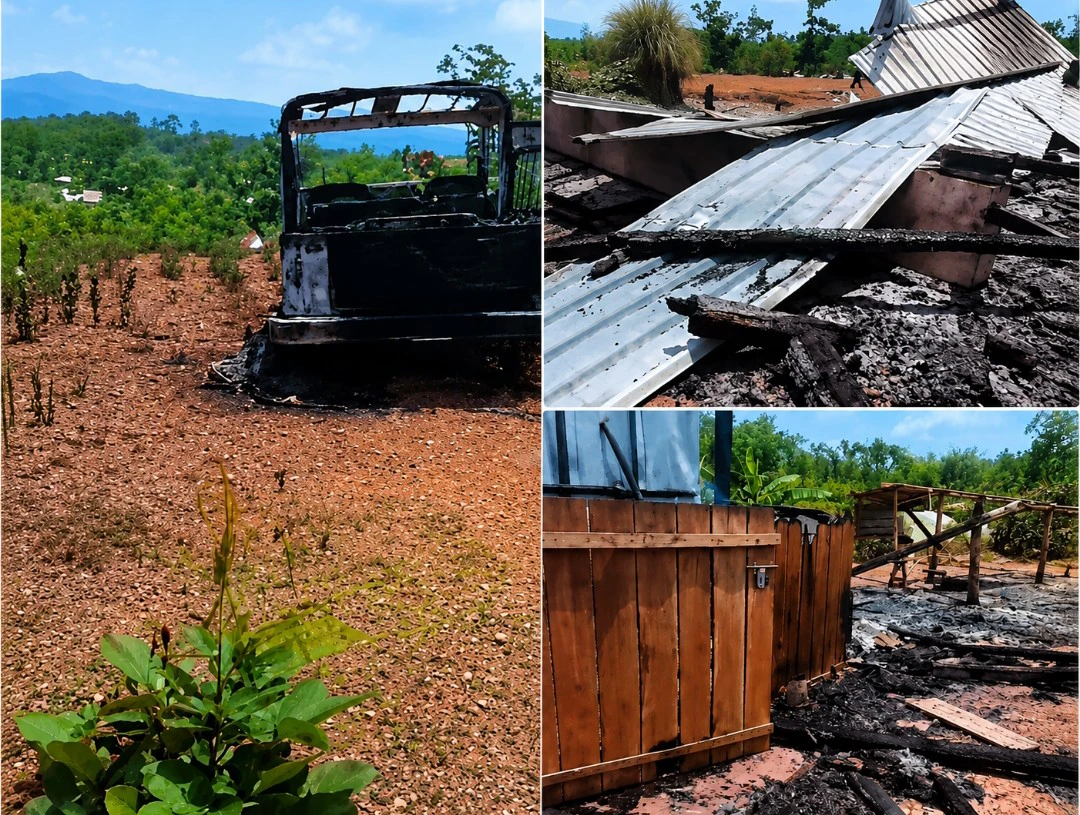
On May 7, 20 the Indian nation stood at a crossroads of memory and reality. While the capital and various military commands were awash in the celebratory glow of the first anniversary of Operation Sindoor, the frontier villages of Manipur’s Kamjong district—Namlee, Wanglee, and Choro—were engulfed in the smoke of fresh arson. This date now represents a jarring dichotomy in India’s security narrative: one side showcasing a "New India" that strikes across borders with surgical precision, and the other revealing a borderland where citizens remain vulnerable to "external aggression" that the state seems hesitant to name.
Operation Sindoor, launched on May 7, 2025, was hailed as a paradigm shift. In response to the tragic Pahalgam attack, the Indian Armed Forces executed a tri-service campaign that decimated terror infrastructure deep inside Pakistan and PoK. The government’s reaction was swift, muscular, and celebratory. Press briefings highlighted the "primacy of air power" and "strategic resolve," turning the operation into a symbol of national pride. Even more poignantly for the people of Manipur, the hero of the mission was Squadron Leader Rizwan Malik, a Meitei Pangal pilot from Imphal East. In the Sindoor narrative, the state was proactive, its intelligence was "surgical," and its political will was absolute.
Fast forward exactly one year to May 7, 2026. As officials paid tribute to the "Sindoor heroes," over 100 heavily armed militants, allegedly from the Kuki National Army-Burma (KNA-B) and the People’s Defence Force (PDF), crossed the Indo-Myanmar border to unleash chaos in Kamjong. Houses were reduced to ashes, a woman was shot, and villagers were forced to flee into the jungles.
Here, the government’s reaction took a markedly different tone. While local leaders like MLA Leishiyo Keishing and the Tangkhul Naga Long (TNL) described the incident as a clear case of "external aggression" and "cross-border terrorism," the government’s response was muted and defensive. State Home Minister Govindas Konthoujam categorically dismissed the "foreign aggression" label citing want of information, and attributing the tragedy to "security lapses" rather than a coordinated breach of national sovereignty. There's also a stoic silence among the central leaders.
The juxtaposition is unavoidable. Why is an attack on tourists in Jammu met with a tri-service offensive across the Line of Control, while a coordinated attack on Naga villages in Manipur by foreign-based militants is characterized merely as a "lapse"?
The people of Kamjong and the wider Northeast are left to wonder why the "Sindoor spirit"—the commitment to protecting every inch of Indian soil with "ruthless" resolve—seems to dissipate when the threat comes from the Chin Hills instead of the Khyber Pakhtunkhwa. In Operation Sindoor, the government sought the global stage to declare that "no sanctuary is safe." In Kamjong, the local communities are demanding an explanation for why their own homes were not safe, despite the presence of central security forces just a few kilometers away.
A nation’s strength is measured not just by the strikes it conducts abroad, but by the security it guarantees at home. To celebrate the anniversary of a cross-border success while downplaying a cross-border incursion on the same day is a strategy of convenience, not one of security. If the "New Dimension of Deterrence" claimed by Operation Sindoor is to be credible, it must apply to the borders of Manipur as firmly as it does to the borders of Kashmir. Until then, May 7th will remain a date of dual legacies: a day of national pride for some, and a day of felt abandonment for others.