The Union Cabinet has approved a Rs. 5,659 crore Cotton Productivity Mission and complementary textile reforms to boost yields, improve quality, enhance traceability, and strengthen India’s global competitiveness, benefiting farmers and the entire textile value chain.
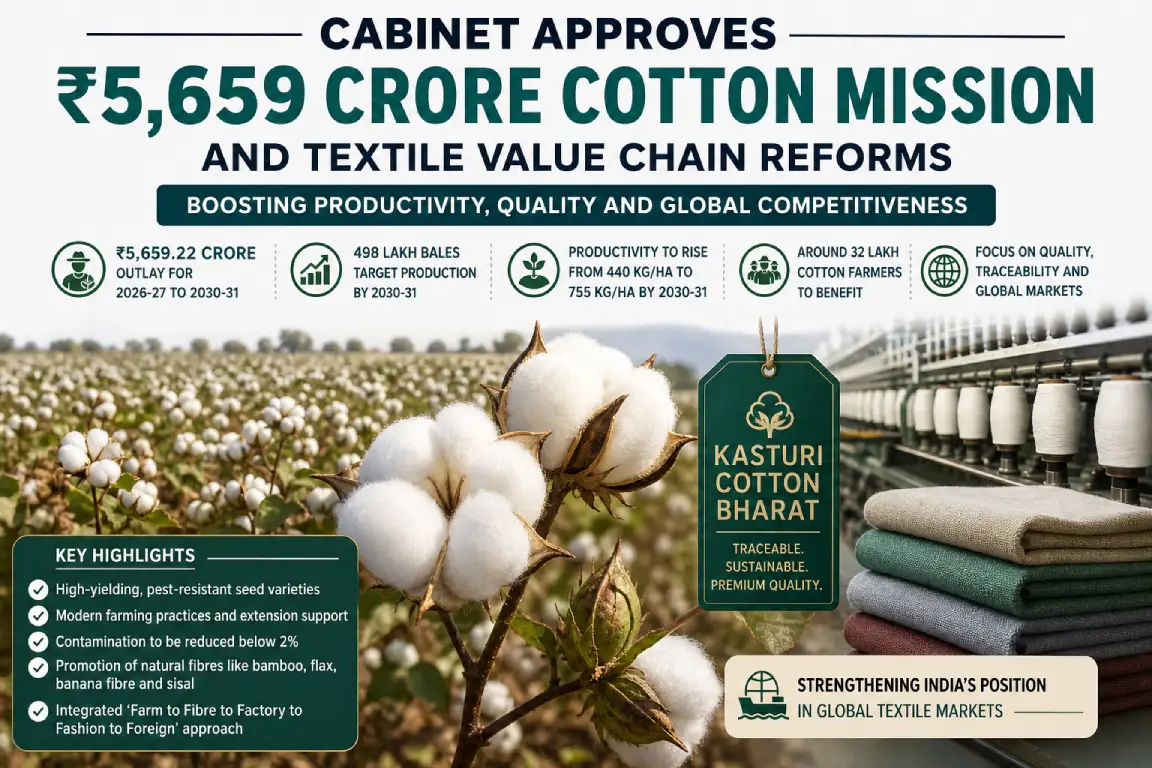
In a major policy push aimed at strengthening India’s agricultural and textile backbone, the Union Cabinet chaired by Narendra Modi has approved the Rs. 5,659.22 crore Mission for Cotton Productivity (2026–27 to 2030–31), alongside complementary measures to enhance the country’s textile value chain, quality standards, and export competitiveness.
The dual decisions signal a strategic shift towards an integrated approach—linking farm-level productivity with global market readiness—under the government’s overarching “Farm to Fibre to Factory to Fashion to Foreign” (5F) vision. Together, the initiatives are expected to boost cotton output, improve quality, and position India as a leading supplier in high-value global textile markets.
“The focus is on transforming India’s cotton sector through productivity, sustainability, and quality enhancement.”
— Government release
Cotton Mission Targets Yield Surge and Farmer Income Growth
The Cabinet’s decision is aimed at Mission for Cotton Productivity, designed to tackle persistent challenges such as low yields, pest attacks, and inconsistent fibre quality.
India, despite being one of the world’s largest cotton producers, has struggled with productivity levels that remain below global benchmarks. The newly approved mission aims to reverse this trend through a comprehensive and technology-driven strategy.
The mission sets ambitious targets:
· Increase cotton production to 498 lakh bales
· Raise productivity from 440 kg per hectare to 755 kg per hectare by 2030–31
· Benefit around 32 lakh cotton farmers
To achieve these goals, the government will focus on the development and distribution of high-yielding, climate-resilient, and pest-resistant seed varieties, along with the promotion of modern agronomic practices.
Extension services will be strengthened through institutions such as Krishi Vigyan Kendras and State Agricultural Universities, ensuring that farmers have access to the latest technologies and best practices. The mission also emphasises efficient water use, soil health management, and mechanisation to enhance overall farm productivity.
?? Key Points Box: Cotton Productivity Mission
· Rs. 5,659 crore allocation for 2026–2031
· Production target: 498 lakh bales
· Productivity increase of nearly 70%
· 32 lakh farmers to benefit
· Focus on technology and sustainability
Quality, Traceability and Branding Take Centre Stage
Beyond productivity, the Cabinet has placed strong emphasis on improving cotton quality—an area critical for India’s competitiveness in international textile markets.
A major initiative in this direction is the promotion of “Kasturi Cotton Bharat”, which seeks to establish a globally recognised brand for Indian cotton. The initiative focuses on traceability, certification, and quality assurance, ensuring that Indian cotton meets international standards.
Efforts will also be made to reduce contamination levels in cotton to below 2%, a benchmark required for premium textile manufacturing. Contamination—caused by the presence of foreign matter such as plastic or dust—has long been a concern affecting the reputation of Indian cotton in global markets.
The government’s push for traceability is expected to improve transparency across the supply chain, making Indian cotton more attractive to global buyers who prioritise sustainability and ethical sourcing.
“Traceability and contamination-free cotton will be key to unlocking premium global markets for Indian textiles.”
Strengthening the Textile Value Chain
The Cabinet decisions go beyond agriculture to address the broader textile ecosystem, recognising that value addition and global competitiveness depend on a seamless integration of all stages—from raw material to finished products.
The initiatives aim to ensure a steady supply of high-quality cotton to domestic textile manufacturers, thereby enhancing the competitiveness of India’s textile and apparel sector.
Additionally, the government is encouraging diversification into alternative natural fibres such as bamboo, flax, banana fibre, and sisal. This move aligns with global trends favouring eco-friendly and sustainable materials, opening new opportunities for Indian producers in niche markets.
By strengthening linkages between farmers, ginners, spinners, and exporters, the government seeks to create a more efficient and resilient value chain capable of responding to global demand dynamics.
?? Key Insight Box
· Cotton underpins India’s textile exports
· Quality improvements enable premium pricing
· Traceability enhances global trust
· Natural fibres align with sustainability trends
Farmer-Centric Approach and Rural Impact
The mission is expected to deliver significant benefits to farmers, particularly in major cotton-growing states. By improving yields and reducing risks associated with pests and climate variability, the programme aims to enhance income stability.
Access to better seeds, improved farming techniques, and stronger extension services will help farmers reduce input costs while increasing output. This, in turn, is expected to improve profitability and encourage greater adoption of modern agricultural practices.
The initiative is also likely to generate employment opportunities across rural areas, particularly in activities such as harvesting, processing, and logistics. As the textile value chain expands, downstream industries are expected to create additional jobs in manufacturing and exports.
Strategic Importance for India’s Global Position
India’s textile sector is one of the largest in the world, contributing significantly to employment and exports. However, competition from countries with higher productivity and better quality standards has posed challenges.
The Cabinet’s decisions aim to address these gaps by combining scientific innovation, policy support, and market-oriented reforms. By focusing on both quantity and quality, India seeks to transition from a volume-driven producer to a value-driven exporter.
The emphasis on sustainability and natural fibres also positions India to tap into growing global demand for environmentally responsible products.
“The goal is not just to produce more cotton, but to produce better cotton that meets global standards.”
The approval of the Cotton Productivity Mission, along with broader textile sector reforms, reflects the government’s commitment to a holistic development strategy that integrates agriculture with industry.
By aligning farm-level interventions with industrial and export policies, the initiatives are expected to create a multiplier effect across the economy—boosting farmer incomes, strengthening manufacturing, and enhancing export earnings.
The success of these measures will depend on effective implementation, coordination among stakeholders, and continuous innovation. However, the policy direction is clear: India is aiming to become a global leader in high-quality, sustainable textile production.