Union Minister Raksha Khadse called for a mission-mode anti-drug movement in Northeast India during the “Nasha Mukt Yuva for Viksit Bharat – Purvottar” programme at IIM Shillong.
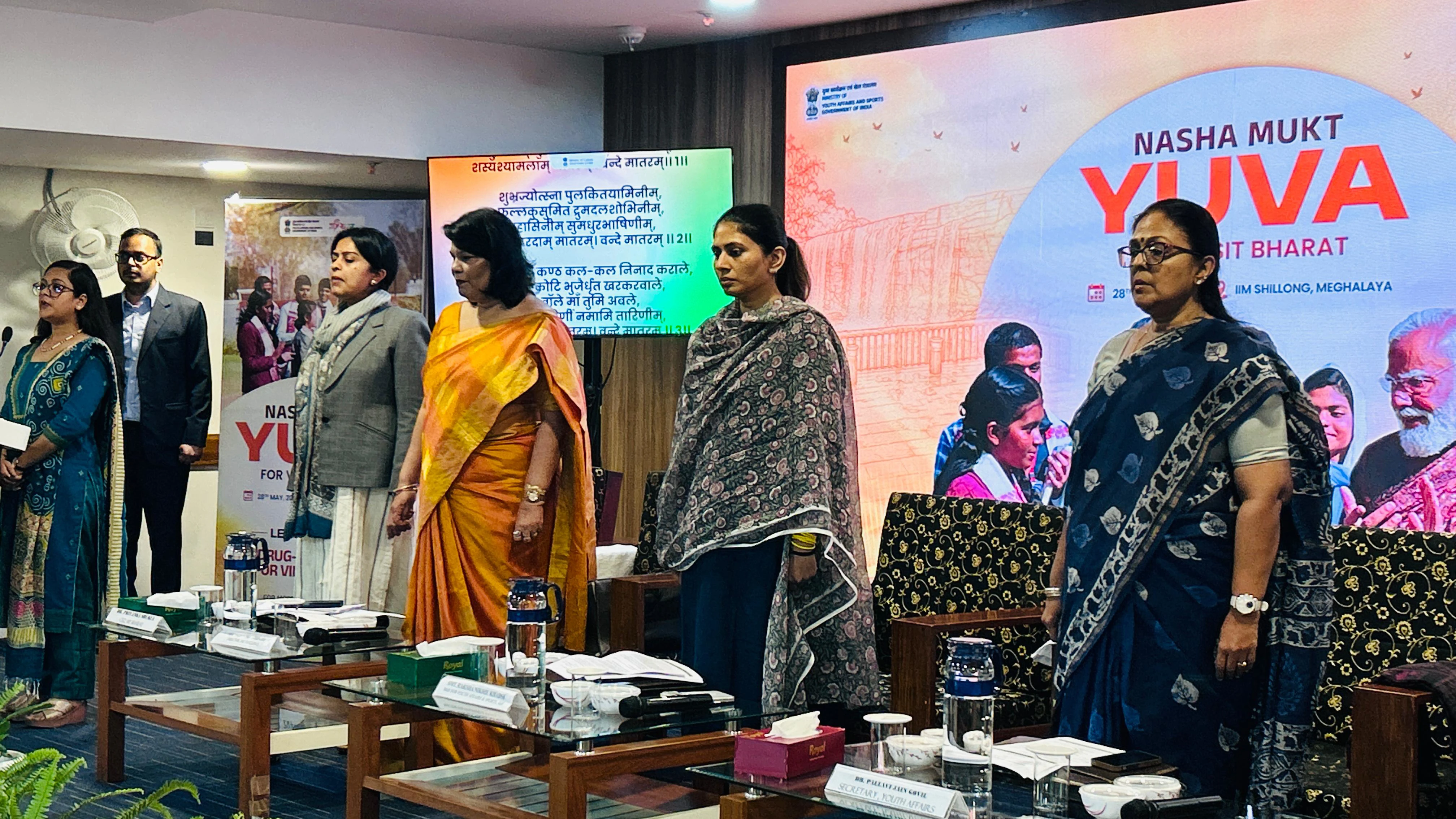
Shillong, May 28: Union Minister of State for Youth Affairs and Sports, Raksha Khadse on Wednesday called for a collective and mission-oriented approach to tackle substance abuse among young people while addressing the “Nasha Mukt Yuva for Viksit Bharat – Purvottar” programme at Indian Institute of Management Shillong.
The programme, organised by MY Bharat under the Department of Youth Affairs, brought together representatives from 24 spiritual and social organisations, youth officers, institutional leaders and civil society groups to discuss anti-drug awareness strategies and youth engagement initiatives across Northeast India.
The event was attended by Pallavi Jain Govil, Secretary of the Department of Youth Affairs, Dr. Priyanka Shukla, CEO of MY Bharat, and Prof. Nalini Prava Tripathy, Director of IIM Shillong, among other dignitaries.
Addressing the gathering, Raksha Khadse said India’s youth population represents the country’s greatest strength and stressed that proper guidance and constructive engagement of young people would be essential to achieving the vision of Viksit Bharat by 2047.
“We must collectively take forward the Nasha Mukt Abhiyan in mission mode. Our youth are the greatest strength of the nation, and it is our shared responsibility to guide them towards the right direction,” she said.
The Minister said substance abuse should not be treated merely as an individual problem but as a broader social challenge requiring coordinated intervention from communities, institutions and government agencies.
Referring to MY Bharat, she said the platform was designed to connect youth with nation-building initiatives and encourage grassroots participation in addressing social issues. She urged youth officers and partner organisations to ensure that the programme reaches every district and section of society.
Raksha Khadse also highlighted the role of sports, cultural participation and community engagement in reducing vulnerability to addiction, stress and social isolation among young people.
“Sports can become one of the most effective instruments for channelising youth energy in a constructive direction,” she said, adding that states across the Northeast already possess a strong sporting culture that can be further strengthened.
Speaking during the programme, Prof. Nalini Prava Tripathy said sports and management education together help build discipline, teamwork and emotional resilience among youth. She said IIM Shillong encourages students to participate in sports, yoga, meditation and cultural activities to support their overall development.
The programme also included presentations on the MY Bharat portal, institutional initiatives and best practices by organisations involved in youth outreach and drug de-addiction work.
Raksha Khadse said earlier consultations held in Varanasi had resulted in recommendations under the “Kashi Declaration,” several aspects of which are now being taken forward by the Ministry.
The prgramme concluded with participating organisations reaffirming support for a coordinated youth-led movement against substance abuse in line with the vision of a drug-free India.
The Centre’s renewed focus on anti-drug mobilisation in the Northeast comes at a time when substance abuse is increasingly being viewed as both a public health concern and a social stability issue in the region.
Several Northeastern states lie close to international trafficking corridors connected to the “Golden Triangle” region of Southeast Asia, which has historically remained one of the world’s major narcotics-producing zones. This geographic reality has exposed parts of the region to drug transit networks, synthetic narcotics circulation and rising addiction risks among youth.
The social impact is becoming visible across both urban and rural communities. Families often face economic strain due to addiction-related healthcare costs, unemployment and social breakdown. In many cases, school dropouts, mental health distress and petty crime are also linked to substance dependency.
For ordinary citizens, especially parents and educators, the issue carries long-term implications. A rise in youth addiction can weaken workforce participation, increase pressure on healthcare systems and affect community safety. Smaller towns and border districts with limited rehabilitation infrastructure are often more vulnerable.
The government’s emphasis on sports and cultural engagement is significant in the Northeast because the region already has a strong grassroots sporting tradition. States such as Manipur, Mizoram and Meghalaya have consistently produced athletes at national and international levels despite limited infrastructure. Expanding sports access, community centres and youth programmes could provide alternative spaces for young people vulnerable to addiction and social isolation.
However, awareness campaigns alone may not be enough. Experts have repeatedly pointed out that anti-drug efforts must also address unemployment, mental health support, rehabilitation access and cross-border trafficking networks. Without sustained investment in these areas, public outreach programmes may have only limited long-term impact.
The involvement of educational institutions, local organisations and civil society groups could nevertheless help strengthen community-level intervention, particularly in areas where trust in local social networks remains strong.