CSIR-NIScPR and RIS signed an MoU on 6 May 2026 to strengthen STI policy and science diplomacy through joint research, capacity building, and South-South cooperation for the Global South.
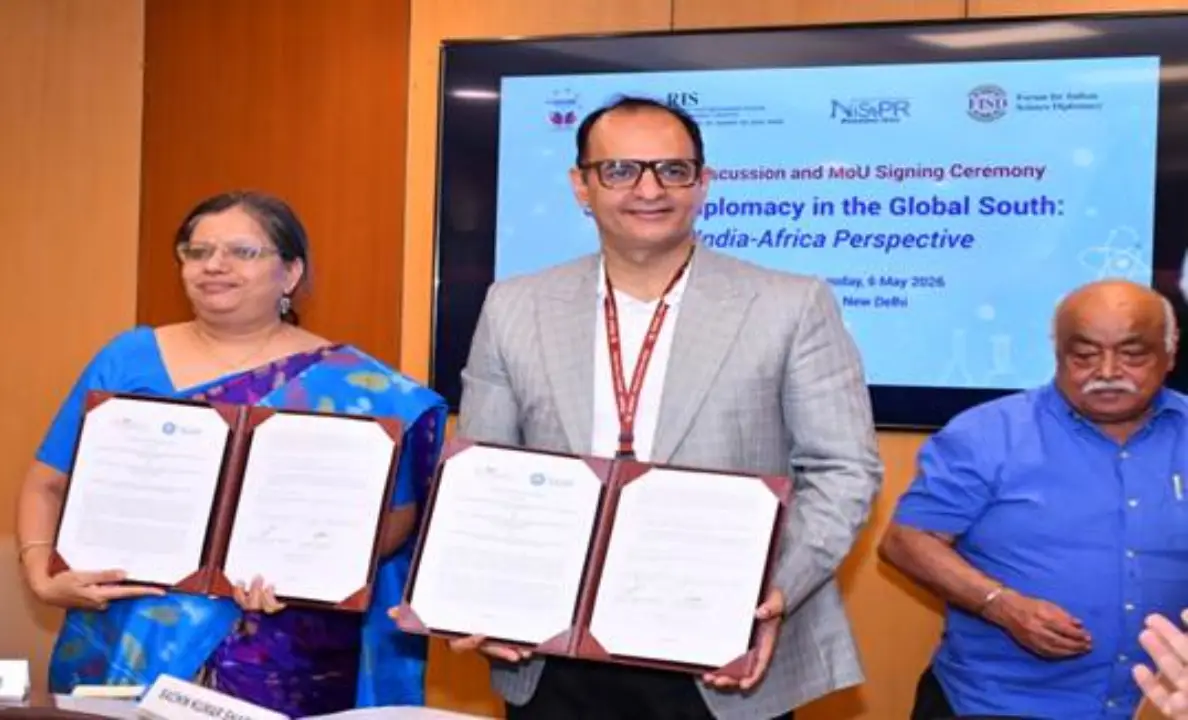
The CSIR-National Institute of Science Communication and Policy Research (CSIR-NIScPR) and the Research and Information System for the Developing Countries (RIS) signed a landmark Memorandum of Understanding (MoU) on 6 May 2026, formalising a strategic partnership aimed at strengthening Science, Technology and Innovation (STI) policy and diplomacy. The collaboration is specifically focused on meeting the development needs of the Global South and consolidating India's leadership in international scientific governance.
The partnership integrates RIS's expertise in international policy analysis with CSIR-NIScPR's strengths in science communication and research dissemination. It commits to demand-driven South-South cooperation, the validation of traditional knowledge as a pillar of scientific governance, and the application of science diplomacy to address global challenges such as climate change, health inequities and technology gaps.
The MoU between CSIR-NIScPR and RIS is designed to create a win-win ecosystem for scientific research and international relations. The primary mission is to strengthen STI policy and diplomacy through four key modalities: joint research and policy analysis, targeted capacity building through existing training platforms, knowledge sharing via policy dialogues and outreach, and multidisciplinary work in science communication, traditional knowledge and diplomacy.
Prof. Sachin Kumar Sharma, Director General of RIS, highlighted science diplomacy as a key tool for building trust and addressing global challenges such as climate change, health inequalities and technology gaps. He emphasised the Global South's role in shaping scientific governance and outlined RIS initiatives including ITEC courses, iGOT Karmayogi training, Forum for Indian Science Diplomacy publications, and global partnerships through DAKSHIN and IBSA Fellowships.
Dr. Geeta Vani Rayasam, Director of CSIR-NIScPR, described the partnership as a collaborative, win-win effort for the Global South, focusing on dedicated working groups and joint publications. She highlighted NIScPR's role in science communication and policy research, along with CSIR's R&D ecosystem, affordable HIV drug innovations, traditional knowledge validation, rural innovations, and its network of 15 open-access journals.
A central pillar of the NIScPR-RIS partnership is its commitment to a new model of South-South scientific cooperation. Dr. S.K. Varshney, Science Consultant at RIS, emphasised the importance of partnerships rooted in equality, sovereignty and demand-driven frameworks that prioritise context-specific solutions, technology sharing and the building of resilient health systems across the Global South.
This approach marks a conscious departure from the historically asymmetric, donor-driven model of international aid. Rather than imposing top-down solutions, the framework prioritises partnerships founded on mutual respect and national autonomy. Technology sharing under this model is specifically designed to address the actual environmental and social realities of developing nations, ensuring that scientific innovations build genuinely resilient systems.
Dr. Amit Kumar, Assistant Professor at RIS, termed the collaboration a key milestone that combines RIS's policy expertise with CSIR's scientific strengths, further reinforced by the Roundtable on Science Diplomacy. Dr. Rajan Sudhesh Ratna similarly highlighted science diplomacy as a driver of development in the Global South, pointing to RIS's role through the DAKSHIN platform in strengthening South-South cooperation.
One of the most distinctive aspects of the NIScPR-RIS partnership is its repositioning of traditional knowledge as a central pillar of international scientific cooperation. Dr. Sarin N.S., Coordinator of the Forum for Indian Traditional Medicine (FITM), highlighted traditional medicine as a pillar of South-South cooperation, integral to the collaboration's work on inclusive and sustainable development.
Dr. Monika Jaggi and Dr. Charu Lata of CSIR-NIScPR highlighted the institute's contributions to science diplomacy and traditional knowledge through initiatives like SVASTIK, which provides rigorous scientific validation for traditional knowledge systems, enabling them to participate in global scientific discourse. By validating traditional medicine through modern scientific frameworks, the partnership enables developing nations to reduce dependency on expensive foreign pharmaceutical intellectual property.
Dr. Yogesh Suman, Chief Scientist at CSIR-NIScPR, emphasised the institute's role in disseminating CSIR technologies for rural livelihoods and sustainable development. With a network of 15 open-access journals, NIScPR ensures that scientific knowledge remains accessible to researchers and policymakers across the Global South, bypassing restrictive academic paywalls and advancing the democratisation of scientific knowledge.
The formalisation of the MoU was accompanied by the release of three significant policy documents that reflect the analytical breadth of the partnership. These publications demonstrate how the NIScPR-RIS collaboration translates scientific research and policy analysis into actionable instruments of international influence.
|
Publication Title |
Authors / Contributors |
Focus Area |
|
India-Republic of Korea S&T Cooperation: Co-Creating the Future |
Sanjeev K. Varshney, Amit Kumar, Sneha Sinha |
Bilateral S&T relations and future strategies |
|
Proceeding of Workshop on Strengthening India's Semiconductor Ecosystem: Policies, Challenges and Opportunities |
Dr. Shiv Narayan Nishad, Dr. Vipan Kumar, Dr. Naresh Kumar, Dr. Sandhiya Lakshmanan |
Semiconductor policy, challenges and opportunities |
|
The Key Drivers of Particulate Pollution from Road Transportation in Indian States (Policy Bulletin) |
Dr. Sandhya Lakshmanan |
Environmental policy and transportation-related pollution |
The first document charts a strategic roadmap for bilateral R&D between India and the Republic of Korea. The second evaluates policy interventions needed to secure vital technology supply chains within the semiconductor sector. The third identifies the drivers of road transportation pollution, providing a policy template for environmental regulation across Indian states.
The collaboration between CSIR-NIScPR and RIS is set to expand its influence through targeted regional engagements. Dr. Sneha Sinha, Consultant at RIS, noted that previous collaborations, including workshops and research in science diplomacy, have laid a strong foundation for future engagement. She highlighted the significance of the Roundtable on Science Diplomacy in the Global South, with an upcoming focus on India-Africa cooperation ahead of the India-Africa Forum Summit.
This next phase will emphasise technology sharing and the integration of science diplomacy perspectives into joint reports between India and African nations, building on the institutional foundations already established through DAKSHIN and IBSA Fellowships. Moving forward, the partnership intends to combine RIS's policy expertise with CSIR's scientific strengths to create a robust framework for international scientific leadership and co-creation.
The NIScPR-RIS MoU marks a significant step in India's science diplomacy architecture. By merging rigorous R&D, science communication infrastructure, policy analysis and traditional knowledge validation under a single collaborative framework, the two institutions are creating a replicable model for how the Global South can move from technological dependency to strategic co-creation in shaping the future of global STI governance.